
1
救生筏上的梅杜萨号幸存者
让-路易·安德烈·特奥多尔·热里卡尔的这部巨作不仅仅是对一场海上灾难的描绘;它是一次对人类绝望、政治丑闻以及自然崇高力量的直观探索。这幅完成于1819年的画布尺寸巨大(491 x 716 cm),超越了人体比例,它永恒地记录了1816年法国护卫舰“麦杜萨号”沉没后那段令人心碎的余波——这场悲剧源于渎职与腐败,曾令整个法国社会为之震惊。

The painting that made 泰奥多尔·杰利柯 famous is 救生筏上的梅杜萨号幸存者 (1818); it hangs in the 卢浮宫, 巴黎. Nymph and Satyr (Jupiter and Antiope) (1820) and The Oath of Brutus after the Death of Lucretia (1815) follow it in the hearts of collectors and museum visitors. Of the 183 works by 泰奥多尔·杰利柯 in our catalogue, these 100 are the most admired, each presented with its date, its museum and what sets it apart.
Ranked by our popularity score, which combines the searches, visits and orders for each work. Updated October 2026. Every masterpiece on this page can be ordered as a museum-quality, hand-painted oil reproduction or a fine art print, at the size you choose.

让-路易·安德烈·特奥多尔·热里卡尔的这部巨作不仅仅是对一场海上灾难的描绘;它是一次对人类绝望、政治丑闻以及自然崇高力量的直观探索。这幅完成于1819年的画布尺寸巨大(491 x 716 cm),超越了人体比例,它永恒地记录了1816年法国护卫舰“麦杜萨号”沉没后那段令人心碎的余波——这场悲剧源于渎职与腐败,曾令整个法国社会为之震惊。

The Allure of the Divine Encounter: Géricault’s *Nymph and Satyr* Jean-Louis André Théodore Géricault's *Nymph and Satyr*, painted in 1819, isn’t merely a depiction of a mythological scene; it’s a profound exploration of desire, transgression, and the inherent tension between innocence and primal instinct. Born amidst the tumultuous backdrop of post-revolutionary France, Géricault, already recognized for his dramatic intensity, sought to capture not just a narrative but an emotional truth—a…

The Oath of Brutus after the Death of Lucretia is an oil on canvas by Théodore Géricault. This history painting captures a moment of heavy, political consequence. The artist, Théodore Géricault, rendered the scene with a focus on the weight of human resolve. It emerged from his studio about 1815.

This vigorous painting of six lions in a remote, spectrally illuminated lair—possibly intended to evoke the Atlas Mountains of Morocco—is an extraordinary example of Gericault’s spontaneous handling of paint. Rather than applying finishing touches to make a polished cabinet picture, the artist left the painting in a state known as an esquisse, or sketch, a work prized by fellow artists for its strength of directly capturing a subject or effect.…

Théodore Géricault's "The Kiss," painted in 1816, isn’t merely a depiction of lovers entwined; it’s a visceral embodiment of the burgeoning Romantic movement’s fascination with raw emotion, dramatic intensity, and the sublime. This arresting work, housed within the Thyssen-Bornemisza Museum in Madrid, transcends simple representation to become a profound meditation on passion, vulnerability, and the very essence of human connection. Géricault, already a figure known for his unflinching portrayals of…

A Symphony of Suffering: Géricault’s “Wounded Soldiers Retrating from Russia” Jean-Louis André Théodore Géricault's "Wounded Soldiers Retrating from Russia" is not merely a painting; it’s a visceral embodiment of the horrors and human cost of war, rendered with an unprecedented level of realism and emotional intensity for its time. Completed in 1814, this monumental canvas—measuring a commanding 250 x 206 cm—captures a pivotal moment during Napoleon's disastrous invasion of Russia,…

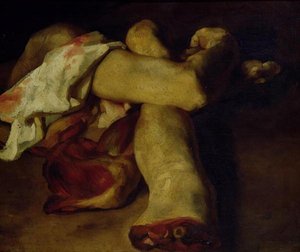
Jean-Louis André Théodore Géricault's "Study of Feet and Hands," painted in 1818, isn’t a grand statement of Romantic drama like his monumental “The Raft of the Medusa.” Instead, it offers a profoundly intimate glimpse into the artist’s meticulous process and a poignant meditation on the human form. This unassuming oil painting—measuring a modest 52 x 64 cm—is far more than just a preparatory sketch; it's a concentrated distillation of Géricault’s…

Jean-Louis André Théodore Géricault's "The Raft of the Medusa," a monumental detail from his 1818 painting, isn’t merely a depiction of shipwreck; it’s a visceral plunge into the depths of human suffering and political indictment. The scene, rendered with a dramatic intensity characteristic of Romanticism, captures the harrowing aftermath of the French frigate *Medusa*'s wreck off the coast of Mauritania in 1816. This disaster, largely attributed to the incompetence and…


Théodore Géricault's "The Wreck," painted in 1821, isn’t merely a seascape; it’s a visceral confrontation with the sublime—a raw depiction of humanity’s vulnerability against the overwhelming force of nature. Born amidst the turbulent currents of post-revolutionary France, Géricault, a figure both lauded and controversial within the burgeoning Romantic movement, channeled his own anxieties and the era's fascination with dramatic events into this monumental canvas. The painting immediately commands attention not…

Jean-Louis André Théodore Géricault's "The Horse Race," painted in 1816, isn’t merely a depiction of a sporting event; it’s a visceral embodiment of Romanticism’s core tenets – passion,…
Bring it home →
Jean-Louis André Théodore Géricault's "Swiss Guard and Wounded Veteran," painted in 1819, is not merely a historical depiction; it’s a profound meditation on duty, sacrifice, and the lingering…
Order a reproduction →
Théodore Géricault's "Mazeppa," painted in 1823, isn’t merely a depiction of a dramatic legend; it’s a visceral embodiment of Romantic turmoil—a raw exploration of suffering, resilience, and the…
Bring it home →
Jean-Louis André Théodore Géricault's "Two Horses," painted in 1808-1809, isn’t merely a depiction of two magnificent animals; it’s a visceral exploration of movement, power, and the fleeting nature…
Bring it home →
Jean-Louis André Théodore Géricault's "A Turk (Mustapha)," painted in 1820, is not merely a portrait; it’s a carefully constructed tableau of exoticism, melancholy, and the burgeoning Romantic sensibility…
Order a reproduction →
In the quiet intensity of Jean-Louis André Théodore Géricault’s 1814 masterpiece, "A Carabinier with His Horse," we encounter more than a mere military portrait; we witness a profound…
Order a reproduction →
A Moment Frozen in Time: Géricault’s “Riderless Horse Races” Jean-Louis André Théodore Géricault's "Riderless Horse Races (detail)" is not merely a depiction of a sporting event; it’s a…
Bring it home →
A Tempestuous Vision: Géricault’s “Boxers” Jean-Louis André Théodore Géricault's "Boxers," completed in 1818, isn’t merely a depiction of a boxing match; it’s a visceral embodiment of Romanticism’s fascination…
Order a reproduction →
Jean-Louis André Théodore Géricault's "Horse Market: Five Horses at the Stake," painted in 1817, is not merely a depiction of livestock; it’s a visceral embodiment of Parisian life…
Order a reproduction →
Jean-Louis André Théodore Géricault's "The Epsom Derby," painted in 1821, isn’t merely a depiction of horse racing; it’s a visceral embodiment of Romanticism’s fascination with drama, movement, and…
Bring it home →
Three riders surge through a heavy, shadowed atmosphere, their presence defined by the sudden flash of scarlet and gold. A dappled grey horse occupies the center, its muscular…
Commission a hand-painted copy →
Théodore Géricault captured a private, feverish moment in Three Lovers. This small oil sketch, created about 1817–1820, offers a rare glimpse into the artist's more intimate preoccupations. It…
Order a reproduction →
A single man emerges from a dark, indistinct background of umber and black. He is positioned slightly off-center, his gaze meeting the viewer with a subtle, knowing expression.…
Commission a hand-painted copy →
In this 1814 oil on canvas, we find ourselves witnessing a singular moment of intense energy. The composition centers on Wincenty Krasiński, a military figure captured in a…
Order a reproduction →
This dramatic oil study, created in 1814, captures a wounded cavalryman in a moment of intense exhaustion or struggle. The composition is defined by a strong diagonal movement…
Commission a hand-painted copy →
Théodore Géricault's "Lion Devouring a Horse," painted in 1819, isn’t merely a depiction of predatory action; it’s a visceral exploration of power, mortality, and the primal instincts that…
Bring it home →

In the annals of art history, few works command the room with such visceral intensity as Théodore Géricault’s The Raft of the Medusa. This monumental oil on canvas…
Bring it home →
This oil on canvas painting, created in 1819, presents a somber and dramatic scene of suffering within a dimly lit interior. The composition is structured around an arched…
Order a reproduction →


A young man emerges from a deep, indistinct darkness, his presence felt through the sudden, sharp clarity of light hitting his features. He sits in a quiet, intimate…
Order a reproduction →
A study for a nude. emerges from the shadows as a powerful presence by Théodore Géricault. Created about 1801, this oil on canvas captures a singular moment of…
Bring it home →
This oil on canvas portrait study presents a close-up, three-quarter view of a Black man's head and shoulders. The subject is positioned slightly off-center, looking toward the viewer…
Commission a hand-painted copy →
The Martyrdom of Saint Peter is an oil on canvas by Théodore Géricault. Created about 1814, the work captures a moment of profound tension. The physical presence of…
Bring it home →
In the annals of French Romanticism, few works command the visceral attention of Théodore Géricault’s The Wreck as profoundly as this haunting seascape. Painted in 1824, a year…
Commission a hand-painted copy →

Mater dolorosa, Copy after Ribera is a religious oil painting by the French artist Théodore Géricault. Created about 1811–1815, the work reflects the artist's engagement with the traditions…
Bring it home →
Jean-Louis André Théodore Géricault’s “Lion in Repose,” painted circa 1820-1823, isn’t merely a depiction of an animal; it’s a profound meditation on power, vulnerability, and the very nature…
Order a reproduction →


Dating from 1800, Jean-Louis André Théodore Géricault’s “Portrait of a Negro” is more than just a depiction of an individual; it’s a poignant statement born from the turbulent…
Bring it home →

Portrait d'homme is an oil on canvas work attributed to the French Romantic painter Théodore Géricault. While historically categorized under various titles, including a mistaken identification as a…
Commission a hand-painted copy →
Equestrian Portrait of Charles V is an oil on canvas work executed by the French Romantic painter Théodore Géricault. Created in 1814, the piece focuses on the figure…
Commission a hand-painted copy →
In this 1814 oil painting, we find ourselves in the quiet, dim interior of a stable. The focus is entirely on a single chestnut horse, captured in profile…
Commission a hand-painted copy →
In the quiet, monochromatic depths of Théodore Géricault’s 1822 lithograph, Horses of the Auvergne, we are transported to a rugged, mist-shrouded corner of France. This evocative work serves…
Commission a hand-painted copy →
A single light grey horse occupies the center of this oil painting, captured in a rearing pose. The animal's body is angled vertically, its muscular flanks and neck…
Bring it home →
To gaze upon Jean-Louis André Théodore Géricault’s "Sheet of Figure Studies" is not merely to look at painted forms; it is to witness the very act of human…
Bring it home →
Jean-Louis André Théodore Géricault's “Portrait of an Artist in His Studio,” completed in 1820, is more than a simple depiction of a young man seated before his easel;…
Bring it home →
In the annals of French Romanticism, few works capture the raw, unbridled energy of the Napoleonic era as viscerally as Théodore Géricault’s 1812 masterpiece, An Officer of the…
Bring it home →
The oil on canvas known as Study of a nude man emerges from the shadows, a powerful presence that commands the viewer's immediate attention. This work, created by…
Commission a hand-painted copy →
In the quiet, brooding landscapes of nineteenth-century France, few works capture the raw, unvarnished essence of pastoral life as poignantly as Théodore Géricault’s “The Plaster Kiln.” Completed in…
Order a reproduction →


In the quiet, tension-filled atmosphere of Théodore Géricault’s The Woman with Gambling Mania, we are invited into a private drama that feels as immediate today as it did…
Commission a hand-painted copy →




The four subjects that return most often among these masterpieces, with the finest example of each.
The 8 museums that hold the most of the paintings on this page.
| Museum | City | Works by 泰奥多尔·杰利柯 | Paintings from this list |
|---|---|---|---|
 卢浮宫 |
巴黎 | 20 | 救生筏上的梅杜萨号幸存者, The Raft of the Medusa (detail), Leda and the Swan |
 香提伊城堡 |
尚蒂伊 | 6 | Mazeppa, Boxers, Lion devouring a horse |
 J·保罗·盖蒂博物馆 |
洛杉矶 | 3 | Three Lovers, Study of a Model, The Race of the Riderless Horses |
 华沙国家博物馆 |
华沙 | 3 | Equestrian portrait of Wincenty Krasiński., A study for a nude., Study of a nude man |
 Burrell Collection |
格拉斯哥 | 8 | The Trumpeter of the Lancers of the Guard, A Prancing Grey Horse |
 法布尔博物馆 |
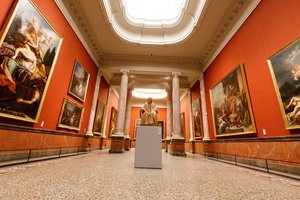
蒙彼利埃 | 4 | Study of Feet and Hands, Portrait d'homme |
 Petit Palais |
巴黎 | 3 | The Scotsman, Italian Landscape with Tomb |
 提森·博爾涅米薩博物館 |
馬德里 | 2 | The Kiss, The Horse Race |
Jean-Louis André Théodore Géricault's "Two Horses," painted in 1808-1809, isn’t merely a depiction of two magnificent animals; it’s a visceral exploration of movement, power, and the fleeting nature…

让-路易·安德烈·特奥多尔·热里卡尔的这部巨作不仅仅是对一场海上灾难的描绘;它是一次对人类绝望、政治丑闻以及自然崇高力量的直观探索。这幅完成于1819年的画布尺寸巨大(491 x 716 cm),超越了人体比例,它永恒地记录了1816年法国护卫舰“麦杜萨号”沉没后那段令人心碎的余波——这场悲剧源于渎职与腐败,曾令整个法国社会为之震惊。

The Allure of the Divine Encounter: Géricault’s *Nymph and Satyr* Jean-Louis André Théodore Géricault's *Nymph and Satyr*, painted in 1819, isn’t merely a depiction of a mythological scene;…
救生筏上的梅杜萨号幸存者 (1818), 卢浮宫, 巴黎. Next come Nymph and Satyr (Jupiter and Antiope) (1820) and The Oath of Brutus after the Death of Lucretia (1815).
27 years old: 救生筏上的梅杜萨号幸存者 dates from 1818 and 泰奥多尔·杰利柯 was born in 1791.
救生筏上的梅杜萨号幸存者, Nymph and Satyr (Jupiter and Antiope), The Oath of Brutus after the Death of Lucretia, Lions in a Mountainous Landscape, The Kiss, Wounded Soldiers Retrating from Russia, Study of Feet and Hands, The Raft of the Medusa (detail), Leda and the Swan and The Wreck. The ranking above gives the year and the museum of each.
Our catalogue lists 183 works by 泰奥多尔·杰利柯, dated from 1800 to 1824.
Most of them are in 卢浮宫 (巴黎), 香提伊城堡 (尚蒂伊) and J·保罗·盖蒂博物馆 (洛杉矶). The table above lists the museums one by one.
In 1810s: 67 of the 100 works on this page date from then, among them 救生筏上的梅杜萨号幸存者.
The earliest on this page is Portrait of a Negro (1800), the latest The Wreck (1824).
Man (12), Portrait (9) and Horse (8), among the 100 works on this page.
Oil On Canvas: 25 of the 100 works on this page.
Romantic painting, as the paintings on this page show.
救生筏上的梅杜萨号幸存者, The Raft of the Medusa (detail) and Leda and the Swan are among the 14 works on this page held by the 卢浮宫, 巴黎.
Yes. Every painting on this page can be ordered as a museum-quality, hand-painted oil reproduction or a fine art print, in the size you choose, from the painting's own page.


