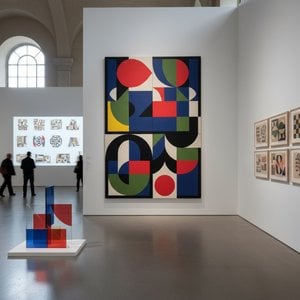
regina aprijaskis was a french artist established in peru, known primarily for her pictorial production centered in geometrical abstraction. born in burdeos, france in 1919, she moved to lima, peru with her parents at the age of five and stayed there until she was ten. her family then returned to bulgaria, where she studied at a school run by french monks for two and a half years.
training and influences
aprijaskis studied plastic arts in the school of fine arts of lima, under the guidance of notable indigenous painters. her mentors included camillo blas, with whom she learned the foundations of figurative painting, and josé sabogal, with whom she worked on nude paintings. she also formed a profound friendship with julia codesido. in the 1950s, she traveled to new york, where she was influenced by the work of mark rothko and barnett newman. her training in the abstract expressionist painter theodoros stamos's workshop in the 1960s had a decisive impact on her shift towards geometrical abstraction.notable works and exhibitions
in 1968, aprijaskis had her first individual exhibition at the institute of contemporary art of lima, showcasing her pictorial paracas series. this exhibition marked the beginning of her later paintings. the show was chosen by peruvian art critic juan acha for its vanguard and rationalist efforts. according to peruvian critic jorge villacorta, "the work of aprijaskis constitutes one of the few solid proposals of geometric abstraction or on the base of constructivist principles that have developed in the panorama of peru's visual arts." key aspects of her work include:- geometrical abstraction
- constructivist principles
- influence of abstract expressionism
- use of vibrant colors and bold shapes