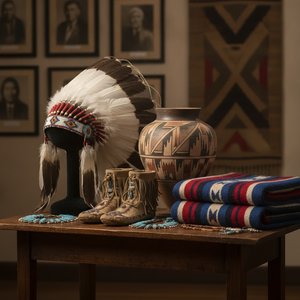
Nora Foote (1896-1923) remains a profoundly significant, yet often overlooked, figure in late 19th and early 20th centuryCanadian art. Her work transcends mere portraiture; it’s a poignant exploration of Indigenous life within the rapidly changing landscape of the Canadian West, offering invaluable insights into the cultures and identities of the Blood people – specifically, the Blood Indian Chief Carry Kettle – and other First Nations communities she encountered. Foote's career was tragically short, cut short by illness at the age of 27, yet during her time, she produced a remarkable body of work that continues to resonate with its honesty, sensitivity, and artistic merit.
Early Life and Artistic Training
Born in 1896 in British Columbia, Nora Foote’s early life remains somewhat shrouded in mystery. She was the daughter of a Scottish father and a Cree mother, a lineage that deeply informed her perspective and connection to Indigenous culture. While formal artistic training is scarce – she didn't attend art school – Foote possessed an innate talent and a genuine desire to document the lives of those around her. Her initial exposure to art likely came through observation and perhaps informal instruction from family members familiar with traditional crafts and storytelling. Crucially, she developed a close working relationship with Carry Kettle, a respected Blood Chief who served as her primary subject and guide during her time in Alberta. This partnership was not merely one of artist and sitter; it represented a deep exchange of knowledge and mutual respect – Kettle sharing his history, traditions, and worldview, while Foote meticulously captured his likeness and the essence of his community.
The Style and Themes of Her Work
Foote’s artistic style is immediately recognizable for its directness and lack of romanticization. Unlike many Western artists who approached Indigenous subjects with a colonial gaze, Foote presented her portraits with remarkable dignity and respect. She typically painted in a realistic style, often employing a dark palette – browns, blacks, and reds – to reflect the rugged environment and traditional clothing worn by her subjects. Her compositions are generally straightforward, focusing on capturing the individual’s presence and conveying their inherent strength and character. A key element of her work is the inclusion of details that speak to Indigenous culture: ceremonial dress, weaponry (often reflecting Kettle's role as a warrior), and symbolic objects – all meticulously rendered with careful attention to detail. Beyond portraiture, Foote also produced scenes depicting daily life on the Blood Reserve, offering glimpses into their routines, social structures, and connection to the land. These works are particularly valuable for providing historical documentation of a way of life that was rapidly disappearing.
Key Works and Recognition
Several of Foote’s paintings stand out as particularly significant examples of her oeuvre. “Carry Kettle (d.1923)” is arguably her most famous work, a powerful portrait that captures the Chief's commanding presence and dignified bearing. "Little Ears" showcases her ability to portray vulnerability and tenderness within a traditional setting. “Portrait of a Blood Woman” offers a rare glimpse into the lives of women within the community, highlighting their beauty and resilience. These works are now housed in prominent collections like The Pitt Rivers Museum in Oxford, testament to their enduring value. While Foote’s work received limited recognition during her lifetime – she was largely excluded from mainstream art circles due to her subject matter and Indigenous heritage – it has since been reevaluated as a vital contribution to Canadian art history.
Legacy and Historical Significance
Nora Foote's legacy extends far beyond the canvases she created. Her work serves as a crucial historical record of the Blood people during a period of profound transformation. She offered a counter-narrative to prevailing colonial stereotypes, presenting Indigenous individuals as complex, dignified human beings with rich cultural traditions. Her commitment to portraying her subjects with respect and authenticity paved the way for future generations of Indigenous artists seeking to reclaim their narratives and celebrate their heritage. Today, Foote’s paintings are studied by art historians, anthropologists, and community members alike, offering a valuable window into the past and reminding us of the importance of preserving and understanding diverse cultural perspectives. Her work stands as a testament to her artistic talent, her deep empathy, and her courageous commitment to documenting the lives of those often marginalized in mainstream history.
由 WahooArt.com 编辑团队撰写
鉴赏力测试
每道题只有一个正确答案。
题目 1:
Nora Foote is primarily known for her portraits of which Indigenous group?
题目 2:
In what decade did Nora Foote primarily create her most famous portraits?
题目 3:
Where were many of Nora Foote's portraits housed during her lifetime?
题目 4:
What is a key characteristic of Nora Foote's artistic style?
题目 5:
Carry Kettle, a prominent Blood Indian Chief, was frequently depicted by Nora Foote. What is the approximate year of Carry Kettle's death?
Discover a curated selection of exquisite Native American fine art. From historical portraits to contemporary masterpieces, explore museum-quality oil reproductions and bespoke commissions designed to honor Indigenous heritage with unparalleled artistry and prestige.