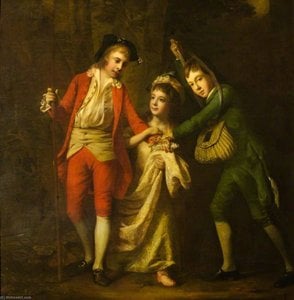
Nathaniel Hone I (1718 – 1784): Bridging Rococo Elegance and Barbizon Landscape
Nathaniel Hone I, born in Dublin around 1718, stands as a pivotal figure in the transition between Rococo and Neoclassical art movements. His artistic journey spanned across Ireland and London, leaving behind a legacy of exquisitely detailed portraits alongside landscapes imbued with a distinctly Barbizon spirit—a stylistic blend that cemented his place within the broader context of eighteenth-century European painting.- Early Life & Training: Hone’s formative years were spent in Dublin, where he received instruction from Francis Bacon and Jonathan Richardson Sr., two prominent Irish portraitists who championed a dramatic, theatrical style rooted in illusionism. This influence profoundly shaped Hone's approach to depicting figures—particularly the aristocratic clientele of his time—emphasizing expressive gesture and psychological insight.
- Parisian Period (1740 – 1768): Hone embarked on a transformative period of artistic development in Paris, immersing himself in the vibrant intellectual and artistic milieu of the Enlightenment. He studied under Jean-Simon Bailly and Jacques-Louis David, absorbing the principles of Neoclassical idealism and honing his technical skills. This Parisian experience undeniably broadened his stylistic horizons.
- Return to London & Landscape Innovation: Returning to London in 1768, Hone continued to produce portraits but simultaneously cultivated a distinctive landscape style—a reaction against the prevailing academic tradition. Drawing inspiration from Claude Lorrain and Gaspard Roubaix, he embraced the Barbizon technique, prioritizing atmospheric perspective and tonal modulation to convey the grandeur of the Irish countryside.
Notable Works & Artistic Style
Hone’s oeuvre comprises a remarkable collection of portraits—many commissioned by members of the British aristocracy—characterized by meticulous detail and psychological nuance. His depictions of figures like ‘The Honourable Mrs Curzon,’ exemplify Rococo elegance, utilizing pastel hues and delicate ornamentation to convey aristocratic status. Simultaneously, Hone's landscapes—such as “Portrait of a Gentleman”—demonstrate his mastery of Barbizon principles, capturing the rugged beauty of Ireland with muted colors and textured brushstrokes. He skillfully blended illusionistic techniques with tonal gradations, creating images that resonate with emotional depth.- ‘The Honourable Mrs Curzon’ (1778): This miniature showcases Hone's exceptional skill in capturing the subtleties of facial expression and posture—a hallmark of Rococo portraiture. The pastel palette contributes to an atmosphere of refined grace, reflecting the social conventions of the era.
- “Portrait of a Gentleman” (circa 1770): Hone’s depiction of a gentleman exemplifies Neoclassical ideals through its restrained composition and idealized portrayal. The artist skillfully employs tonal modulation to convey dignity and composure.
Influence & Legacy
Nathaniel Hone I exerted considerable influence on subsequent generations of artists, particularly those exploring the Barbizon landscape style. His pioneering approach to tonal painting—characterized by gradual transitions between light and dark—became a cornerstone of the Barbizon movement’s aesthetic sensibility. Furthermore, Hone's commitment to psychological realism—evident in his portraits—challenged prevailing artistic conventions and paved the way for more introspective representations of human subjects. Despite a relatively short career, Hone I left an indelible mark on British art history.Death & Recognition
Nathaniel Hone I died in London in 1784, leaving behind a substantial body of work that continues to be admired for its artistic merit and technical virtuosity. His landscapes—particularly ‘The Honourable Mrs Curzon’—remain treasured examples of eighteenth-century art, demonstrating Hone's enduring contribution to the stylistic evolution of his time.问答详情
我可以通过艺术流派来浏览 Nathaniel Hone I 的作品吗?
您可以在艺术家的 全部流派 页面中查看 Nathaniel Hone I 所属的艺术流派,该页面按流派对作品进行了分类。
在哪里可以浏览 Nathaniel Hone I 的全部作品?
您可以在 Nathaniel Hone I 的 全部作品 页面上浏览其在 本站 上的所有作品。
目前目录中共有多少件 Nathaniel Hone I 的作品可供浏览?
您可以在 全部作品 页面浏览由 Nathaniel Hone I 创作的 47 件作品 件作品。