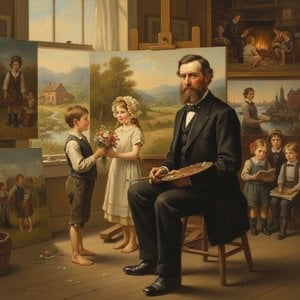
Morris Hirshfield (1872–1946): A Visionary Rediscovered
Morris Hirshfield (1872–1946) was a Polish-American painter whose extraordinary artistic journey captivated the art world and continues to inspire admiration for his singular vision. Born in Poland near the German border, Hirshfield’s early life was marked by craftsmanship—he carved wooden sculptures of religious subjects as a young man—a skill that would later inform his distinctive approach to painting. He emigrated to the United States at eighteen, securing employment at a women's coat factory and establishing a successful slipper business alongside his brother, demonstrating an entrepreneurial spirit that underpinned his artistic pursuits. Forced into retirement by failing health in 1935, Hirshfield embarked on a prolific creative endeavor, transforming himself from a garment worker into one of America’s most celebrated self-taught artists.
- Early Life and Training: Hirshfield's formative years instilled in him a meticulous attention to detail—a characteristic that would permeate his paintings. His sculptural inclinations foreshadowed the decorative patterns and stylized figures he would later depict with remarkable precision.
- Career Transition & Entrepreneurship: Recognizing the importance of financial stability, Hirshfield pursued a career in the clothing industry, honing skills that would prove invaluable for his subsequent artistic endeavors. He founded E-Z Walk Manufacturing Company, specializing in arch support and ankle straighteners, achieving considerable success and demonstrating an unwavering dedication to his craft.
- The Awakening Artist: Inspired by Sidney Janis’s encouragement—Janis recognized Hirshfield's talent and championed him as a self-taught artist—Hirshfield began painting in 1937. This pivotal moment marked the genesis of his artistic career, fueled by an innate desire to express himself creatively.
A Singular Artistic Style: Decorative Patterns & Surrealist Influences
Hirshfield’s paintings are instantly recognizable for their distinctive aesthetic qualities—characterized by densely patterned surfaces reminiscent of textiles and imbued with a captivating blend of surrealist symbolism. Rejecting academic conventions, he eschewed the use of models, relying instead on memory, imagination, and occasionally printed images to inspire his compositions. This approach yielded works that defied categorization, blending decorative artistry with psychological depth. Critics noted Hirshfield’s penchant for creating “fantastical” worlds—worlds populated by stylized figures and imbued with an unsettling beauty—a stylistic hallmark that resonated deeply with the avant-garde movement of his time.
- Recurring Motifs: Hirshfield frequently employed women, animals, and architectural elements in his paintings, creating compositions that explored themes of femininity, nature, and human presence.
- Technique & Texture: He achieved remarkable textural effects through meticulous layering of paint—often utilizing multiple coats to build up surface sheen and create intricate patterns.
- Surrealist Connections: Hirshfield’s work gained recognition within the Surrealist circle, attracting the admiration of André Breton and Piet Mondrian, who championed his originality and artistic vision.
Recognition & Legacy: Exhibitions & Collections
Morris Hirshfield's paintings achieved considerable acclaim during his lifetime—receiving prominent exposure in exhibitions organized by Sidney Janis Gallery and Peggy Guggenheim Collection. Notably, the Museum of Modern Art mounted a retrospective showcasing his oeuvre in 1943, sparking critical debate about his artistic merit and challenging prevailing perceptions of self-taught artists. His work was subsequently honored by collectors like Peggy Guggenheim and Marcel Duchamp—artists who recognized Hirshfield’s singular contribution to American art history. Today, Hirshfield's paintings reside in major collections worldwide, including The Metropolitan Museum of Art, New York; The Museum of Modern Art, New York; the Peggy Guggenheim Collection, Venice; and The Jewish Museum, New York—testaments to his enduring artistic influence.
- Key Exhibitions: *Morris Hirshfield Rediscovered*, American Folk Art Museum (23.9.2022–29.1.2023); *Der Schatten der Avantgarde*. Rousseau und die vergessenen Meister, Museum Folkwang, Essen (2.10.2015–10.1.2016); *44 Paintings by Morris Hirshfield*, Sidney Janis Gallery, New York (2.3.- 3.3.1965).
- Notable Collectors: Peggy Guggenheim; Marcel Duchamp
Concluding Thoughts: A Master of Two Left Feet
Despite facing criticism from some quarters—particularly regarding his unconventional artistic style—Morris Hirshfield remains a celebrated figure in American art history. As art historian Richard Meyer aptly summarized, “Hirshfield has made a new world; a bold, revolutionary, colorful world of unsophisticated perspective and curiously shaped inhabitants, and one disquietingly hypnotic to those outside it.” His legacy endures as an inspiration for artists striving to forge their own paths—demonstrating that artistic brilliance can emerge from unexpected sources and that true originality lies in defying convention.