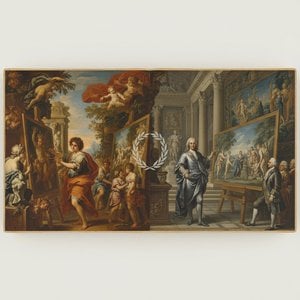
Michel Victor Acier (1736 - 1799): A Pioneer of Rococo Porcelain
Michel Victor Acier, born in Versailles in 1736, stands as a pivotal figure in the history of French porcelain art and sculpture. His formative years were steeped in aristocratic culture, nurtured by his father, Victor Acier, a respected craftsman himself—a lineage that instilled within him an appreciation for meticulous artistry and technical prowess. Educated at the Académie Royale de Paris, Acier honed his skills alongside luminaries like Étienne Marc François Falconet and Louis Claude Vassé, absorbing the stylistic ideals of Rococo – characterized by delicate ornamentation, asymmetrical compositions, and a celebration of pastoral beauty—that would profoundly shape his artistic vision.
- Early Career & Training: Acier’s initial foray into art involved mastering various crafts, including engraving and stucco work, demonstrating versatility beyond the realm of sculpture.
- Meissen Appointment (1764): Recognizing his talent, Johann Joachim Kändler, director of Meissen Porcelain Manufactory, invited Acier to join their workshop as a second master modeller. This collaboration marked a crucial juncture in Acier’s career and propelled him into the epicenter of Saxon porcelain production.
- Collaboration with Kändler: Acier worked closely with Kändler for several years, contributing significantly to the stylistic evolution of Meissen ceramics—a period often termed “Kändler’s Style,” which prioritized elegance and refined naturalism.
Acier's artistic output primarily revolved around porcelain modeling and sculpture. He excelled in creating intricate figures depicting mythological subjects, pastoral scenes, and portraits – reflecting the prevailing tastes of the Enlightenment era. His distinctive style blended Rococo exuberance with classical restraint, resulting in sculptures that possessed both gracefulness and intellectual depth. Notably, he produced a monumental marble Hautrelief portraying the death of General Schwerin—a masterpiece lauded for its dramatic realism and masterful execution—which cemented his reputation as one of Meissen’s foremost sculptors. This work exemplifies Acier's ability to convey emotion and narrative complexity within a sculptural form.
- Academic Recognition: In 1787, Acier was bestowed honorary membership in the Prussian Academy of Arts—a testament to his artistic accomplishments and influence—underscoring the esteem with which he was regarded by contemporaries.
- Family Life & Legacy: Acier married Maria Christina Eleonora Wittig and established a large family, including several children who pursued careers in art and science. His grandson, Andrey Assier, became a celebrated composer, furthering the artistic heritage of the Acier lineage.
Michel Victor Acier’s contribution to porcelain sculpture transcends mere technical skill; he embodies the spirit of his time—a period marked by intellectual curiosity, artistic innovation, and a fervent embrace of classical ideals. His sculptures continue to captivate audiences today, serving as enduring symbols of Rococo artistry and reflecting the profound impact of Enlightenment aesthetics on European art history. He remains an important figure in understanding the development of Meissen porcelain and its role in shaping the visual culture of 18th-century Prussia.