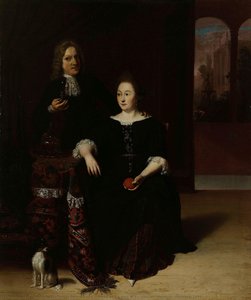
Matthijs Wulfraet: A Painter of Intimate Moments in the Dutch Golden Age
Born on New Year's Eve, between midnight and one in the morning of 1648 in Arnhem, Netherlands, Matthijs Wulfraet’s arrival into the world seemed destined for a touch of the extraordinary. His father, a German language teacher and doctor, initially envisioned a scholarly path for his son, sending him to Latin school. However, young Matthijs found himself irresistibly drawn to the world of drawing, often facing punishment for prioritizing artistic pursuits over academic ones. Despite these early challenges, his passion persisted, fueled by a collection of prints, drawings, and utensils—a testament to his burgeoning dedication. This unwavering commitment eventually led to an apprenticeship with Abraham Diepraam, a respected artist in Arnhem, marking the beginning of Wulfraet’s journey as a painter.
From Arnhem to Amsterdam: Developing a Distinct Style
Wulfraet's early training under Diepraam undoubtedly shaped his initial artistic sensibilities, but it was his later move to Amsterdam that truly allowed him to flourish. The vibrant art scene of Amsterdam provided fertile ground for experimentation and development. He began to carve out a niche for himself, initially focusing on historical allegories and lively depictions of merry companies—scenes brimming with detail and capturing the spirit of Dutch society. However, it was his mastery of portraiture, particularly small-scale portraits perfect for travelers and citizens in Frankfurt, that truly established his reputation. These intimate portrayals showcased Wulfraet’s keen eye for character and his ability to capture a sense of individuality within the constraints of the genre. His skill wasn't merely technical; it was about conveying personality—a subtle turn of the head, a particular expression – bringing his subjects to life on canvas.
A Legacy of Portraits and Genre Scenes
Wulfraet’s artistic legacy rests primarily upon his portraits and genre scenes, works that offer invaluable glimpses into the daily lives and social customs of 17th-century Holland. His paintings are characterized by a remarkable attention to detail—the textures of fabrics, the gleam of metalwork, the subtle nuances of facial expressions. He skillfully employed light and shadow to create depth and atmosphere, drawing the viewer into the scene and fostering a sense of immediacy. While influenced by contemporaries like Caspar Netscher, Wulfraet developed his own distinct style, marked by a warmth and intimacy that sets his work apart. His genre scenes, in particular, are notable for their unpretentious depiction of everyday activities—a family gathered around a table, individuals engaged in domestic tasks – offering a window into the lives of ordinary people during the Dutch Golden Age.
Family and Artistic Lineage: The Influence of Margaretha Wulfraet
The story of Matthijs Wulfraet is inextricably linked to that of his daughter, Margaretha. Recognizing her artistic talent, he nurtured her skills, passing down his knowledge and expertise. Margaretha herself became a respected painter, known for her portraits, landscapes, and genre works—a testament to the enduring legacy of her father’s instruction. Her success further solidified the Wulfraet name within the Dutch art world, demonstrating the power of familial influence and artistic transmission across generations. The fact that Arnold Houbraken intended to dedicate a page to Margaretha's memory before his own passing speaks volumes about the esteem in which she was held by her contemporaries.
Historical Significance: Capturing the Spirit of an Era
Matthijs Wulfraet’s contribution to Dutch Golden Age art lies not in groundbreaking innovation, but rather in his consistent and skillful portrayal of everyday life and individual character. His paintings serve as invaluable historical documents, offering a rich visual record of 17th-century Holland—its customs, its fashions, and its people. Through his intimate portraits and engaging genre scenes, Wulfraet captured the spirit of an era, leaving behind a legacy that continues to resonate with viewers today. He stands as a testament to the enduring power of art to illuminate the past and connect us to those who came before.