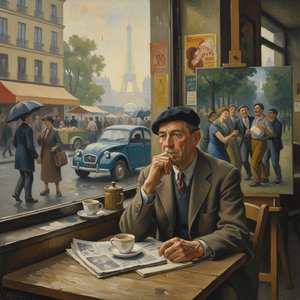
Marius Borgeaud: A Late Bloom in the Swiss Post-Impressionist Landscape
Marius Borgeaud, a name perhaps less familiar than his contemporaries within the vibrant Swiss art colony of the early 20th century, nevertheless possesses a quietly compelling body of work. Born in Lausanne in 1861 and passing away in Paris in 1924, Borgeaud’s artistic journey was marked by a deliberate delay, an unexpected shift from a conventional path to a passionate dedication to painting that blossomed later in life than many of his peers. His story is one of quiet determination, a late-blooming talent shaped by circumstance and a profound connection to the landscapes he so meticulously rendered.
Borgeaud’s early years were decidedly unartistic. He initially pursued an education at the Industrial School of Lausanne, seemingly destined for a life in commerce – a stark contrast to his eventual vocation. A chance encounter with Paul Vallotton, a future influential gallerist, during his schooling proved pivotal, igniting a nascent interest that would ultimately reshape his destiny. Following his father’s death and inheriting a considerable legacy, Borgeaud embarked on a period of extravagant spending in Paris, a trajectory that threatened his health and necessitated a restorative stay at Lake Constance in 1900 under medical supervision. It was during this time of recuperation that he rediscovered his artistic spirit, recognizing painting as a means of both personal expression and healing.
The Parisian Apprenticeship and Early Influences
Borgeaud’s arrival in Paris at the turn of the century coincided with a flourishing Swiss art scene. He found himself immersed within a community of talented artists – Félix Vallotton, Théophile Alexandre Steinlen, Eugène Grasset, Ernest Bieler, and René Auberjonois – all seeking to forge their own paths within the evolving artistic landscape. Recognizing his relative inexperience, he secured apprenticeships with two prominent figures: Fernand Cormon and Ferdinand Humbert, both esteemed academics whose teachings provided a solid foundation for his developing style. These early years were largely characterized by experimentation and exploration, producing a body of work that regrettably remains fragmented due to its limited survival – only around a dozen paintings are known to have survived from this period.
Crucially, Borgeaud’s artistic development was profoundly influenced by his interactions with younger artists. He cultivated friendships with figures like Francis Picabia, Paul de Castro, and Maurice Asselin, absorbing their innovative approaches and embracing the spirit of experimentation that defined the era. His summers spent painting alongside Picabia at Moret-sur-Loing, alongside the Pissarro brothers, exposed him to Impressionistic techniques and a looser, more expressive style. These formative experiences laid the groundwork for his later success.
Brittany: A Late-Life Revelation
While Paris provided an initial artistic environment, it was Borgeaud’s discovery of Brittany in 1908 that truly unlocked his creative potential and established him as a distinctive voice. Drawn to the region's rugged beauty, its traditional villages, and the ever-changing light of the coastline, he spent several summers exploring its diverse landscapes. This period marked a significant shift in his artistic focus, moving away from purely academic training and embracing a more personal, evocative style. His paintings of Rochefort-en-Terre and later Le Faouët are considered to be among his finest works, capturing the essence of Breton life with remarkable sensitivity and detail.
The landscapes of Brittany became a recurring subject throughout his career, but it was in these later years that Borgeaud truly mastered the art of portraying light and atmosphere. His brushwork became looser, more expressive, and imbued with a sense of immediacy. He developed a distinctive technique for rendering water, capturing its shimmering reflections and turbulent currents with remarkable skill. The portraits he created during this period are equally compelling, offering intimate glimpses into the lives of ordinary people.
A Legacy of Intimate Landscapes and Portraits
Borgeaud’s artistic output, though relatively modest in quantity, is characterized by a quiet elegance and a profound appreciation for the beauty of the natural world. His paintings – primarily landscapes and intimate interior scenes – are imbued with a sense of melancholy and nostalgia, reflecting his own personal journey and his deep connection to the places he inhabited. Notably, he produced a series of portraits, most famously his depiction of Coco Chanel, which showcased his ability to capture both the subject’s personality and her iconic style.
Despite a relatively late entry into the art world, Marius Borgeaud left an enduring mark on the Swiss Post-Impressionist landscape. His work, often overlooked in mainstream narratives, offers a poignant reminder that artistic talent can blossom at any age, fueled by passion, perseverance, and a deep connection to the beauty of the world around us. Today, his paintings continue to resonate with viewers who appreciate their quiet elegance, evocative atmosphere, and intimate portrayal of human experience.