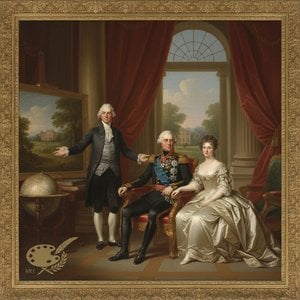
A Chronicler of Victorian Childhood: The Life and Art of John Edgar Williams
John Edgar Williams, a name perhaps less celebrated than his more prominent Pre-Raphaelite contemporaries, nevertheless occupies a significant niche in the pantheon of 19th-century British painting. Born around 1821, details surrounding his early life remain elusive; he emerges from the historical record primarily through his canvases – charming and meticulously rendered portraits that offer a fascinating glimpse into the lives of Victorian families, particularly their children. While biographical specifics are scarce, the very absence of sensational narrative allows Williams’ art to speak for itself, unburdened by romanticized notions of artistic struggle or bohemian excess. He was, in essence, a professional portraitist, catering to a burgeoning middle class eager to commemorate their status and familial bonds through carefully constructed visual representations.The Rise of Domestic Portraiture
Williams' career flourished during a period marked by the increasing prosperity of the British middle classes and a corresponding demand for accessible art. The advent of photography certainly impacted the portrait market, but it also spurred painters like Williams to refine their skills, emphasizing not merely likeness but also character, atmosphere, and narrative detail. He specialized in capturing children – often boys, though his subjects were varied – engaged in activities that reflected both their social standing and the prevailing Victorian ideals of education and refinement. His early works, dating back to the 1840s and 50s, reveal a developing talent for realism, but it was with paintings like ‘The Young Microscopists’ (1857) that his distinctive style truly crystallized. This piece, depicting three brothers absorbed in scientific exploration, is not simply a record of youthful curiosity; it's a subtle commentary on the era’s growing emphasis on empirical knowledge and rational thought. The careful arrangement of objects – the microscope itself, books, specimens – speaks to a deliberate construction of an image that conveys both intellectual aspiration and domestic tranquility.Technique and Influences
Williams’ technique is characterized by a remarkable attention to detail, a smooth application of paint, and a restrained palette. He wasn't one for dramatic chiaroscuro or bold experimentation; instead, he favored a naturalistic approach, striving to capture the textures of fabrics, the sheen of hair, and the subtle nuances of facial expression. While direct influences are difficult to pinpoint with certainty, echoes of Dutch Golden Age portraiture can be detected in his meticulous rendering of light and shadow, as well as in his ability to imbue everyday scenes with a sense of quiet dignity. He also appears to have been influenced by contemporary genre painters who focused on depicting scenes of domestic life, though Williams consistently elevated his subjects through the formality and precision of portraiture. His work stands apart from the more overtly sentimental or moralizing paintings of the period; he presents his subjects without explicit judgment, allowing viewers to draw their own conclusions about their character and social context.Portraits as Social Documents
The true significance of Williams’ art lies in its role as a social document. His portraits offer invaluable insights into Victorian fashion, education, and family dynamics. The clothing worn by his young subjects – from the elaborate dresses and sashes of the mid-century to the more practical attire of later years – provides a detailed record of changing styles and social conventions. Furthermore, the activities depicted in his paintings reveal the values that were instilled in children during this period: scientific inquiry, artistic pursuits, and proper decorum. Paintings like ‘John Howard (1791–1878), Mayor of Bedford’ and ‘William Avery (1812–1893), Mayor’ demonstrate a shift towards portraying civic leaders with a sense of grounded realism rather than idealized grandeur. He wasn't merely painting individuals; he was capturing the aspirations, anxieties, and social fabric of an era.Legacy and Rediscovery
John Edgar Williams died in 1891, leaving behind a body of work that continued to be appreciated by collectors and art enthusiasts. While his name may not be as widely recognized as some of his contemporaries, his paintings are increasingly sought after for their historical significance and artistic merit. The rediscovery of his work in recent years has shed new light on the importance of domestic portraiture in Victorian society and the subtle artistry with which Williams captured the essence of childhood. His canvases serve as a poignant reminder of a bygone era – an era defined by both progress and tradition, aspiration and restraint, and a deep-seated desire to preserve the fleeting moments of family life for posterity.问答详情
可以按心情浏览 John Edgar Williams 的作品吗?
艺术家的 心情空间 页面展示了 John Edgar Williams 按氛围分类排列的艺术作品。
John Edgar Williams 的哪些作品浏览量最高?
John Edgar Williams 的 访问统计 页面展示了基于 本网站 上列出的艺术家作品所计算出的统计数据。
John Edgar Williams 还以哪些名称为人所知?
John Edgar Williams 也以 John Edgar Williams (C.1821–1891), Williams, John Edgar, C.1821–1891 等其他名称为人所知。
John Edgar Williams 的艺术生涯是如何划分为不同时期的?
您可以在艺术家的 艺术编年史 页面上查阅 John Edgar Williams 作品的编年史,其作品按创作顺序分章节依次呈现。
在哪里可以按技法分类浏览 John Edgar Williams 的作品?
若要查找John Edgar Williams在特定媒介下的所有作品,请访问艺术家的全部媒介页面。
在哪里可以查看 John Edgar Williams 作品的色彩风格?
John Edgar Williams 作品的色彩特征展示在艺术家的 色彩基因 页面上。
我可以通过色谱来探索 John Edgar Williams 的作品吗?
色彩索引 页面按色彩对 John Edgar Williams 的作品进行了分类整理。
是否有John Edgar Williams作品的完整列表?
您可以在 John Edgar Williams 的 全部作品 页面上浏览其在 本网站 上的所有作品。