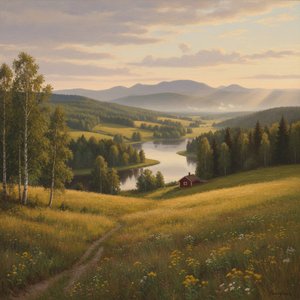
Johan Krouthén: Bridging Tradition and Nature’s Embrace
In the annals of Swedish art history, few names evoke the delicate balance between meticulous realism and poetic idealism quite like Johan Krouthén. Born on November 2, 1858, in Linköping, Krouthén emerged from a lineage deeply rooted in the tactile world of craftsmanship; his family, the Krouthéns of Norrköping, had practiced the intricate trade of pewter smithing for generations. This ancestral connection to fine detail and material precision likely laid the groundwork for an artistic eye that could find profound beauty in the smallest textures of the natural world. His journey began not in a grand studio, but through a formative apprenticeship under Svante Leonard Rydholm, where he honed the dual disciplines of painting and photography—a combination that would later grant his canvases a unique sense of light and structural truth.
Krouthén’s artistic evolution was marked by a courageous departure from the rigid, often stifling formalism of the Swedish Academy. While his early education at the Royal Swedish Academy of Arts provided him with essential technical foundations, it was the influence of mentors like Edvard Perseus that encouraged him to look beyond established academic doctrines. Krouthén sought a more visceral connection to the environment, a pursuit that led him on a transformative journey through the art capitals of Europe. A brief but impactful sojourn in Paris expanded his aesthetic horizons, exposing him to the shifting currents of modernism, while his time in Denmark allowed him to find kinship with the legendary Skagen Painters. These encounters with artists such as Oscar Björck and Anders Zorn helped refine a style that was both deeply Swedish in its subject matter and cosmopolitan in its technical execution.
The Mastery of Light and Landscape
Upon returning to Sweden, Krouthén turned his gaze toward the lush landscapes of Scania and Bohuslän, finding endless inspiration in the interplay of light and seasonal change. His work became a celebrated tapestry of rural life, where gardens, meadows, and portraits of local people were rendered with an uncompromising honesty. He possessed a rare ability to capture the soul of a place—not merely its topography, but its atmosphere. In his evocative oil landscapes, such as the 1912 depiction of 'Heather clad cliffs with sheep,' one can feel the rugged, windswept majesty of the Scottish moorlands, brought to life through masterful atmospheric depth and meticulous detail.
His technical prowess extended into the portrayal of movement and nostalgia. In works like 'Horsedrawn Carriage' (1918), Krouthén transports the viewer to a vanishing era, using textural realism to evoke the crispness of autumnal air and the rhythmic pace of country life. Even when tackling more complex or historical themes, his touch remained masterful. His 1921 painting 'Malmen' stands as a testament to his versatility, portraying cavalry maneuvers with a muted color palette that lends a sense of historical gravity and emotional resonance to the scene. Whether capturing the tranquil stillness of a garden or the dynamic energy of a rural landscape, Krouthén’s brushwork remained anchored in a profound respect for the natural world.
A Lasting Legacy in Scandinavian Art
The significance of Johan Krouthén lies far beyond his individual masterpieces; he was a catalyst for a new aesthetic sensibility within the Nordic art landscape. By rejecting the strict constraints of academic tradition in favor of a more emotive, observational approach, he helped pave the way for a modern Swedish identity in painting. His ability to fuse the precision of realism with the dreamlike qualities of idealism allowed him to create works that felt both grounded in reality and elevated by spirit.
Today, Krouthén’s legacy is preserved in esteemed institutions such as the Östergötlands Länsmuseum, where his serene landscapes and intimate portraits continue to captivate audiences. His contribution to art remains a vital chapter in the story of Swedish Romanticism, reminding us that true artistic progress often requires the courage to look away from the academy and toward the enduring beauty of the earth itself.