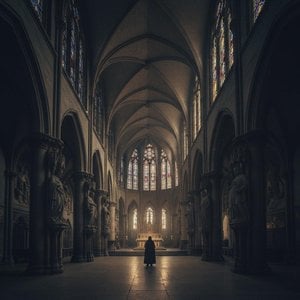
A Visionary of the Burgundian Court
In the twilight of the fourteenth century, amidst the opulent and pious atmosphere of the Burgundian court, the name Jean de Beaumetz emerged as a symbol of spiritual intensity and artistic refinement. Born around 1335 in the French region of Beauchêne, Beaumetz lived through an era where art served as a profound bridge between the earthly realm and the divine. His life was inextricably linked to one of the most powerful figures of the Middle Ages, Philip the Bold, Duke of Burgundy. Serving not merely as a painter but also as a valet to the Duke from approximately 1375 until his death in 1396, Beaumetz occupied a unique position that allowed him to translate royal ambition into enduring visual devotion.
The artist’s career was defined by this intimate connection to the ducal house, which provided him with the resources to execute monumental works of profound theological significance. His presence in the court circles of Burgundy placed him at the heart of a burgeoning cultural movement, where the International Gothic style began to take shape. Through his hands, the rigid structures of earlier medieval art began to soften, making way for a more emotive and humanistic approach to religious narrative. This period of transition is nowhere more evident than in his ability to capture the heavy, somber atmosphere of monastic life through the lens of royal grandeur.
The Mastery of Devotional Narrative
Beaumetz’s most significant contribution to the history of art lies in his specialized production of devotional panels, specifically those intended for the Chartreuse de Champmol. Between 1389 and 1395, he worked on a magnificent cycle of twenty-six oil-on-oak panels designed for the cells of Carthusian monks. These monks, known for their intense, solitary contemplation of Christ’s suffering, required imagery that could provoke deep empathy and spiritual connection. Beaumetz responded with works of staggering emotional depth, utilizing a palette of vibrant reds and deep blues to illuminate the tragedies of the Passion.
One of the most hauntingly beautiful remnants of this lost cycle is Calvary with a Carthusian Monk. In this masterpiece, the artist employs several sophisticated techniques to guide the viewer's soul:
- Symbolic Goldwork: The use of punched decoration in the gold background creates a shimmering effect, representing the Trees of Life and Knowledge and connecting the biblical past to the present moment.
- Emotional Realism: Through meticulous detail in facial expressions, Beaumetz captures the profound sorrow of Saint John the Evangelist and the fainting grief of the Virgin Mary.
- Thematic Contrast: The presence of a solitary monk at the foot of the cross serves as a mirror for the viewer, inviting a shared experience of ascetic devotion and mourning.
His technique, often involving tempera and early oil applications on plaster or wood, allowed for a luminous quality that seemed to radiate from within the artwork itself. This luminosity was essential in creating the ethereal, otherworldly atmosphere required by the Carthusian order, turning each panel into a window through which the divine could be glimpsed.
Legacy of the Gothic Spirit
Though much of Jean de Beaumetz’s oeuvre has been lost to the ravages of time—with only a few precious panels surviving in institutions like the Louvre and the Cleveland Museum of Art—his historical significance remains undiminished. He stands as a pivotal figure who bridged the gap between the stylized traditions of the high Middle Ages and the burgeoning naturalism of the early Netherlandish school. His work reflects a moment in history when the boundaries between courtly elegance and monastic austerity were blurred by a shared language of intense religious fervor.
The legacy of Beaumetz is found in the way he humanized the divine. By focusing on the physical and emotional weight of the Crucifixion, he helped pave the way for future generations of painters to explore the psychological depths of their subjects. He remains a testament to the power of patronage in shaping the course of art history, proving that when the political might of a Duke meets the spiritual vision of a master, the result is an artistic heritage that transcends the centuries.
问答详情
Jean De Beaumetz 出生于哪个国家?
Jean De Beaumetz 出生于 France。
我可以通过主题来探索 Jean De Beaumetz 的作品吗?
Jean De Beaumetz 的 主题图谱 是一个按主题对艺术家作品进行索引的页面。
是否有关于Jean De Beaumetz作品的3D虚拟展厅巡览?
您可以进行虚拟参观:Jean De Beaumetz 的 3D 博物馆 页面在三维画廊中展示了艺术家的作品。
Jean De Beaumetz 的出生地和出生年份是?
Jean De Beaumetz 于 1335 出生于 Beauchêne。
在哪里可以找到关于Jean De Beaumetz作品的相关统计数据?
Jean De Beaumetz 拥有一个 访问统计 页面,其中展示了该艺术家在 本网站 上的作品统计数据。
Jean De Beaumetz 出生于哪个城市和国家?
Jean De Beaumetz 出生于 France 的 Beauchêne。
在哪里可以按关键词浏览 Jean De Beaumetz 的作品集?
若要按特定主题查找 Jean De Beaumetz 的作品,请访问艺术家的 按关键词检索 页面,该页面通过关键词对作品进行了分类整理。