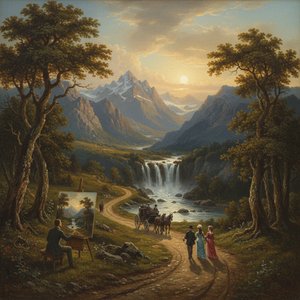
Isidore Meyers: A Master of 19th-Century Urban Landscapes
Born in Antwerp, Belgium, in 1836, Isidore Meyers (also known as Isidore Meyer) emerged as a significant figure in Belgian art during the mid-19th century. His career spanned several decades, marked by a dedication to capturing the vibrant energy and intricate details of urban life – particularly the bustling streets and grand architecture of Antwerp and Brussels. While not always receiving the widespread recognition afforded to his contemporaries like James Ensor or Magritte, Meyers’s work offers a unique and compelling perspective on a rapidly changing Europe, revealing a keen eye for composition, light, and the subtle nuances of human interaction within a historical context.
Meyers's early life remains somewhat shrouded in anecdotal detail. Accounts suggest he was initially trained as a draftsman, honing his observational skills before pursuing painting. This foundational training proved invaluable, allowing him to translate what he saw onto canvas with remarkable accuracy and precision. His artistic development coincided with the rise of Realism and Impressionism, movements that profoundly influenced his approach to depicting the world around him. Unlike the purely representational tendencies of earlier academic art, Meyers sought to capture not just the *appearance* of a scene but also its atmosphere and emotional resonance.
The Palette of Progress: Themes and Techniques
Meyers’s oeuvre is predominantly characterized by meticulously rendered landscapes and cityscapes. He frequently depicted scenes from Antwerp, his birthplace, showcasing the port's dynamic activity, the grandeur of its buildings, and the everyday lives of its inhabitants. His paintings often feature a cast of characters – merchants, laborers, horse-drawn carriages, and pedestrians – all contributing to a sense of bustling realism. The “Promenade Hotel,” one of his most celebrated works, exemplifies this style perfectly, offering a detailed snapshot of 19th-century Antwerp’s social fabric. The painting's monochrome palette—a deliberate choice—heightens the drama and emphasizes the textures of the streetscape.
Technically, Meyers was a master of detail. He employed a precise draftsmanship, carefully rendering architectural elements, clothing, and facial features. However, he avoided overly fussy or cluttered compositions, instead favoring balanced arrangements that drew the eye through the scene. His use of light and shadow was particularly noteworthy; he skillfully manipulated these elements to create depth, volume, and mood. Meyers’s work also demonstrates a subtle understanding of atmospheric perspective, creating a sense of distance and recession within his urban landscapes.
Influences and Artistic Context
Meyers's artistic trajectory reveals the influence of several key movements and artists. The Realist movement, with its focus on depicting everyday life without idealization, undoubtedly shaped his approach to subject matter. Furthermore, he was influenced by the Barbizon School painters in France, whose emphasis on plein air painting—working directly from nature—inspired him to observe and capture the world around him with greater immediacy. The meticulous detail of Gustave Courbet’s landscapes also appears to have resonated with Meyers.
It's important to note that Meyers operated within a specific historical context – the rapid industrialization and urbanization of 19th-century Europe. His paintings offer a visual record of this transformation, documenting the changing social landscape and the impact of technological advancements on urban life. His work can be seen as a reflection of the anxieties and aspirations associated with this period of profound change.
Legacy and Rediscovery
Despite not achieving widespread fame during his lifetime, Isidore Meyers’s art has experienced a resurgence in recent years, largely due to renewed interest in Belgian 19th-century painting. His meticulous detail, evocative compositions, and insightful portrayal of urban life continue to captivate viewers today. WahooArt's reproductions offer an opportunity to appreciate the beauty and historical significance of his work, bringing these captivating scenes from Antwerp’s past back to life.
Further research into Meyers’s life and work reveals a dedicated artist who quietly documented a pivotal era in European history. His paintings serve as valuable windows into the social, economic, and cultural dynamics of 19th-century Belgium, offering a unique and compelling perspective on a world undergoing rapid transformation.
问答详情
我可以在其所有作品中研究 Isidore Meyers 对色彩的运用吗?
Isidore Meyers 作品的色彩特征展示在艺术家的 色彩基因 页面上。
Isidore Meyers 还以哪些名称为人所知?
Isidore Meyers 也以 Isidore Meyer 等其他名称为人所知。
可以按媒介类型浏览 Isidore Meyers 的作品吗?
您可以在Isidore Meyers的全部媒介页面上按媒介浏览其作品。