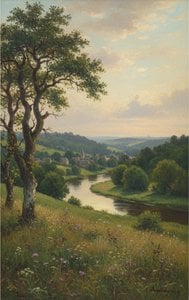
Henri Mège: A Painter of French Landscapes and Vietnamese Echoes
Born in Évreux, Normandy, in 1904, Henri Mège’s artistic journey spanned nearly eight decades, culminating in a distinctive style deeply rooted in Impressionism yet infused with the exotic allure of Southeast Asia. His life was inextricably linked to art; his father, a painter himself, instilled in him an early appreciation for color and form, setting the stage for a career dedicated to capturing the beauty of the natural world. Mège’s formative years were spent absorbing the landscapes of Normandy, a region renowned for its rolling hills, shimmering rivers, and dramatic skies – elements that would consistently inform his later work.
Mège's artistic development unfolded primarily in the aftermath of World War II. He initially trained at the École des Beaux-Arts in Paris, but it was his relocation to Saigon (now Ho Chi Minh City) in 1950 that profoundly shaped his artistic vision. Assigned as a professor at the School of Fine Arts, he found himself immersed in a vibrant and dramatically different cultural landscape – Vietnam. This experience proved transformative, shifting his focus from purely French landscapes to incorporating elements of Vietnamese scenery, light, and atmosphere into his paintings. The humid heat, dense vegetation, and golden hues of the Mekong Delta became recurring motifs, offering a striking contrast to the familiar tones of Normandy.
A Style Bridging Impressionism and Exoticism
Mège’s artistic style is best described as a nuanced blend of Impressionism and a distinctly personal interpretation of Orientalist aesthetics. He inherited the Impressionists' emphasis on capturing fleeting moments, utilizing broken brushstrokes and vibrant color palettes to convey light and atmosphere. However, unlike many of his contemporaries who focused solely on European exotic locales, Mège developed a unique sensitivity to the nuances of Vietnamese landscapes. He wasn’t merely replicating scenes; he was translating them through his own artistic lens, imbuing them with a sense of tranquility and poetic beauty.
His technique involved layering thin washes of color, often employing a dry brushstroke to create texture and suggest movement within the foliage. He paid meticulous attention to detail in rendering water surfaces – reflections shimmering on lakes and rivers, capturing the play of light and shadow with remarkable accuracy. The influence of Millet is evident in his depictions of rural life and landscapes, particularly in the careful observation of figures within the natural setting, but Mège’s work transcends simple imitation; it possesses a unique emotional resonance.
Key Works and Notable Achievements
Among Mège's most celebrated works are “Paysage” (Landscape), a vibrant depiction of a tropical scene that exemplifies his mastery of color and light, and "Nuit d’Été au Lac d'Aiguebelette, Savoie" (Summer Night at Lake Aiguebelette), a moody and evocative painting capturing the ethereal beauty of the Savoy region. His series of paintings depicting scenes from Vietnam – “Vue de HûÉ” (View of Hue) being particularly noteworthy – showcase his ability to translate the spirit of that country onto canvas. These works, often characterized by their serene atmosphere and subtle color harmonies, have been exhibited at both French and international galleries.
Mège’s work gained recognition through exhibitions at the Musée Thomas-Henry in Évreux, where a significant collection of his paintings resides. His dedication to capturing the essence of both French and Vietnamese landscapes cemented his place as a distinctive voice within 20th-century art, bridging European artistic traditions with the vibrant cultural tapestry of Southeast Asia.
Legacy and Historical Significance
Henri Mège’s legacy extends beyond his individual paintings. He represents a fascinating example of an artist who embraced cross-cultural exchange, using his art to explore the connections between Europe and Asia. His work offers a valuable perspective on the changing landscape of artistic expression in the post-war era, demonstrating how artists can adapt their style while retaining a deep connection to their subject matter.
Furthermore, Mège’s paintings serve as a reminder of the importance of preserving cultural heritage. The Musée Thomas-Henry, where much of his oeuvre is housed, plays a crucial role in safeguarding and promoting his artistic legacy for future generations. His work continues to resonate with viewers today, inviting them to contemplate the beauty of nature and the enduring power of art to transcend geographical boundaries.