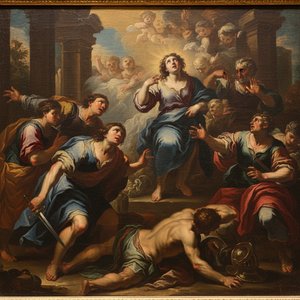
A Neapolitan Shadow: The Life and Art of Giovanni Do
Giovanni Do, a name perhaps less celebrated than his contemporaries like Ribera or Caracciolo, nevertheless occupies a crucial position in the dramatic evolution of 17th-century Neapolitan painting. Born before 1617 in Xàtiva, near Valencia, Spain, Do’s artistic journey led him to Naples, a city then pulsating with both religious fervor and a burgeoning artistic scene. While biographical details remain frustratingly sparse—the plague of 1656 likely contributing to the loss of records—enough evidence exists to paint a picture of an artist deeply immersed in the tenebrist style and profoundly influenced by the masters he encountered in Italy. His early training in Valencia, within the orbit of Jacinto Rodríguez Espinosa, laid the foundation for his naturalist inclinations, but it was in Naples that Do truly found his voice. By 1626, he had established himself in the city, marrying Grazia de Rosa, sister to the painter Paceco de Rosa, a union that further integrated him into the vibrant artistic community. The marriage contract itself is revealing, listing Giovanni Battista Caracciolo and Jusepe de Ribera as witnesses—a testament to Do’s immediate acceptance among the leading figures of Neapolitan art.
The Embrace of Tenebrism: Style and Influences
Do's artistic development was inextricably linked to the prevailing aesthetic climate of Naples, dominated by a powerful strain of tenebrism—a dramatic use of light and shadow derived from Caravaggio’s innovations. This wasn’t merely a stylistic adoption; Do internalized the emotional intensity and psychological realism that characterized the movement. While initially influenced by Spanish naturalism, his work quickly absorbed the earthy palettes, stark contrasts, and dynamic compositions favored by Ribera and Caracciolo. However, to simply label him an imitator would be a disservice. Do possessed a unique sensitivity in rendering human forms, imbuing them with a quiet dignity even within scenes of religious suffering or contemplation. His brushwork, often described as dense and impastoed, contributes to the tactile quality of his paintings, drawing the viewer into the immediacy of the depicted moment. The influence of these masters is undeniable, yet Do’s individual approach—a subtle blend of Spanish realism and Italian drama—distinguished him within the Neapolitan school.
The Adoration as a Defining Moment
The single work most firmly attributed to Giovanni Do, and considered his masterpiece, is the *Adoration of the Shepherds* originally commissioned for the Church of Pietà dei Turchini in Naples. This painting encapsulates all the hallmarks of his mature style: the intense chiaroscuro, the naturalistic portrayal of figures, and a profound sense of emotional depth. For years, the work was misattributed to Ribera, highlighting the close stylistic affinities between the two artists. However, careful analysis—particularly comparisons with other documented works—has firmly established Do’s authorship. The painting is not merely a depiction of a biblical scene; it's an exploration of human vulnerability and spiritual awakening. The shepherds are not idealized figures but rather humble individuals drawn into the sacred event by its sheer power. A later version, discovered in the Real Academia de Bellas Artes de San Fernando in Madrid, further cemented his place as a pivotal figure, revealing a close connection to Ribera’s unpublished originals.
A Legacy Shrouded in Shadow
Despite the impact of his work, Giovanni Do remains a relatively obscure figure in art history. The scarcity of surviving documentation—compounded by the devastating plague that swept through Naples during his lifetime—has hindered a comprehensive understanding of his career. It is believed he made significant contributions to Neapolitan painting beyond the *Adoration*, yet many works remain unattributed or lost to time. His importance lies not in prolific output but in his ability to synthesize Spanish and Italian traditions, creating paintings that are both emotionally resonant and technically masterful. He bridged a gap between the naturalism of Valencia and the dramatic realism of Naples, leaving an indelible mark on the artistic landscape of Southern Italy. While his name may not be as widely recognized as those of his contemporaries, Giovanni Do’s art continues to captivate with its quiet intensity and profound humanity—a testament to the enduring power of a Neapolitan shadow.