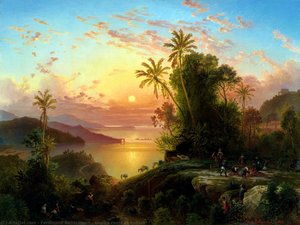
Ferdinand Bellermann: A Venezuelan Visionary
Ferdinand Konrad Bellermann (1814 – 1889) stands as a singular figure in German Romantic landscape painting, primarily recognized for his breathtaking depictions of Venezuela during the mid-nineteenth century. Born into modest circumstances—his father, a tanner, succumbed to illness prematurely—Bellermann’s upbringing instilled a profound appreciation for practicality and responsibility, shaping him into a man deeply committed to supporting his family. Despite receiving invaluable assistance from his uncle Johann, a successful businessman who fostered his artistic ambitions, Bellermann pursued a path less conventional than many of his peers, accepting employment as a shepherd – an experience that would profoundly influence his understanding of the natural world.
His talent emerged early, discovered by educators who recognized his innate aptitude for drawing and painting. At fourteen, he enrolled in Weimar’s Prince Frederick Augustus School of Drawing and Sculpture, where he honed his skills under Wilhelm Leibl and Carl Blechen—influences that cemented his stylistic trajectory toward Romanticism's expressive realism. The school’s intention was to prepare him for a career at Volkstedt Porcelain Manufactory, but Bellermann’s developing vision problems redirected him towards Berlin, where he studied with Wilhelm Schirmer and further refined his technique. During these formative years, he undertook extensive excursions throughout thuringia and visited Rügen, meticulously sketching the landscapes and flora of these regions—activities that cultivated a lifelong fascination for botany and instilled in him an acute observational eye.
The pivotal moment arrived in 1840 when Bellermann embarked on a daring expedition to Norway alongside Friedrich Preller and two fellow students – a journey fraught with hardship but yielding invaluable artistic inspiration. Traversing remote backcountry roads under primitive conditions, they documented the rugged beauty of Norwegian scenery with remarkable accuracy. Upon their return, Bellermann produced “Landscape in the Andes,” a monumental canvas that instantly captivated critics and secured him patronage from King Frederick William IV—a testament to his exceptional ability to convey atmospheric depth and geological grandeur. This painting remains lost, yet its legacy persists as an emblem of Romantic idealism and scientific observation.
Recognizing Bellermann’s extraordinary talent for capturing the essence of nature, Alexander von Humboldt championed his inclusion in a groundbreaking expedition to South America commissioned by a Hamburg merchant. Arriving in Venezuela in July 1842, Bellermann diligently documented the region's diverse ecosystems—from bustling Caracas to the ruins scarred by the 1812 earthquake—producing detailed sketches and watercolors that served as invaluable scientific records alongside artistic masterpieces. He explored vast stretches of territory, capturing panoramic vistas of tepuis mountains and lush rainforests with unparalleled sensitivity.
Bellermann’s contribution to art history transcends mere aesthetic beauty; he embodies the Romantic spirit's conviction that art could illuminate the sublime grandeur of the natural world while simultaneously advancing scientific understanding. His work stands as a poignant reminder of a time when artistic vision intersected seamlessly with scientific inquiry—a legacy that continues to inspire artists and scholars alike.