Carl Herpfer: A Window into Victorian Society
Carl Herpfer (1836-1897) was a German painter whose evocative and meticulously detailed scenes of 18th and 19th-century bourgeois life offer a remarkably intimate glimpse into the social customs and private moments of his era. Born in a town near Munich, Herpfer’s artistic journey began under the tutelage of prominent figures like Johann von Schraudolph and Karl von Piloty at the Royal Academy of Art in Munich – an environment steeped in the traditions of academic history painting. However, rather than adhering strictly to this established style, Herpfer carved out a distinctive niche for himself through his focus on genre scenes, specifically those depicting domestic settings and social gatherings. His work isn’t grand historical narratives; instead, it's a quiet observation of everyday life – a subtle yet powerful commentary on the values and rituals of the time.
Early Influences and Artistic Development
Herpfer’s early training undoubtedly provided him with a solid foundation in technique and composition. The influence of his teachers is evident in his careful rendering of figures, drapery, and architectural details. Yet, he quickly moved beyond mere imitation, developing a unique style characterized by an almost photographic realism combined with a remarkable sensitivity to light and atmosphere. Notably, Herpfer’s work began to shift away from purely academic subjects towards scenes of domesticity and social interaction. This transition reflects a broader artistic trend during the mid-19th century, where artists increasingly sought to capture the nuances of contemporary life rather than idealized historical or mythological themes. The YouTube video (link) offers a glimpse into his approach – utilizing a simple camera phone to share his work and engage with viewers.
Themes of Domesticity and Social Observation
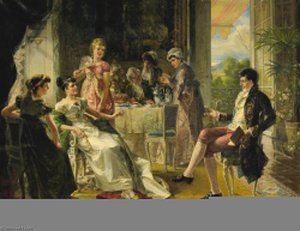
Herpfer’s paintings are most celebrated for their ability to transport the viewer directly into the heart of Victorian society. His subjects—aristocratic families, ladies in drawing rooms, servants attending to their duties—are presented with a remarkable degree of realism and psychological insight. Works like “An Evening's Entertainment” (link) vividly depict the leisure activities of the wealthy, while "Dressing the Bride" (link) captures a moment of anticipation and beauty surrounding a wedding. “The Love Missive” (link), with its pastel hues and intimate setting, reveals the quiet dramas unfolding behind closed doors. These scenes aren’t simply decorative; they offer a window into the social conventions, relationships, and anxieties of the era.
Technique and Style
Herpfer's technical skill is undeniable. He employed meticulous detail in his rendering of fabrics, textures, and facial expressions, creating an illusion of three-dimensionality that draws the viewer into the scene. His use of light and shadow is particularly noteworthy, contributing to the atmospheric quality of many of his paintings. He favored a realistic style, often described as Neoclassical or Rococo depending on the subject matter, but always imbued with a sense of immediacy and emotional resonance. The Artnet entry (link) highlights several examples of his work, demonstrating the breadth of his output.
Legacy and Historical Significance
While Herpfer may not be as widely recognized as some of his contemporaries, his paintings hold a significant place in art history. They provide invaluable insights into Victorian social life, offering a nuanced portrayal of a bygone era that transcends mere documentation. His ability to capture the subtle emotions and unspoken dynamics within domestic scenes is particularly compelling. His work serves as a testament to the power of genre painting to illuminate the everyday experiences of ordinary people – or, in this case, the privileged members of Victorian society. Carl Herpfer’s legacy lies not just in his technical skill but also in his ability to evoke a sense of nostalgia and invite us to contemplate the complexities of human relationships within a specific historical context.