Early Life and Florentine Beginnings
Agostino Cornacchini, born in the Tuscan town of Pescia on August 27th, 1686, emerged into a world steeped in artistic tradition. While details surrounding his family’s early life remain somewhat elusive, their relocation to Florence around 1697 signals an ambition for young Agostino and a recognition of the opportunities available within the city's vibrant art scene. It was here, at the age of eleven, that he entered the workshop of Giovanni Battista Foggini, a prominent sculptor favored by Cosimo III de’ Medici, Grand Duke of Tuscany. This apprenticeship proved foundational, immersing Cornacchini in the dramatic late Baroque style then prevalent in Florentine workshops and instilling within him a mastery of technical skill.
Foggini's influence was considerable; he was renowned for his elaborate ornamentation and dynamic compositions. During these formative years, Cornacchini absorbed not only sculpting techniques but also an appreciation for the refined aesthetics favored by the Medici court. Early commissions began to trickle in, demonstrating a burgeoning talent. Notably, around 1709, English antiquarian John Talman selected Cornacchini to create drawings of Italy’s most celebrated monuments—a testament to his growing reputation and observational abilities. A marble statue of Clement XI, dated 1710 and now residing in Urbino Cathedral, further solidified his position within the artistic community.
Roman Triumph and Papal Patronage
The year 1712 marked a pivotal shift in Cornacchini’s career as he journeyed to Rome. This move was facilitated by his uncle, Cardinal Carlo Agostino Fabbroni, who generously provided him with both studio space and financial support for the next eight years. Establishing himself within the household of such an influential figure proved instrumental, granting access to a network of patrons and opportunities that would define his artistic trajectory. Fabroni’s patronage allowed Cornacchini to focus intently on developing his unique style, moving beyond the strictures of his Florentine training.
Rome, a crucible of artistic innovation, fostered a transformation in Cornacchini's work. He joined the prestigious Accademia di San Luca in 1712 and was later appointed its principal in 1720—a clear indication of his rising stature within Roman artistic circles. Papal commissions soon followed, notably from Clement XI and Benedict XIII. These projects included restorations of ancient sculptures within the Vatican itself, alongside religious figures destined for churches throughout Rome and Orvieto. This period saw Cornacchini’s oeuvre evolve towards a calmer, more elegant Rococo sensibility—emphasizing gentle forms and refined grace over the intense movement and dramatic lighting effects characteristic of earlier Baroque sculpture.
The Equestrian Statue of Charlemagne: A Masterpiece of Perspective
Cornacchini's career reached its zenith in the early 1720s with the commission for the colossal marble equestrian statue of Charlemagne. This monumental work, completed in 1725 and installed at the base of the Scala Regia—the grand staircase leading to the Apostolic Palace within Vatican City—stands as his undisputed masterpiece. The statue was not merely an artistic endeavor; it held significant political weight, symbolizing the burgeoning relationship between Rome and France under Benedict XIII.
Positioned opposite Gian Lorenzo Bernini’s celebrated equestrian statue of Constantine, Cornacchini's Charlemagne presented a striking contrast in style and approach. While Bernini’s work embodies Baroque dynamism, Cornacchini’s sculpture is characterized by its stunning perspectival setting—a combination of stucco decoration and mosaic scenery that creates an illusion of depth and grandeur. The asymmetry and deliberate misdirection of the viewer’s gaze draw attention to the decorative qualities of the piece: the intricate patterns in Charlemagne's cape, the subtle drill holes adding texture to his beard and hair, and the volute-like curls of the horse’s mane. This masterful manipulation of space and form exemplifies Cornacchini’s unique ability to blend exuberance with intimacy—a hallmark of early 18th-century sculpture in Rome.
Later Years and Enduring Legacy
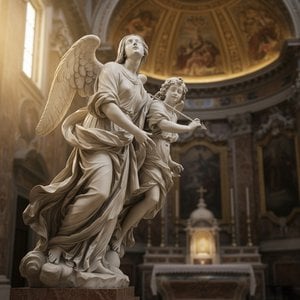
Beyond the Charlemagne statue, Cornacchini continued to receive significant commissions throughout the 1720s and 30s. He completed a marble statuary group of Hope for the chapel of the Monte di Pietà, and his work graced churches in Orvieto—including the exquisite marble Guardian Angel (1729) within the Duomo—as well as the Basilica of Superga in Turin around 1730. His versatility extended to mythological themes, exemplified by *Sleeping Endymion* (1716), now housed in the Cleveland Museum of Art.
Agostino Cornacchini passed away in Rome in 1754, leaving behind a legacy that bridged the traditions of Baroque sculpture with the emerging elegance of Rococo. His influence resonated through subsequent generations of artists, particularly those who benefited from his leadership at the Accademia di San Luca and were inspired by his innovative papal commissions. He remains celebrated for his graceful sculptures, his contributions to Roman ecclesiastical art, and—most notably—for the enduring power and beauty of his equestrian statue of Charlemagne, a testament to his skill and vision.