A Portrait of Quiet Sorrow
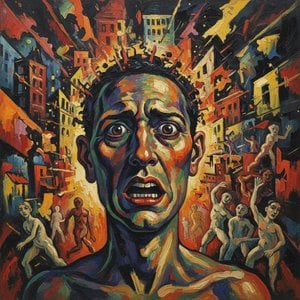
In Amedeo Clemente Modigliani’s 1909 masterpiece, The Beggar of Livorne, we are invited into a profound exploration of human emotion and psychological depth. The painting presents a solitary man, rendered with a remarkable precision that captures more than just a physical likeness; it captures a soul in contemplation. As he holds his chin delicately in his hand, his gaze is directed outward, seemingly confronting an unseen world, yet his posture exudes a stillness and introspection that pulls the viewer into his private moment of melancholy. This gesture of resting the chin serves as a silent testament to unspoken sadness and deep thought, making the subject feel intimately connected to the observer.
The composition is masterfully layered, subtly incorporating two additional individuals in the background. These figures, though smaller and less defined than the central man, add a layer of complexity and depth to the scene, suggesting a world that continues to move around the subject's internal stillness. The muted palette further contributes to the painting’s somber mood, focusing all attention on the central figure and the heavy, reflective atmosphere that permeates the canvas.
Stylistic Innovation and Emotional Resonance
At the turn of the century, as Europe grappled with unprecedented anxieties, Modigliani utilized a unique stylistic language to convey inner turmoil. In The Beggar of Livorne, he achieved a striking fusion of Expressionism and Cubist principles. The elongated facial features characteristic of his burgeoning style are particularly evident here, emphasizing the contours of the face to heighten the emotional impact. This deliberate distortion is not meant to deceive the eye but to amplify the sense of melancholy and vulnerability inherent in the subject.
Technically, Modigliani employed a smooth, blended brushstroke technique, a hallmark of Expressionism that lends the work an almost ethereal quality. The way the light and shadow interact with the man's green jacket and bearded face creates a sense of weight and presence. For collectors and interior designers alike, this piece offers a powerful symbolic resonance; the beggar’s hunched shoulders and downward gaze represent humility and a yearning for solace amidst hardship. It is an evocative work that transcends mere representation, inviting anyone who views it—or brings a high-quality reproduction into their home—to contemplate the enduring complexities of the human condition.
常见问题与解答
这幅 莫迪里亚尼 的《The beggar of Livorne》 的复制品会为房间增添怎样的氛围?
莫迪里亚尼 的《The beggar of Livorne》 营造出 Romantic 的氛围,与推荐的陈设空间——Living Room 完美契合。
建议将"The beggar of Livorne"用于何处及何种用途?
莫迪里亚尼 的《The beggar of Livorne》 推荐用于 Accent,理想的摆放空间为 Living Room。结合使用场景与空间布局,可以更好地确定复制品的陈列位置。
莫迪里亚尼 的《The beggar of Livorne》 的对比度有多强?
"The beggar of Livorne" 的明暗对比度记录为 Serene。对比度描述了亮部与暗部之间的差异强度。