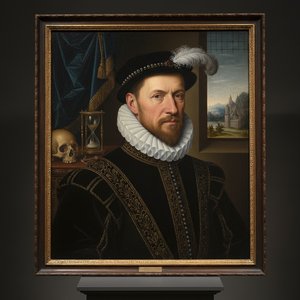
Christoph Amberger: The Silent Witness of Augsburg’s Renaissance
Christoph Amberger (c. 1505 – 1562) stands as a quietly influential figure within the artistic landscape of Augsburg during the High Renaissance—a painter whose legacy resides not in grand monuments or flamboyant commissions, but in the meticulous detail and humanist spirit captured within his portraits and biblical narratives. Born into a family steeped in craftsmanship—his father a stonemason and grandfather a woodcarver—Amberger’s formative years instilled an appreciation for precision and artistry that would permeate his entire oeuvre.
His artistic journey began under the tutelage of Hans Holbein the Younger, arguably Augsburg's most celebrated painter at the time, forging a connection with Holbein’s distinctive style characterized by crisp realism and psychological depth. This mentorship proved pivotal, shaping Amberger’s approach to depicting human subjects—particularly evident in his prolific series illustrating Joseph’s Life, twelve canvases that meticulously recount biblical events with remarkable accuracy and symbolic resonance. These paintings aren't merely representations of scripture; they are carefully constructed visual dialogues exploring themes of faith, virtue, and divine providence. The influence of Holbein’s masterful use of light and shadow is palpable throughout Amberger’s work, demonstrating a shared commitment to capturing the essence of human emotion and portraying subjects with profound psychological insight.
Amberger’s artistic activity flourished amidst the burgeoning intellectual and economic dynamism of Augsburg—a city at the epicenter of European trade and patronage. He regularly traveled to Augsburg, engaging with prominent figures like Jakob Fugger, Konrad Peutinger, and Georg von Frundsberg – individuals whose portraits he undertook, securing commissions from wealthy merchants and civic leaders. These portraits are not simply likenesses; they convey status, power, and ambition through subtle gestures and carefully considered poses—reflecting the aspirations of Augsburg’s elite during a period of unprecedented prosperity. His meticulous attention to detail—evident in the rendering of fabrics, jewelry, and facial expressions—underscores Amberger's dedication to artistic excellence and his ability to elevate portraiture beyond mere representation into a form of visual storytelling.
Furthermore, Amberger ventured into Northern Italy between 1525 and 1527, immersing himself in the artistic fervor of Venice and Florence, absorbing influences from Leonardo da Vinci and Michelangelo. This exposure broadened his stylistic horizons and enriched his understanding of humanist ideals—particularly the emphasis on observation, anatomical accuracy, and classical beauty. He skillfully incorporated elements of Italian Renaissance art into his own compositions, demonstrating a willingness to experiment with new techniques and perspectives while maintaining his core artistic principles. The encounter with Leonardo’s sfumato technique, for instance, subtly softened Amberger's contours and created an ethereal quality in certain portraits—a testament to the transformative power of artistic exchange.
The Emperor Charles V commissioned several portraits from Amberger, cementing his reputation as a court artist and demonstrating the esteem accorded to Augsburg’s artistic talent. His meticulous technique—primarily employing oil paints—allowed him to achieve unparalleled luminosity and textural nuance, capturing subtle expressions and conveying psychological complexity with remarkable subtlety. Unlike Holbein's bolder brushstrokes, Amberger favored a more restrained palette and refined compositional arrangements, prioritizing clarity of form and harmonious balance. He was also a prolific fresco painter, adorning churches and civic buildings with scenes from biblical history and religious iconography. His frescoes exemplify the humanist aesthetic prevalent during the period—integrating classical motifs alongside Christian narratives—reflecting the broader cultural currents shaping Renaissance Europe. Christoph Amberger's enduring influence lies in his ability to synthesize Holbein’s realism with Augsburg’s humanist spirit, securing his place as a pivotal artist of the sixteenth century and a silent witness to the grandeur of Augsburg’s renaissance.
Редакційна команда WahooArt.com
Тест на знання мистецтва
У кожному запитанні лише одна правильна відповідь.
Explore the breathtaking precision of Hans Holbein the Younger. From Tudor royal portraits to intricate Northern Renaissance details, discover the mastery behind his legendary works and learn how to bring this historical grandeur into your collection with museum-quality reproductions.