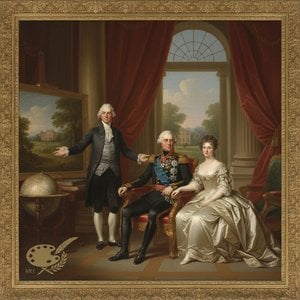
Thomas Hudson: A Life Dedicated to the Art of Portraiture
Thomas Hudson, a name synonymous with elegance and refinement in 18th-century English portraiture, remains a captivating figure whose career spanned decades and profoundly influenced generations of artists. Born in Bideford, Devon, in 1701 – though the precise details of his early life remain somewhat shrouded in mystery – Hudson’s artistic journey began under the tutelage of Jonathan Richardson in London, an apprenticeship that instilled within him a meticulous approach to capturing likeness and a deep appreciation for classical aesthetics. This foundational training proved pivotal, shaping not only his technical skills but also his understanding of the role of portraiture as a reflection of status and personality. A particularly noteworthy event during this early period was Hudson’s marriage to Richardson's daughter, a union that occurred before 1725 despite the mentor’s disapproval – a testament to Hudson’s determination and perhaps a subtle challenge to established artistic norms.
The Peak Years: Workshop Practice and Artistic Flourishing
Hudson’s career truly blossomed between 1740 and 1760, during which time he ascended to become arguably London's most successful portraitist. This period witnessed an astonishing output – estimates suggest he painted around 400 portraits throughout his lifetime – fueled by a remarkably efficient workshop system. Operating a bustling studio, Hudson employed numerous assistants, including the skilled drapery painter Joseph van Aken, allowing him to fulfill a vast number of commissions and maintain a consistent flow of work. His style during this time was characterized by polished brushwork, an unwavering attention to detail, and a remarkable ability to render fabrics and textures with breathtaking realism. The portraits he produced weren’t merely representations; they were carefully constructed narratives, capturing the essence of their sitters – nobility, merchants, and members of the gentry – and conveying their wealth, power, and social standing.
Continental Influences and Artistic Expansion
Hudson's artistic vision wasn’t confined to England. In 1748, he embarked on a significant journey to the Low Countries, followed by an even more transformative trip to Italy in 1752. These continental excursions proved instrumental in broadening his artistic horizons, exposing him to diverse styles and techniques that challenged and enriched his existing skillset. He absorbed influences from Italian portraiture’s emphasis on dramatic lighting and composition, as well as the meticulous detail characteristic of Flemish painting. Returning to London, Hudson integrated these new perspectives into his own work, resulting in a more dynamic and sophisticated style. His residence at Cross Deep, Twickenham, near Alexander Pope's villa, further cemented his position within a vibrant intellectual and artistic community, fostering connections with other prominent figures like William Hogarth and Francis Hayman.
Notable Students and the Legacy of a Master
Hudson’s influence extended far beyond his own creations; he was a dedicated mentor who nurtured the talents of several rising artists. Among his most celebrated pupils were Joshua Reynolds – arguably the most influential portrait painter of the 18th century – and Joseph Wright of Derby, whose later works would explore themes of social commentary and scientific observation. Hudson also trained Peter Toms, a specialist in painting draperies, demonstrating his commitment to technical mastery across various artistic disciplines. His legacy is deeply intertwined with the development of English portraiture, establishing a standard for elegance, precision, and an acute understanding of human character.
A Lasting Impact on British Art
Thomas Hudson’s contribution to British art is undeniable. He wasn't simply a painter; he was a conduit between artistic traditions, a master craftsman who elevated the status of portraiture, and a teacher whose influence resonated through generations of artists. His paintings are now housed in prestigious institutions such as the National Portrait Gallery, the National Maritime Museum, Tate, Foundling Museum, and the Bristol City Museum and Art Gallery, ensuring that his artistry continues to be appreciated by art enthusiasts worldwide. Furthermore, many of his works are readily accessible online, allowing a broader audience to engage with his captivating portraits. Hudson’s life and work serve as a testament to the enduring power of artistic dedication, meticulous technique, and the ability to capture not just likeness but also the very soul of one's subject.