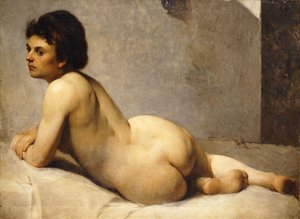
Lembesis Polychronis: Echoes of Salamis Island
Polychronis Lembesis, (Greek Πολυχρόνης Λεμπέσης) (c. 1848, Salamis Island - 1913, Athens), stands as a quietly significant figure within the Munich School of Greek artists – a group often overshadowed by its more celebrated members like Nikolaos Gysis but possessing a unique and deeply personal artistic voice. His story is inextricably linked to his childhood on the small island of Salamis, an experience that would profoundly shape his subject matter, palette, and ultimately, his enduring appeal. Born into a family with roots tracing back to Boeotia, Lembesis’s early life amidst the rugged beauty of the Aegean Sea instilled in him a profound connection to the Greek landscape – a connection he relentlessly pursued through his art. The memories of this island haven, its simple rhythms, and the stark contrasts of light and shadow became the bedrock of his artistic vision, informing every brushstroke with an intimate understanding of his homeland.
Early Life and Artistic Training
Lembesis’s formal training began at the Athens School of Fine Arts, where he initially studied under Nikiforos Lytras, a prominent figure in Greek art during that period. However, it was his relocation to Munich in 1875 – facilitated by a scholarship granted by the politically influential Dimitrios Voulgaris (“Tsoumpes”) – that truly propelled his artistic development. Munich, with its rich artistic heritage and access to renowned museums, proved to be an ideal environment for him to hone his skills under the tutelage of esteemed masters like Wilhelm Lindenschmidt and Ludwig von Löfftz. He quickly immersed himself in the works of German artists, particularly those who employed a masterful use of light and color – influences that would subtly shape his own distinctive style. Crucially, it was in Munich that he forged a lasting friendship with Nikolaos Gysis, a fellow Greek artist already established within the Munich School, providing him with invaluable guidance and exposure to the broader artistic community.
A Portraitist of His Time
Returning to Athens in 1880, Lembesis established his own atelier in the Thission district – a vibrant hub of artistic activity at the time. While he possessed considerable skill in landscape painting, it was primarily through portraiture that he gained recognition and built his reputation. He meticulously captured the likenesses of prominent figures from Athenian society: aristocrats like Kapsalis and Santarozas, politicians such as Serpieris and Levidis, and even the influential Stephanos Dragoumis, whose family would become a lifelong patron of the artist. These portraits weren’t merely exercises in likeness; they were imbued with a sensitivity to character and an ability to convey subtle nuances of personality – a testament to Lembesis's keen observational skills and his understanding of human nature. His teaching role further solidified his position within Athenian artistic circles, mentoring aspiring artists and contributing to the development of future generations of Greek painters.
Style and Themes: Romanticism Rooted in Reality
Lembesis’s artistic style is often described as romantic, yet grounded in a deep appreciation for the realities of the Greek landscape and its people. He was particularly influenced by Murillo, adopting his characteristic use of dramatic lighting and rich color palettes to create scenes that were both emotionally evocative and visually stunning. His paintings frequently juxtaposed vivid light with deep shadows, enhancing the sense of drama and creating a powerful emotional impact. Recurring themes in his work include depictions of rural life – shepherds tending their flocks, farmers working the land, and children playing amidst the natural beauty of Greece. These scenes were not simply picturesque; they were imbued with a nostalgic longing for a simpler time, reflecting Lembesis’s own memories of his childhood on Salamis Island. His religious works, particularly those created after 1883, further explored themes of faith, morality, and human compassion.
Legacy and Recognition
Despite his considerable talent and the support of influential patrons like the Dragoumis family, Lembesis’s artistic legacy remained largely unrecognized during his lifetime. A shift in Athenian artistic tastes – a move away from the Munich School towards more modern, Parisian-influenced movements – contributed to his fading into obscurity. He died in 1913, impoverished and largely unknown, with only a single obituary offering a brief glimpse into his life and work. However, in recent decades, Lembesis’s art has experienced a resurgence of interest, with scholars and collectors recognizing the depth and originality of his vision. Today, his paintings are housed in prominent museums across Greece, including the National Gallery of Athens and the Averoff Gallery, ensuring that this quiet but compelling artist will finally receive the recognition he deserves – as one of the most important representatives of the Munich School movement and a master of evocative Greek landscape and portraiture.