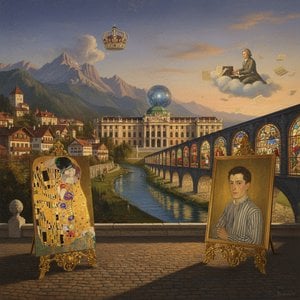
Otto Koloman Wagner (1841–1918): A Pioneer of Modernity
Otto Koloman Wagner, born in Vienna in 1841, stands as a pivotal figure bridging the gap between 19th-century historicism and the dawn of modern architecture. His journey wasn’t one of immediate revolution, but rather a gradual evolution—a thoughtful dismantling of established norms coupled with an unwavering commitment to functionality and honest expression. Initially steeped in classical training at the Vienna Polytechnic Institute and later refined at the Royal Academy of Architecture in Berlin, Wagner's early work reflected the prevailing academic styles. However, even within these traditional frameworks, seeds of innovation were sown. His studies under August Sicardsburg and Eduard von der Nüll instilled a crucial principle: architecture must possess a “rational expression” suited to its modern purpose—a concept that would become central to his life’s work. These formative years weren't merely about mastering technique; they were about questioning the very foundations of architectural thought, setting the stage for Wagner’s eventual break from convention. He began building a reputation through speculative ventures, designing apartment houses that subtly blended classical elements with emerging modernist ideas, financing these projects himself and demonstrating an entrepreneurial spirit alongside his artistic vision.
Early Training and Classical Influences
Wagner's formative years were deeply shaped by the intellectual currents of his time. Trained at the Vienna Polytechnic Institute and subsequently at the Royal Academy of Architecture in Berlin—institutions renowned for their adherence to classical ideals—he absorbed the lessons of giants like Schinkel and Mengelstädt. These educators championed the notion that architecture should strive for “rational expression,” prioritizing clarity, proportion, and structural integrity. This conviction would permeate Wagner’s entire oeuvre, informing his stylistic choices and guiding him toward a distinctive aesthetic that transcended mere ornamentation. His early architectural projects—primarily apartment buildings—demonstrated an astute understanding of classical principles while simultaneously experimenting with innovative spatial arrangements. Notably, he incorporated elements of neo-Renaissance into several residences, reflecting the broader revival of interest in Italian Renaissance art and architecture during this period. Wagner’s meticulous attention to detail and his unwavering dedication to craftsmanship underscored his belief that beauty could be achieved through disciplined execution—a cornerstone of his artistic philosophy.
The Vienna Secession: A Radical Departure
A transformative moment arrived in 1897 with Wagner’s participation in the founding of the Vienna Secession. This audacious collective of artists, architects, and designers rejected the conservative aesthetic conventions of Viennese society and sought liberation from academic dogma. Driven by a desire to forge a new artistic path—one unbound by historical imitation—the Secession championed experimentation, innovation, and stylistic freedom. Wagner’s involvement in this movement signaled a decisive shift away from his earlier preoccupation with classical forms and toward a more expressive style rooted in Art Nouveau principles. Influenced by artists like Gustav Klimt and Josef Maria Olbrich, Wagner embraced flowing lines, floral motifs, and intricate decorative patterns—elements that would become synonymous with the Secession’s distinctive aesthetic. The Secession's manifesto declared its intention to “break away from the shackles of tradition” and to pursue “a new artistic language,” reflecting a profound skepticism toward established artistic hierarchies.
Landmark Architectural Achievements: Functionality Meets Ornamentation
Wagner’s architectural legacy is cemented by a series of groundbreaking buildings that exemplify his masterful synthesis of functionality and ornamentation—characteristics that define his signature style. The Vienna Metro Stations, designed collaboratively with Josef Maria Olbrich and Koloman Moser, stand as monuments to Secessionist innovation. These stations are not merely conduits for transportation; they are immersive environments adorned with vibrant majolica tiles and stylized floral murals—a testament to Wagner’s conviction that architecture could elevate the everyday experience of urban life. The Majolica House (1906–1913), conceived as a residential complex, embodies this aesthetic vision perfectly. Its façade is covered in shimmering majolica tiles—a technique pioneered by Moser—creating an astonishing display of color and texture that defies conventional architectural conventions. Wagner’s meticulous attention to detail—from the sculptural ornamentation to the carefully calibrated proportions—underscores his belief that beauty could arise from a harmonious interplay between form and material. The Austrian Postal Savings Bank building (1894–1905) represents another pivotal achievement, showcasing Wagner’s embrace of geometric abstraction while retaining an undeniable sense of grandeur. Its austere exterior walls contrast sharply with the richly ornamented interior spaces—a deliberate strategy designed to convey a message of understated elegance and structural integrity.
A Lasting Influence: Shaping Modern Architecture
Otto Koloman Wagner’s contribution to architectural history extends far beyond his individual buildings. He championed the concept of “rational expression,” arguing that architecture must serve as a vehicle for conveying ideas—a principle that would profoundly influence subsequent generations of architects. His rejection of excessive ornamentation and his unwavering commitment to structural honesty paved the way for the emergence of modernist aesthetics—characterized by simplicity, geometric forms, and an emphasis on material qualities. Wagner’s legacy continues to inspire designers today who strive to create buildings that are both aesthetically compelling and functionally responsive to human needs. He remains a towering figure whose work exemplifies the transformative potential of artistic vision combined with intellectual rigor—a true pioneer who helped usher in the dawn of a new era in architectural thought.