БЕЗКОШТОВНА КОНСУЛЬТАЦІЯ З МИСТЕЦТВА


x
Для кожного питання є лише одна правильна відповідь.
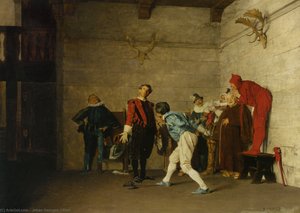
Jehan Georges Vibert (1840 – 1902) stands as a singular figure in the landscape of late nineteenth-century French painting, distinguished not by grand narratives or monumental ambition but by a meticulous observation of everyday life—particularly within the confines of the Church and its interactions with the burgeoning middle class. While overshadowed by luminaries like Géricault and Bouguereau, Vibert carved out a distinctive reputation for himself through witty, often ironic depictions imbued with subtle social commentary that resonated deeply with an audience increasingly questioning established authority.
Born in Paris to engraver Théodore Vibert and grandson of the renowned rose breeder Jean-Pierre Vibert, Vibert’s artistic inclinations emerged early. Unlike many of his contemporaries who pursued formal training in classical art, he prioritized painting over engraving—a decision that would prove pivotal to his stylistic evolution. He began his studies under the tutelage of Félix-Joseph Barrias and subsequently enrolled at the École des Beaux-Arts when he was sixteen, where he honed his technique under François-Édouard Picot’s guidance.
His debut at the Salon of 1863 with *La Sieste* (The Siesta) and *Repentir* signaled a turning point. Vibert's initial efforts leaned toward mythological subjects, mirroring the prevailing tastes of the Salon system—a stylistic choice that garnered critical acclaim for its technical prowess but also drew scrutiny regarding originality. However, recognizing his true talent lay in capturing the nuances of contemporary life, he swiftly abandoned grand historical canvases for genre scenes.
The Franco-Prussian War profoundly impacted Vibert’s artistic trajectory. Serving as a sharpshooter during the conflict and sustaining injuries at Malmaison in October 1870 solidified his commitment to civic duty and earned him the Légion d’honneur—a testament to his bravery and sacrifice.
Vibert's stylistic hallmark was his masterful command of color and light, achieved through painstaking detail and compositional precision. He possessed an exceptional ability to render interiors with uncanny realism, populated by figures that conveyed a palpable sense of authenticity. His signature red hue—dubbed “Vibert’s Red”—became synonymous with his style, particularly in depictions of cardinals and ecclesiastical officials.
Beyond painting, Vibert engaged in diverse artistic pursuits, experimenting with varnishes and brushes, crafting satirical plays inspired by Molière, and even delving into architectural design. His multifaceted creativity underscored the breadth of his talent and his unwavering passion for art—a dedication that would ultimately shape his distinctive visual language.
His prolific output included numerous genre paintings exploring themes of morality and social critique. Vibert’s satirical works challenged conventional religious dogma, reflecting a broader societal shift toward skepticism and questioning established institutions. His enduring legacy resides not in revolutionary artistic innovation but in the astute observation and skillful representation of his era—a testament to Vibert's ability to capture both the splendor and contradictions inherent in French society during its transformative period.
Explore the captivating world of Eugène Lami, a pivotal 19th-century French painter. Discover his eclectic style blending Romanticism & Academic traditions in history, fashion, and literary illustrations. Learn about his legacy today!

Explore the Barbizon School's pivotal role in 19th-century French painting. Discover how these artists revolutionized landscape art with their commitment to Realism and a profound connection to nature. Learn about key figures like Rousseau, Millet & Corot.

Explore the world of Academic Art! Discover its history, key artists like Ingres & Bouguereau, defining techniques, and lasting influence on 19th-century painting. Learn about the Salon system and its legacy.


Будьте в курсі останніх новин зі світу мистецтва, ексклюзивних пропозицій та ідей для декорування.
Розкажіть нам про свій проєкт, і наші експерти з мистецтва підготують для вас 3 персоналізовані пропозиції щодо творів мистецтва.
Дозвольте нам підібрати 3 варіанти спеціально для вас — безкоштовно!