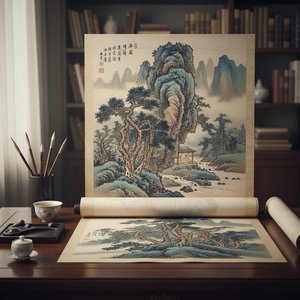
Yun Shou-ping (nantian): A Master of Blossoms and Breath
Born in Wujiang, China, in 1633 – a time of profound upheaval as the Ming Dynasty crumbled – Yun Shou-ping, also known as Nantian, emerged from a turbulent era to become one of the most celebrated figures of the early Qing dynasty. More than simply a painter, he was a poet and calligrapher, embodying the ideals of the ‘Six Masters’ alongside Wang Hui, Wu Li, and the four Wangs – a group that redefined Chinese art during this pivotal period. His legacy isn't merely found in museums; it resonates within the very spirit of Chinese literati painting, emphasizing individual expression and a deep connection to nature.
Yun Shou-ping’s early life was marked by displacement and adaptation. Following the collapse of the Ming Dynasty, his family fled, eventually finding refuge with a Manchu noble family before returning to his father. This journey instilled in him a profound appreciation for both Chinese traditions and the broader cultural landscape. He initially pursued a path toward civil service but ultimately dedicated himself entirely to art, a decision that would shape not only his own life but also the trajectory of Qing dynasty painting.
The Language of Flowers: Artistic Style and Technique
Yun Shou-ping’s artistic style is immediately recognizable – a bold fusion of elegance and dynamism. He was renowned for his masterful depictions of flowers, bamboos, animals, and insects, often rendered with an almost palpable sense of life. His paintings weren't simply representations; they were attempts to capture the very essence of these subjects, their beauty, and their inherent spirit. A key element of his technique was the ‘boneless’ or ‘mogu’ method – a style characterized by washes of color rather than precise outlines, creating an ethereal quality reminiscent of clouds or water.
His use of color is particularly striking. He moved away from the muted tones favored in earlier styles, embracing vibrant reds and purples that were considered somewhat extravagant at the time. This daring choice reflected his willingness to challenge convention and express himself with unrestrained passion. He drew inspiration from the 11th-century artist Xu Chongsi, a master of the mogu method, and further refined this technique, passing it on to his daughter, Yun Bing. His compositions often feature landscapes interwoven with figures or still lifes, creating a harmonious balance between the natural world and human experience.
Notable Works and Influences
While many of Yun Shou-ping’s paintings are scattered across private collections and museums worldwide – including examples at the Cleveland Museum of Art – his ‘Dead Tree’ with bamboo issuing from a rock stands as a particularly compelling example of his style. The painting exemplifies his ability to capture both the physical form and the emotional resonance of nature, utilizing bold brushstrokes and vibrant colors to create a truly captivating image.
His work is often compared to that of Zhao Yun, another prominent figure in Chinese art history, reflecting a shared interest in landscape painting and the use of mineral pigments. Yun Shou-ping’s artistic journey was also profoundly influenced by Wang Hui, a close friend and fellow member of the ‘Six Masters.’ Their collaborative spirit helped shape the aesthetic direction of Qing dynasty painting, emphasizing both individual expression and a deep respect for tradition.
Legacy and Enduring Significance
Yun Shou-ping’s influence extends far beyond his own lifetime. He is considered one of the key figures in the Bunjinga art movement, which championed individual expression and personal interpretation over strict adherence to technical rules. His work continues to inspire artists today, particularly those studying at the National Taiwan Normal University's Mandarin Training Center – an institution that plays a vital role in preserving and promoting Chinese art and culture.
Yun Shou-ping’s paintings are not merely beautiful objects; they are windows into a complex and fascinating period of Chinese history. They offer a glimpse into the mind of an artist who dared to challenge convention, embrace innovation, and ultimately leave behind a legacy that continues to resonate with audiences around the world. His bold brushstrokes and vibrant colors remain a testament to his artistic genius and enduring significance within the rich tapestry of Chinese art.