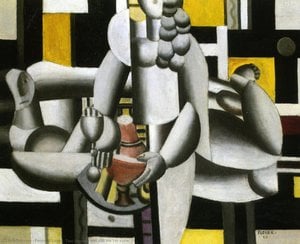
Фернан Леже, 1881 – 1955

100 найвідоміших картин Фернан Леже

Картина, яка принесла Фернан Леже славу, — це Місто (1919). Механік (1920) та Трьох жінок (1921) не поступаються їм у серцях колекціонерів та відвідувачів музеїв. З 834 робіт Фернан Леже у нашому каталозі ці 100 є найбільш шанованими; кожна з них представлена з датою створення, назвою музею та описом її унікальності.

Рейтинг сформовано на основі нашого показника популярності, що поєднує кількість пошукових запитів, переглядів та замовлень для кожної роботи. Оновлено Жовтень 2026. Кожен шедевр на цій сторінці можна замовити як художню олійну репродукцію ручної роботи музейного рівня або як високоякісний арт-принт у будь-якому обраному вами розмірі.

Портрет Фернан Леже
Фернан Леже · 1881 – 1955
Народився · помер
1881 – 1955, Аржантан
Рух
Кубізм
Роботи в нашому каталозі
834
Найвідоміші
Місто (1919)
Найбільше робіт у
Музей сучасного мистецтва (MoMA)

Фернан Леже: десять шедеврів

Місто (1919) роботи Фернан Леже
1

Місто

1919 · Олія на полотні

“Місто” Фернанда Леже, створене у 1919 році, – це не просто картина, а справжній портал у світ початку XX століття. Це монументальне полотно, що виходить за межі звичного зображення урбаністичного пейзажу, перетворюючись на динамічну та захопливу інтерпретацію сучасності. Леже, геніальний художник-кубіст, розкладає місто на його фундаментальні геометричні складові – циліндри, прямокутники та викривлені лінії, створюючи відчуття ритму та енергії, що пронизують сучасне життя. Він не просто копіює реальність, а відкриває…

Механік (1920) роботи Фернан Леже
2

Механік

1920 · Олія на полотні · Національна галерея Канади, Оттава

У 1920 році, у розквіті свого новаторського мистецтва, художник Фернанд Лєґер створив полотно “The Mechanic” – твір, що не просто зображує механіка, а й втілює дух епохи, наповнений динамікою індустріалізації та експериментами з формою. Це не просто портрет; це візуальний квинтет, який поєднує в собі елементи кубізму, ар-деко та глибоке розуміння механічного світу, що швидко змінював світ того часу. Лєґер, відійшовши від традиційних методів зображення, прагнув зафіксувати не лише зовнішній…

Трьох жінок (1921) роботи Фернан Леже
3

Трьох жінок

1921 · Олія на полотні · Музей сучасного мистецтва (MoMA), Нью-Йорк

Вступ до «Трьох Жінок» Фернанда Лежера Фернанде Лежера «Трьох Жінок» (1921) – шедевр сучасного мистецтва, який бездоганно поєднує впливи кубізму та ар деко. Цей яскравий і динамічний композиційний вираз захоплює суть раннього XX століття, роблячи його приголомшливою доповненням будь-якої сучасної художньої колекції або елегантного інтер'єру. Тема та Композиція Картина зображує трьох жіночих фігур у розслаблених заняттях, розташованих у трикутній формі, що створює відчуття балансу та гармонії. Одна фігура відпочиває на…

Нюди в лісі (1910) роботи Фернан Леже
4

Нюди в лісі

1910 · Олія на полотні · Музей Кролер-Мюллер, Оттерло

Картина Фернана Леже «Нюди в лісі» (1909-1910) є ключовим твором, що ознаменував вирішальний етап у розвитку кубізму. Це не просто зображення постатей серед дерев; це смілива деконструкція форми та перспективи, яка продовжує захоплювати глядачів понад сто років потому. Цей живопис присвячений не тому, *що* саме представлено, а тому, *як* це зроблено — радикальний підхід, який переосмислив сучасне мистецтво.

Величний парад (1954) роботи Фернан Леже
5

Величний парад

1954 · Олія на полотні

У світі мистецтва, де часто домінує спокій і роздуми, “The Great Parade” Фернанда Леже – це вибух енергії, яскравий та дихаючий образ сучасності. Створений у 1954 році, цей великий полотно не просто зображує парад; воно передає відчуття руху, хаосу та захоплення, що характеризували перехідний період між двома світовими війнами. Леже, відомий своїм новаторським підходом до мистецтва, з’єднав у “The Great Parade” елементи кубізму, футуризму та навіть трохи коміксів, створюючи унікальний…

Весілля роботи Фернан Леже
6

Весілля

Олія на полотні

Сюжет та композиція Цей захопливий витвір мистецтва представляє фрагментоване, абстрактне зображення людської фігури, ймовірно, жінки, що занурена у складну гру геометричних фігур та абстрактних форм. Композиція запрошує глядача одночасно досліджувати кілька перспектив, що є характерною ознакою кубістичного впливу. Фігура ніби перебуває в інтимний або споглядальний момент, оточена хаотичним, але водночас гармонійним ансамблем кутастих форм, які викликають відчуття внутрішньої рефлексії та емоційної глибини. Багатошарове розташування форм натякає на розповідь, багату на…

Сніданок (1921) роботи Фернан Леже
7

Сніданок

1921 · Олія на полотні · Музей сучасного мистецтва (MoMA), Нью-Йорк

У яскравому ландшафті початку XX століття модернізму мало які твори здатні так вражаюче передати ритмічний пульс епохи змін, як "Сніданок" Фернана Леже. Написаний у 1921 році, цей шедевр слугує вікном у світ, де побутове та індустріальне почали зливатися в єдине динамічне бачення. Сцена представляє групу з трьох жінок, що зібралися навколо обіднього столу, проте вони далекі від традиційних постатей у тихому портреті. Натомість, крізь революційну призму Леже акт спільного ранкового…

Жінка з букетом квітів (1920) роботи Фернан Леже
8

Жінка з букетом квітів

1920 · Олія на полотні · Staatsgalerie Stuttgart, Штутгарт

З сітки важких чорних ліній постає жіночий силует, чия форма вибудована з циліндрів та сфер. Вона тримає букет, проте квіти тут — не м'які пелюстки, а яскраві фрагменти червоного, жовтого та синього кольорів. Кожна фігура здається вагомою, наче витесаною зі сталі або відлитою з заліза. Щільні контури окреслюють тіло, що рухається з ритмічною точністю машини. Тут немає тіней, що пом'якшують краї; лише пласкі кольорові площини, що сходяться в гострих архітектурних…

Композиція в синьому роботи Фернан Леже
9

Композиція в синьому

Олія на полотні · Art Institute of Chicago, Чикаго

“Композиція в синьому” Фернана Леже – это воплощение современного искусства, демонстрирующее уникальное сочетание кубизма и футуризма. Картина представляет собой поразительную композицию, доминирующую оттенки синего цвета, с центральной фигурой – словно женщина или человекоподобная форма – выполненной в различных тонах этого цвета. Эта фигура частично скрыта большим синим головным убором, создавая загадочный и слегка механический вид. В работе используются геометрические формы, такие как круги, прямоугольники и линии, характерные для стиля Леже,…

Міст (1923) роботи Фернан Леже
10

Міст

1923 · Олія на полотні · Музей Тиссена-Борнмізеса, Мадрид

Підійдіть ближче, щоб побачити, як саме структурований цей простір. У полотні «Міст», створеному у 1923 році, немає єдиної перспективи, на якій міг би відпочити погляд. Натомість ми бачимо композицію, розділену на чіткі горизонтальні та вертикальні зони, що натякають на роздроблену архітектурну реальність. Дві масивні, смарагдово-зелені колони стають опорою у верхній частині середнього плану, виступаючи структурними стовпами в цій архітектурній побудові. За ними розгортається фон через пласкі площини червоного, чорного та…

Більше шедеврів Фернан Леже, від 11 до 100

Натюрморт із лампою (Still Life with Lamp) (1914) роботи Фернан Леже
#13

Натюрморт із лампою (Still Life with Lamp)

1914 · Museo Nacional Centro de Arte Reina Sofía

Геометрія стільниці Лампа, чаша з фруктами та кілька чашок спочивають на поверхні. У 1914 році ці предмети втрачають свої м'які контури, перетворюючись на циліндри та конуси. Фернан Леже…

Прикрасьте свій дім →
Місто (Фрагмент, Третій стан) (1919) роботи Фернан Леже
#14

Місто (Фрагмент, Третій стан)

1919 · Філадельфійський музей мистецтв

Пульс сталі та первинного кольору Полотно вібрує ритмічним металевим гулом міського пейзажу, що перебуває в русі. Геометричні форми — циліндри, прямокутники та гострі дуги — накладаються одна на…

Замовити копію ручної роботи →
Reading (1924) роботи Фернан Леже
#15

Reading

1924

In the quietude of an ambiguous interior, two figures sit side-by-side, lost in the profound intimacy of shared silence and individual discovery. Fernand Léger’s 1924 masterpiece, Reading, is…

Замовити репродукцію →
Танець (1942) роботи Фернан Леже
#16

Танець

1942

Ритмічне свято форми та кольору Танець Фернана Леже — це набагато більше, ніж просто зображення руху; це жвава, пульсуюча симфонія кольору та геометрії, що втілює саму суть людської…

Замовити копію ручної роботи →
Диски (1910) роботи Фернан Леже
#17

Диски

1910 · Музей округу Лос-Анджелес

Серія перекриваючих одне одного кіл дрейфує по полотну, наче важкі, виписані фарбою сигнали. Ці диски, нанесені густими шарами олії, перетинаються з гострими прямокутниками та діагональними смугами кольору. Глибокий…

Замовити копію ручної роботи →
Dance (1929) роботи Фернан Леже
#22

Dance

1929

Two nude female figures move through a landscape of interlocking shapes, their bodies caught in a moment of dynamic instability. The scene unfolds with a flattened perspective, where…

Замовити репродукцію →
Жінка з вазою (1924) роботи Фернан Леже
#23

Жінка з вазою

1924 · Statens Museum For Kunst

У цій картині 1924 року, виконаній олією на полотні, ми зустрічаємо постать, яка здається надзвичайно солідною, майже скульптурною у своїй конструкції. Жінка зображена анфас, її форма визначена масивними,…

Замовити копію ручної роботи →
Квітка, що йде (La fleur qui marche) (1952) роботи Фернан Леже
#25

Квітка, що йде (La fleur qui marche)

1952 · Kimbell Art Museum

«Квітка, що йде» Фернана Леже: симфонія кольору та форми на тлі індустріального пейзажу Керамічна скульптура «Квітка, що йде (La fleur qui marche)» Фернана Леже, завершена у 1952 році,…

Поршні II (1942) роботи Фернан Леже
#26

Поршні II

1942

Симфонія форми та фрагментації ідентичності У самому серці 1942 року, серед глибоких тіней, відкинутих Другою світовою війною, Фернан Леже представив Поршні II — твір, що є набагато більшим,…

Замовити копію ручної роботи →
Woman with Mirror (1920) роботи Фернан Леже
#27

Woman with Mirror

1920 · Музей сучасного мистецтва міста Парижа

The painting Woman with Mirror, created in 1920, presents a configuration of geometric shapes that deconstruct the human figure and its surroundings. The composition relies on an arrangement…

Замовити репродукцію →
The City (1919) роботи Фернан Леже
#32

The City

1919 · Музей сучасного мистецтва (MoMA)

Step closer and observe how the canvas seems to move even when you remain still. In 1919, Fernand Léger captured something far more visceral than a mere urban…

Прикрасьте свій дім →
Стрибуни (1943) роботи Фернан Леже
#42

Стрибуни

1943 · Harvard Art Museums

Підійдіть ближче, щоб побачити, як постаті виринають із білого простору. У роботі «Стрибуни» ми зустрічаємо групу людей, застиглих у повітрі; вони виконують акробатичні маневри, що натякають на стилізоване…

Замовити копію ручної роботи →
Жінка з котом (1921) роботи Фернан Леже
#48

Жінка з котом

1921 · Гамбургська художня галерея

Жінка сидить, її постать вибудована зі сфер та трубок. Вона тримає на колінах чорного кота — темну масу, що контрастує з яскраво-жовтими та глибокими синіми площинами її тіла.…

Прикрасьте свій дім →
Будівельні риштування (Перший стан) (1919) роботи Фернан Леже
#49

Будівельні риштування (Перший стан)

1919 · Філадельфійський музей мистецтв

Металевий циліндр розрізає плаский колірний пласт. У 1919 році Париж був містом реконструкції, а площа Кліші була оповита скелетною структурою індустріальної епохи. Ця картина фіксує саме той момент…

Замовити копію ручної роботи →
Composition (Definitive State) (1925) роботи Фернан Леже
#52

Composition (Definitive State)

1925

A large, dark reddish-brown oval anchors the center of the canvas, acting as a heavy weight amidst a sea of shifting planes. Around this central anchor, thick black…

Велосипед (1930) роботи Фернан Леже
#53

Велосипед

1930 · Галерея Нового Південного Уельсу

У центрі композиції білий багатокутник утримує глибоку синю, текучу форму, що нагадує оливкову пляму. У цьому синьому просторі тонкі білі лінії викреслюють скелетні, колесоподібні структури, що натякають на…

Замовити репродукцію →
Натюрморт (1928) роботи Фернан Леже
#54

Натюрморт

1928 · Art Institute of Chicago

Підійдіть ближче і спостерігайте, як знайомі елементи настільного натюрморту трансформуються крізь призму структурної точності. У цій роботі 1928 року художник відходить від традиційного зображення, щоб прийняти мову циліндрів,…

Замовити репродукцію →
Still Life (1927) роботи Фернан Леже
#59

Still Life

1927 · Національний музей мистецтва, архітектури та дизайну

Step closer to observe how the familiar objects on this table have been transformed. In this 1927 composition, we find a quiet arrangement that rejects the soft edges…

Замовити репродукцію →
Three Characters (1924) роботи Фернан Леже
#64

Three Characters

1924

A Symphony of Form and Feeling: Exploring Fernand Léger’s “Three Characters” Fernand Léger's 1924 painting, *“Three Characters,”* is a pivotal work exemplifying his distinctive contribution to Cubism –…

Прикрасьте свій дім →
Contrast of Forms (1913) роботи Фернан Леже
#67

Contrast of Forms

1913

A fragmented landscape emerges through a complex vocabulary of cones, cylinders, cubes, and planes. The composition deconstructs reality into overlapping geometric shapes that intersect across a shallow, flattened…

Прикрасьте свій дім →
Натюрморт (1922) роботи Фернан Леже
#68

Натюрморт

1922

Симфонія форми та індустріальної грації 1922 рік став епохою трансформацій у паризькому авангарді, і Натюрморт Фернана Леже постає глибоким свідченням цього періоду радикального переосмислення. Відмовившись від миттєвих, залитих…

Замовити репродукцію →
Mural Painting (1920) роботи Фернан Леже
#69

Mural Painting

1920 · Музей Соломона Р. Гуггенхайма

To stand before this 1924 canvas is to encounter the very pulse of a changing era. There is a certain structural honesty in how the composition unfolds, utilizing…

Прикрасьте свій дім →
Smoke (1912) роботи Фернан Леже
#70

Smoke

1912

Created in 1912 by Fernand Léger, Smoke is an oil on canvas painting that belongs to the Cubism style. This cityscape features various buildings and structures characterized by…

Замовити репродукцію →
Woman with a Book (1923) роботи Фернан Леже
#77

Woman with a Book

1923 · Музей сучасного мистецтва (MoMA)

Fernand Léger: A Pioneer of Mechanistic Cubism Fernand Léger stands as one of the most distinctive figures in twentieth-century art, a painter who relentlessly pursued his own vision…

Прикрасьте свій дім →
Sacred Heart of Audincourt (1951) роботи Фернан Леже
#78

Sacred Heart of Audincourt

1951

In the quiet, hallowed atmosphere of the Saint-Joseph Chapel in Audincourt, France, lies a masterpiece that defies the traditional boundaries between the sacred and the industrial. Fernand Léger’s…

The Sacred Heart of audincourt (1950) роботи Фернан Леже
#86

The Sacred Heart of audincourt

1950

In the quiet, hallowed spaces of Audincourt, France, there exists a window that does not merely permit light to pass through, but rather transforms it into a rhythmic…

The Sacred Heart of audincourt (1950) роботи Фернан Леже
#87

The Sacred Heart of audincourt

1950

In the quiet, hallowed atmosphere of Audincourt, France, light does not merely illuminate; it transforms. Fernand Léger’s The Sacred Heart of Audincourt, completed around 1950-1951, stands as a…

Sacred Heart of Audincourt (1951) роботи Фернан Леже
#88

Sacred Heart of Audincourt

1951

In the quiet, hallowed atmosphere of post-war Europe, Fernand Léger’s "Sacred Heart of Audincourt" emerged not merely as a religious ornament, but as a profound philosophical manifesto. Completed…

The Sacred Heart of audincourt (1950) роботи Фернан Леже
#95

The Sacred Heart of audincourt

1950

In the quiet aftermath of a world reshaped by conflict, Fernand Léger’s "The Sacred Heart of Audincourt" emerges as a luminous testament to resilience and renewal. Completed around…

Red Pot (1926) роботи Фернан Леже
#99

Red Pot

1926

In the vibrant landscape of early twentieth-century modernism, few works capture the rhythmic pulse of the machine age as elegantly as Fernand Léger’s Red Pot. Created in 1926,…

Прикрасьте свій дім →

Картини Фернан Леже за періодами

Теми, які найчастіше писав Фернан Леже

Чотири сюжети, які найчастіше зустрічаються серед цих шедеврів, з найкращими прикладами кожного з них.

Де можна побачити картини Фернан Леже

8 музеїв, у яких зберігається найбільша кількість картин із цього списку.

Музеї Місто Твори Фернан Леже Картини з цього списку
Музей сучасного мистецтва (MoMA), Нью-ЙоркМузей сучасного мистецтва (MoMA) Нью-Йорк 14 Трьох жінок, Сніданок, The City
Філадельфійський музей мистецтв, ФіладельфіяФіладельфійський музей мистецтв Філадельфія 8 Місто (Фрагмент, Третій стан), Contrast of Forms, Будівельні риштування (Перший стан)
Art Institute of Chicago, ЧикагоArt Institute of Chicago Чикаго 6 Композиція в синьому, Reclining Woman, Натюрморт
Метрополітен-музей, Нью-ЙоркМетрополітен-музей Нью-Йорк 6 The Builders, Mechanical Elements
Музей сучасного мистецтва міста Парижа, ПарижМузей сучасного мистецтва міста Парижа Париж 5 The Man with the Pipe, Woman with Mirror
Музей Кролер-Мюллер, ОттерлоМузей Кролер-Мюллер Оттерло 4 Нюди в лісі, Mechanical Element
Музей Соломона Р. Гуггенхайма, Нью-ЙоркМузей Соломона Р. Гуггенхайма Нью-Йорк 4 Characters in the City, Mural Painting
Музей Тиссена-Борнмізеса, МадридМузей Тиссена-Борнмізеса Мадрид 3 Міст

Фернан Леже, десятиліття за десятиліттям: визначальна картина кожного етапу

  1. 1910s
    Місто (1919) роботи Фернан Леже
    № 1 із 100

    Місто

    Вік 29 – 38 років

    “Місто” Фернанда Леже, створене у 1919 році, – це не просто картина, а справжній портал у світ початку XX століття. Це монументальне полотно, що виходить за межі звичного…

  2. 1920s
    Механік (1920) роботи Фернан Леже
    № 2 із 100

    Механік

    Вік 39 – 48 років · Національна галерея Канади

    У 1920 році, у розквіті свого новаторського мистецтва, художник Фернанд Лєґер створив полотно “The Mechanic” – твір, що не просто зображує механіка, а й втілює дух епохи, наповнений…

  3. 1930s
    The Bather (1932) роботи Фернан Леже
    Місце 18 з 100

    The Bather

    Вік 49 – 58 років

    In the quiet intersection of Surrealist dreamscapes and the rigid precision of Cubism lies Fernand Léger’s 1932 masterpiece, The Bather. This is not merely a painting of a…

  4. 1940s
    Танець (1942) роботи Фернан Леже
    № 16 із 100

    Танець

    Вік 59 – 68 років

    Ритмічне свято форми та кольору Танець Фернана Леже — це набагато більше, ніж просто зображення руху; це жвава, пульсуюча симфонія кольору та геометрії, що втілює саму суть людської…

  5. 1950s
    Величний парад (1954) роботи Фернан Леже
    № 5 із 100

    Величний парад

    Вік 69 – 74 років

    У світі мистецтва, де часто домінує спокій і роздуми, “The Great Parade” Фернанда Леже – це вибух енергії, яскравий та дихаючий образ сучасності. Створений у 1954 році, цей…

Шедеври Фернан Леже: запитання та відповіді

Яка картина є найвідомішою у Фернан Леже?Показати відповідь

Місто (1919). Далі йдуть Механік (1920) та Трьох жінок (1921).

Скільки років було Фернан Леже, коли він/вона створював(ла) Місто?Показати відповідь

38 років: Місто датована 1919 роком, а Фернан Леже народився(-лася) у 1881.

Які десять найкращих картин Фернан Леже?Показати відповідь

Місто, Механік, Трьох жінок, Нюди в лісі, Величний парад, Весілля, Сніданок, Жінка з букетом квітів, Композиція в синьому та Міст. У рейтингу вище вказано рік створення та музей для кожної картини.

Скільки робіт написав Фернан Леже?Показати відповідь

У нашому каталозі представлено 834 робіт Фернан Леже, датованих періодом з 1910 по 1954.

У яких музеях можна побачити шедеври Фернан Леже?Показати відповідь

Більшість із них знаходяться в Музей сучасного мистецтва (MoMA) (Нью-Йорк), Філадельфійський музей мистецтв (Філадельфія) та Art Institute of Chicago (Чикаго). У таблиці вище перелічені музеї по черзі.

Коли Фернан Леже створив свої шедеври?Показати відповідь

У 1920s: 36 із 100 робіт на цій сторінці датуються цим часом, серед них Механік.

Які перша та остання відомі картини Фернан Леже?Показати відповідь

Найдавніша робота на цій сторінці датована Нюди в лісі (1910), найновіша — Величний парад (1954).

Якими були улюблені сюжети Фернан Леже?Показати відповідь

Geometric shapes (29), Geometric forms (16) та Mechanical forms (9), серед 100 робіт на цій сторінці.

Яку техніку віддавав перевагу Фернан Леже?Показати відповідь

Oil On Canvas: 39 із 100 робіт на цій сторінці.

До якого художнього напряму належить Фернан Леже?Показати відповідь

Кубізм, як демонструють картини на цій сторінці.

Які шедеври Фернан Леже експонуються в Музей сучасного мистецтва (MoMA)?Показати відповідь

Трьох жінок, Сніданок та The City — це одні з 5 робіт на цій сторінці, що належать Музей сучасного мистецтва (MoMA), Нью-Йорк.

Чи можу я придбати репродукцію шедевра Фернан Леже?Показати відповідь

Так. Кожну картину на цій сторінці можна замовити як музейну репродукцію, написану олією вручну, або як художній принт у будь-якому обраному вами розмірі — безпосередньо зі сторінки самої картини.

Життя Фернан Леже

The Life of Fernand Léger

The story of Fernand Léger begins in the village of Argentan, located in the Orne region of Lower Normandy. He arrived into this world on February 4, 1881, as an only son. His early years were shaped by the quietude of the French countryside and the presence of his mother, Marie-Adèle Daunou. His father, a man who made his living as a cattle dealer, passed away when Fernand was still a young boy, leaving the child to be raised by his mother in a household marked by her piety and a certain self-effacing nature.

This upbringing in the rural landscapes of Normandy provided a grounding contrast to the life he would eventually lead in the bustling centers of French culture. While his roots were tied to the earth and the physicality of agricultural life, his spirit was drawn toward the complexities of the modern age. He would eventually expand his reach far beyond the borders of Argentan, becoming a man of many disciplines. He did not limit himself to the canvas, but instead sought to express his vision through sculpture and the moving images of film.

His life was a constant movement between the organic textures of his youth and the structured, mechanical rhythms of the cities. This duality defined his very existence, as he navigated the shifts of a changing century. His path was never a simple one, marked by the tension between the traditional world of his childhood and the rapid, industrial pulse of the future he would eventually help to define through his art.

Early Life, Family and Training

The roots of his vision were planted in the rural landscapes of Argentan, in the Orne region of Lower Normandy, France. Born into a world of cattle farming, his early years were shaped by the physicality of the land and the steady rhythms of agricultural life. This grounding in the tangible, working world would remain a quiet presence beneath the surface of his later, more complex explorations. He was an only son, raised by a mother who was both pious and self-effacing, and his path was initially steered toward the structured discipline of architecture. From 1897 to 1899, he dedicated himself to this technical craft, learning the logic of space and the necessity of precise drafting.

By 1900, the pull of the city became too strong to ignore, and he moved to Paris. He supported himself by working as an architectural draftsman, a role that required a keen eye for line and proportion. While his formal training in architecture provided a foundation of structural understanding, his heart began to drift toward the canvas. He sought entry into the prestigious École des Beaux-Arts, but the institution did not grant him the official status of an enrolled student. Undeterred, he attended the school as a non-enrolled student, absorbing the lessons of the masters while navigating the fringes of the academic establishment. This period of study, though sometimes described as a time of searching, was essential in refining the technical skill he would eventually use to dismantle and rebuild the world in his own image.

The Influence of Cézanne and Cubism

A profound shift occurred in 1907 when the artist encountered the retrospective of Cézanne at the Salon d'Automne. This encounter acted as a catalyst, pulling him away from the soft impressions of his youth and toward a more structural way of seeing. He began to look past the surface of things, seeking instead the underlying geometry that defines the world. By 1909, his presence in the creative circles of Paris grew as he met figures such as Alexander Archipenko, Jacques Lipchitz, Marc Chagall, and Robert Delaunay. These encounters were not merely social; they were collisions of new ideas that helped shape the direction of his developing vision.

As the years progressed, he found himself moving within the orbit of the Puteaux Group, a circle of artists also known as the Section d'Or. Alongside Jean Metzinger and Henri Le Fauconnier, he explored the mathematical and structural possibilities of this new language. He was not content to simply follow the paths laid by others, but instead sought to find his own way through the fractured planes and overlapping forms that defined the era. This period of intense experimentation led to his first major exhibition at the Salon des indépendants in 1911, where he presented Nudes in the Forest.

War and the Mechanical Period

The chaos of the Great War pulled the artist away from the studios of Paris and into the harsh realities of the front. From 1914 to 1917, he served in the French Army, spending two grueling years in the Argonne. The conflict was not merely a backdrop to his life but a transformative force that altered his very perception of form. In 1916, a mustard gas attack nearly claimed his life, leaving him to recover while the world around him was being reshaped by the sheer power of industrial destruction. Even during a brief furlough in that same year, he found himself compelled to paint, producing Soldier with a Pipe. This work captured a sense of the new reality, where the human figure began to take on the qualities of the machines that dominated the battlefield.

By 1917, a distinct shift had taken hold in his creative spirit, marking the beginning of what would be called his mechanical period. He found a strange, rhythmic beauty in the tools and technology of modern warfare and industry. The sleek, tubular shapes and the precision of mechanical parts became his new visual language. He did not see these objects as cold or impersonal; instead, he embraced their strength and their ability to organize the chaos of modern existence. The war had stripped away the soft edges of his earlier work, replacing them with a hard-edged, structural clarity that mirrored the steel and pistons of a changing age.

Technique and Style

His brush moved with a rhythmic, almost industrial precision, seeking to capture the pulse of a changing era. He moved away from the soft, blended shadows of the past, choosing instead to build his compositions through a language of robust, geometric strength. This led to the development of a personal form of Cubism that critics identified as "Tubism." In this style, the world was reimagined through tubular, conical, and cubed forms, creating a sense of volume that felt both solid and dynamic. He did not merely paint objects; he sought to find their essential, structural logic.

The colors he chose were as assertive as the shapes they filled. He favored a palette dominated by primary colors, often punctuated by stark black and white, which helped to define the sharp boundaries of his subjects. Rather than relying on traditional illusionism, he applied paint in bold, flattened planes of color. He often used a thick impasto, a technique that emphasized the physical presence of the medium on the canvas. This textural approach ensured that his work felt grounded and material, mirroring the very machines and urban structures he so admired. His figures often took on sleek, mechanical-looking shapes, blurring the line between the organic human form and the engineered precision of the modern age.

Later Years and Death

The shifting tides of global conflict eventually pulled the artist away from his Parisian circles and across the Atlantic. Between 1940 and 1945, he lived in the United States, a period that offered a different perspective on the modern world he had so long sought to translate onto canvas. This time abroad provided a pause in his long evolution, a moment of transition before his eventual return to the soil of France.

Upon returning to his homeland, his personal life saw a significant change. In February 1952, he married Nadia Khodasevich. This union marked a final chapter in his life, one lived amidst the continued production of his diverse works, from large-scale murals to delicate stained-glass windows. Even as he aged, his recognition remained steady on the international stage. In 1955, he won the Grand Prize at the São Paulo Bienal, a high honor that arrived in the same year as his passing. He died on August 17, 1955, in Gif-sur-Yvette, France.

Legacy and Influence

Léger left a mark that reached far beyond the avant-garde circles of his own time. By bridging the gap between abstract art and figurative representation, he offered a way for artists to engage with the modern world without abandoning the human subject entirely. His approach allowed for a dialogue between the structural logic of geometry and the recognizable presence of people and objects. This ability to find a middle ground between the purely conceptual and the tangible helped shape the direction of much of the art that followed.

His bold simplification of form and his fascination with the aesthetics of mass production acted as a forerunner to the pop art movement. He saw a certain beauty in the repetitive, functional nature of the machine age, a perspective that would later resonate with a new generation of creators. Artists such as Roy Lichtenstein and Andy Warhol drew a clear line from his experiments with bold outlines and mechanical imagery to their own explorations of popular culture. He helped prepare the visual language for an era that would eventually celebrate the very industrial and commercial elements he had once sought to translate onto canvas.

Where to See the Works Today

To encounter the physical presence of his vision, one might travel to the south of France, specifically to Biot in the Alpes-Maritimes. Here, the Musée national Fernand Léger resides, a place dedicated entirely to the study and preservation of his creative output. The museum occupies the Mas Saint-André, a villa that once belonged to the artist himself. Within these walls and the surrounding gardens, his polychrome ceramic sculptures find their intended setting, allowing the viewer to see how his forms interact with the light and space of the Mediterranean landscape.

Beyond this specialized sanctuary, his canvases and sculptures are held within various significant institutions. The Musée d'Art et d'Histoire in France maintains a collection of his works, ensuring his presence in the broader narrative of French art. These holdings allow for a continued study of how he translated the energy of the machine age into static, yet pulsing, visual forms. Travelers seeking his specific aesthetic can find his traces in several major collections, including:

His influence also lingers in the works of others, but the primary way to witness his direct hand is through these established repositories. Whether observing the bold, cylindrical shapes in a museum setting or seeing his sculptures in the quiet of a garden, the viewer is met with the same structural clarity that defined his life's work. His legacy remains anchored in these specific locations, where the heavy, mechanical rhythms of his paintings are preserved for those who seek the truth of his geometry.

Усі 834 робіт Фернан Леже →