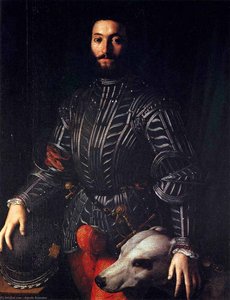
Бронзіно, 1503 – 1572

Картини Бронзіно: 100 найвідоміших творів у рейтингу

Найвідоміший витвір Бронзіно — це Венера, Купідон і Час (Аллюгорія похоти) (1540), що зберігається в Національна галерея, Лондон. Разом із Portrait of Eleonora da Toledo (1555) та Venus, Cupido and Satyr це завершує трійцю творів, які впізнає кожен. У нашому каталозі представлено 189 робіт Бронзіно; нижче наведено 100 найпопулярніших творів світу, кожен із яких має зазначений рік створення, музейне місце зберігання та опис його культурної значущості.

Рейтинг сформовано на основі нашого показника популярності, що поєднує кількість пошукових запитів, переглядів та замовлень для кожної роботи. Оновлено Жовтень 2026. Кожен шедевр на цій сторінці можна замовити як художню олійну репродукцію ручної роботи музейного рівня або як високоякісний арт-принт у будь-якому обраному вами розмірі.

Портрет Бронзіно
Бронзіно · 1503 – 1572
Народився · помер
1503 – 1572, Флоренція
Рух
Маньєризм
Роботи в нашому каталозі
189
Найвідоміші
Венера, Купідон і Час (Аллюгорія похоти) (1540)
Найбільше робіт у
Галерея Уффіці

10 найвідоміших картин Бронзіно

Венера, Купідон і Час (Аллюгорія похоти) (1540) роботи Бронзіно
1

Венера, Купідон і Час (Аллюгорія похоти)

1540 · Олія на полотні · Національна галерея, Лондон

Агноло Бронзино, видатний художник епохи маньєризму, подарував нам шедевр – “Венера, Купідон і Час (Алегорія Лястовістю)”. Це не просто картина; це складний візуальний наратив, що поєднує міфологію, символізм та майстерність техніки. Створена у 1540 році для флорентійського дому Медічі, ця робота стала свідченням геніальності Бронзино та його здатності передати складність людських почуттів на полотно. Вона занурює глядача в світ бажання, швидкоплинності та непередбачуваності, залишаючи після себе відчуття захоплення та задуму.

Portrait of Eleonora da Toledo (1555) роботи Бронзіно
2

Portrait of Eleonora da Toledo

1555 · Олія на панелі

To gaze upon Agnolo Bronzino's Portrait of Eleonora da Toledo is to step directly into the rarefied atmosphere of High Renaissance Florence. This painting, executed in 1555, transcends a mere likeness; it is a carefully constructed monument to status, power, and exquisite refinement. The subject, Eleonora da Toledo, radiates an almost palpable aura of aristocratic dignity. Bronzino captures her not just as a woman, but as a symbol of Medici…

Venus, Cupido and Satyr роботи Бронзіно
3

Venus, Cupido and Satyr

Олія

A pale, reclining figure occupies the center of the frame, her skin possessing the cool, polished sheen of marble. This is Venus, the goddess of love, draped in a way that emphasizes the tension between soft flesh and the hard edges of the composition. Beside her, Cupid clings to her form, a small, fleshy presence that embodies the sudden, sharp sting of passion. Their limbs are elongated, stretching toward one…

Portrait of Andrea Doria as Neptune (1550) роботи Бронзіно
4

Portrait of Andrea Doria as Neptune

1550 · Oil On Canvas · Пінакотека ді Брера, Мілан

In the grand theater of the Italian Mannerist period, few images command the eye with such authoritative grace as Agnolo Bronzino’s Portrait of Andrea Doria as Neptune. This is not merely a portrait of a man, but a profound exercise in political allegory and divine projection. The subject, the legendary Genoese admiral Andrea Doria, is stripped of the heavy silks and velvet doublets typical of sixteenth-century aristocratic portraiture. Instead, Bronzino…

St. John the Baptist (1542) роботи Бронзіно
5

St. John the Baptist

1542 · Oil On Panel · Музей Дж. Пола Гетті, Лос-Анджелес

The figure of St. John the Baptist emerges from the shadows, rendered with a muscular intensity by the Florentine master Bronzino. This depiction captures the patron saint of Florence in a moment of profound spiritual tension. Created about 1542 - 1545, the work possesses a striking verticality that speaks to its original purpose. It does not exist in isolation but remains a fragment of a larger sacred narrative, having once…

Deposition (1565) роботи Бронзіно
6

Deposition

1565 · Oil On Canvas · Галерея Академії у Флоренції, Флоренція

“Deposition,” painted in 1565 by the Florentine master Agnolo Bronzino, is not merely a religious scene; it's a meticulously crafted tableau of restrained emotion and profound psychological depth. Commissioned for the Observant Monastery in Cosmopoli, this work transcends simple narrative to become a meditation on grief, loss, and the delicate balance between earthly sorrow and divine grace. Bronzino, renowned for his “reserved elegance,” achieved this through an almost unnervingly controlled…

Portrait of a Young Man (1555) роботи Бронзіно
7

Portrait of a Young Man

1555 · Oil On Canvas · Nelson-Atkins Museum of Art, Канзас-Сіті

To gaze upon this portrait is to step directly into the rarefied atmosphere of mid-sixteenth-century Florence, a world governed by the subtle power plays and exquisite tastes of the Medici court. Agnolo Bronzino, the master chronicler of such elite circles, captured not merely a likeness, but an entire social stratum. The sitter, though anonymous to us today, embodies the controlled elegance expected of those who moved within the gilded cage…

Cosimo de Medici in Armour (1545) роботи Бронзіно
8

Cosimo de Medici in Armour

1545 · Oil On Panel · Музей Тиссена-Борнмізеса, Мадрид

The gaze of the Grand Duke of Tuscany, Cosimo I de' Medici, meets the viewer through the work titled Cosimo de Medici in Armour. Created by the Florentine artist Bronzino, this portrait captures the ruler in a moment of poised authority. The image emerges from the mid-16th century, dated about 1545, and presents a commanding presence through its structured composition. It exists as a significant version of the painting held…

Portrait of Cosimo I de' Medici as Orpheus (1537) роботи Бронзіно
9

Portrait of Cosimo I de' Medici as Orpheus

1537 · Oil On Panel · Філадельфійський музей мистецтв, Філадельфія

In this portrait, we encounter Cosimo I de' Medici, not merely as a ruler, but as the mythological musician Orpheus. He is positioned in a three-quarter view from behind, turning his gaze back toward us with a sense of psychological alertness. His body, rendered with a polished, marble-like texture, possesses an idealized beauty that speaks to the High Mannerist style. A single splash of crimson red drapery provides a sharp…

Portrait of Eleonora of Toledo and Her Son, Francesco de'Medici (1549) роботи Бронзіно
10

Portrait of Eleonora of Toledo and Her Son, Francesco de'Medici

1549 · Oil On Panel · Cincinnati Art Museum, Цинциннаті

In this vertical half-length portrait, we encounter the Duchess of Florence, Eleonora of Toledo, and her son, Francesco de' Medici. The composition is defined by a controlled, almost sculptural stillness. Eleonora stands slightly behind the young boy, her hand resting upon his shoulder in a gesture that is both protective and formal. There is a certain aristocratic detachment in their expressions, a cool composure that characterizes the Florentine Mannerist style.…

Бронзіно, картини від 11 до 100

Pope Leo X (1555) роботи Бронзіно
#22

Pope Leo X

1555 · Галерея Уффіці

To gaze upon this portrait of Pope Leo X is to encounter a moment suspended in the opulent grandeur of the Italian Renaissance. Agnolo Bronzino, master chronicler of…

Прикрасьте свій дім →
Miracle of the Brazen Serpent (1542) роботи Бронзіно
#30

Miracle of the Brazen Serpent

1542 · Palazzo Vecchio

In the heart of Florence’s Palazzo Vecchio, tucked within the sacred stillness of the Cappella di Eleonora, resides one of the most arresting spectacles of the Mannerist era:…

Martyrdom of St Lawrence (1569) роботи Бронзіно
#33

Martyrdom of St Lawrence

1569 · Базиліка Сан Лоренцо

Agnolo Bronzino’s “Martyrdom of St. Lawrence,” painted in 1569, isn't merely a depiction of a historical event; it’s a profound meditation on faith, suffering, and the enduring spirit…

Crossing of the Red Sea (1542) роботи Бронзіно
#42

Crossing of the Red Sea

1542 · Palazzo Vecchio

The fresco titled Crossing of the Red Sea was executed by the Florentine artist Agnolo Bronzino. This work, completed around 1542, utilizes the fresco technique to depict a…

View of the Chapel of Eleonora da Toledo (1440) роботи Бронзіно
#64

View of the Chapel of Eleonora da Toledo

1440 · Palazzo Vecchio

The painting presents a view of a chapel featuring a fresco that depicts the life of Christ. Within this sacred setting, the scene is populated by numerous figures,…

Moses strikes water from the wall rocks (1544) роботи Бронзіно
#75

Moses strikes water from the wall rocks

1544

The air feels heavy with anticipation as Moses raises his staff against the rugged, unyielding face of the rock. In this mid-sixteenth century fresco, a sudden, life-giving force…

Altarpiece (1540) роботи Бронзіно
#76

Altarpiece

1540 · Palazzo Vecchio

The year is 1540, and Florence pulses with the ambition of the Medici court. Within the private chapel of Eleonora di Toledo, Duchess of Florence, a masterpiece emerges…

Прикрасьте свій дім →

Картини Бронзіно за періодами

Теми, які найчастіше писав Бронзіно

Чотири сюжети, які найчастіше зустрічаються серед цих шедеврів, з найкращими прикладами кожного з них.

Де можна побачити картини Бронзіно

8 музеїв, у яких зберігається найбільша кількість картин із цього списку.

Музеї Місто Твори Бронзіно Картини з цього списку
Галерея Уффіці, ФлоренціяГалерея Уффіці Флоренція 18 Holy Family, Portrait of Lucrezia Panciatichi, Pope Leo X
Palazzo Vecchio, ФлоренціяPalazzo Vecchio Флоренція 11 Miracle of the Brazen Serpent, The Miracle of the Spring, Gathering of the Manna
Музей мистецтв Будапешта, БудапештМузей мистецтв Будапешта Будапешт 8 Venus, Cupid and Jealousy, Adoration of the Shepherds, Venus, Cupid and Envy
Національна галерея, ЛондонНаціональна галерея Лондон 5 Венера, Купідон і Час (Аллюгорія похоти), Venus cupid time, Venus, Cupid and Time (detail)
Національна галерея мистецтв, ВашингтонНаціональна галерея мистецтв Вашингтон 4 Eleonora di Toledo, Portrait of Eleanora di Toledo, A Young Woman and Her Little Boy
Детройтський інститут мистецтв, ДетройтДетройтський інститут мистецтв Детройт 2 Costanza da Sommaia, Madonna and Child with Saint John the Baptist
Walters Art Museum, БалтиморWalters Art Museum Балтимор 2 The Feast Given by Joseph for His Brothers, Portrait of a Baby Boy
Королівська колекція, ЛондонКоролівська колекція Лондон 2 Portrait of a Lady in Green, Portrait of a Lady in Green

Найвідоміша картина Бронзіно кожного десятиліття

  1. 1520s
    Virgin and Child with the Young Saint John the Baptist (1528) роботи Бронзіно
    #55 з 100

    Virgin and Child with the Young Saint John the Baptist

    Вік 17 – 26 років · Art Institute of Chicago

    In this Mannerist oil painting, three figures occupy a vertical, tightly cropped arrangement against a dark, near-black background. The Virgin Mary is positioned centrally, her form defined by…

  2. 1530s
    Portrait of Cosimo I de' Medici as Orpheus (1537) роботи Бронзіно
    Місце 9 з 100

    Portrait of Cosimo I de' Medici as Orpheus

    Вік 27 – 36 років · Філадельфійський музей мистецтв

    In this portrait, we encounter Cosimo I de' Medici, not merely as a ruler, but as the mythological musician Orpheus. He is positioned in a three-quarter view from…

  3. 1540s
    Венера, Купідон і Час (Аллюгорія похоти) (1540) роботи Бронзіно
    #1 з 100

    Венера, Купідон і Час (Аллюгорія похоти)

    Вік 37 – 46 років · Національна галерея

    Агноло Бронзино, видатний художник епохи маньєризму, подарував нам шедевр – “Венера, Купідон і Час (Алегорія Лястовістю)”. Це не просто картина; це складний візуальний наратив, що поєднує міфологію, символізм…

  4. 1550s
    Portrait of Eleonora da Toledo (1555) роботи Бронзіно
    № 2 із 100

    Portrait of Eleonora da Toledo

    Вік 47 – 56 років

    To gaze upon Agnolo Bronzino's Portrait of Eleonora da Toledo is to step directly into the rarefied atmosphere of High Renaissance Florence. This painting, executed in 1555, transcends…

  5. 1560s
    Deposition (1565) роботи Бронзіно
    #6 з 100

    Deposition

    Вік 57 – 66 років · Галерея Академії у Флоренції

    “Deposition,” painted in 1565 by the Florentine master Agnolo Bronzino, is not merely a religious scene; it's a meticulously crafted tableau of restrained emotion and profound psychological depth.…

Питання про картини Бронзіно

Яка найвідоміша картина Бронзіно?Показати відповідь

Венера, Купідон і Час (Аллюгорія похоти) (1540), Національна галерея, Лондон. Далі йдуть Portrait of Eleonora da Toledo (1555) та Venus, Cupido and Satyr.

Скільки років було Бронзіно, коли було написано Венера, Купідон і Час (Аллюгорія похоти)?Показати відповідь

37 років: Венера, Купідон і Час (Аллюгорія похоти) датована 1540 роком, а Бронзіно народився(-лася) у 1503.

Які 10 найкращих картин Бронзіно?Показати відповідь

Венера, Купідон і Час (Аллюгорія похоти), Portrait of Eleonora da Toledo, Venus, Cupido and Satyr, Portrait of Andrea Doria as Neptune, St. John the Baptist, Deposition, Portrait of a Young Man, Cosimo de Medici in Armour, Portrait of Cosimo I de' Medici as Orpheus та Portrait of Eleonora of Toledo and Her Son, Francesco de'Medici. У рейтингу вище вказано рік створення та музей для кожної картини.

Скільки картин створив Бронзіно?Показати відповідь

У нашому каталозі представлено 189 робіт Бронзіно, датованих періодом з 1525 по 1569.

Де знаходяться найвідоміші картини Бронзіно?Показати відповідь

Більшість із них знаходяться в Галерея Уффіці (Флоренція), Palazzo Vecchio (Флоренція) та Музей мистецтв Будапешта (Будапешт). У таблиці вище перелічені музеї по черзі.

Коли Бронзіно написав свої найвідоміші твори?Показати відповідь

У 1540s: 36 із 100 робіт на цій сторінці датуються цим часом, серед них Венера, Купідон і Час (Аллюгорія похоти).

Які найперші та найпізніші відомі картини Бронзіно?Показати відповідь

Найдавніша робота на цій сторінці датована St Matthew (1525), найновіша — Martyrdom of St Lawrence (1569).

Що найчастіше писав Бронзіно?Показати відповідь

Renaissance (29), Woman (11) та Man (10), серед 100 робіт на цій сторінці.

Яку техніку найчастіше використовував(ла) Бронзіно?Показати відповідь

Oil On Panel: 24 із 100 робіт на цій сторінці.

До якого художнього напряму належить Бронзіно?Показати відповідь

Маньєризм, як демонструють картини на цій сторінці.

Які картини Бронзіно можна побачити в Галерея Уффіці?Показати відповідь

Holy Family, Portrait of Lucrezia Panciatichi та Pope Leo X — це одні з 8 робіт на цій сторінці, що належать Галерея Уффіці, Флоренція.

Чи можу я купити репродукцію картини Бронзіно?Показати відповідь

Так. Кожну картину на цій сторінці можна замовити як музейну репродукцію, написану олією вручну, або як художній принт у будь-якому обраному вами розмірі — безпосередньо зі сторінки самої картини.

Про Бронзіно

Agnolo Bronzino: Florentine Master of Reserved Elegance

Agnolo di Cosimo, known to history as Bronzino, emerged from the vibrant artistic landscape of Renaissance Florence in 1503, a period already brimming with genius. Born the son of a butcher—a humble origin for an artist destined to become one of the most celebrated portraitists of his era and a defining figure of Mannerism—his path diverged sharply from familial trade, guided instead by an innate talent that would see him achieve unparalleled renown. His early artistic training commenced with Raffaellino del Garbo, but it was under the tutelage of Jacopo da Pontormo that Bronzino’s artistic sensibilities truly blossomed. Recognizing Pontormo's groundbreaking experimentation with perspective and color—a bold departure from prevailing stylistic conventions—Bronzino absorbed these innovations while simultaneously forging his own distinctive voice—one characterized by a profound stillness, meticulous detail, and an understated elegance markedly different from Pontormo’s often emotionally turbulent compositions. This formative period was further enriched by studies conducted alongside Andrea del Sarto, exposing him to the legacies of Michelangelo and Leonardo da Vinci—giants whose artistic vision profoundly shaped Bronzino's understanding of art history and technique. The young Bronzino swiftly demonstrated an exceptional aptitude for capturing not merely physical likeness but a subtle psychological depth—a feat rarely accomplished by his contemporaries—even in his earliest commissions.

Early Influences and Artistic Development

The influence of Michelangelo’s monumental sculptures and Leonardo da Vinci's scientific observation profoundly impacted Bronzino’s artistic sensibilities. Like Michelangelo, he embraced anatomical precision and sculptural form, striving to convey a sense of grandeur and permanence within his portraits. Similarly, Da Vinci’s meticulous attention to detail—particularly in his sfumato technique—inspired Bronzino to achieve an unparalleled level of surface refinement. These foundational influences instilled in him a conviction that art should transcend mere representation; it must embody intellectual contemplation and elevate the viewer's perception of beauty. His initial artistic explorations focused on mastering traditional techniques—drawing, etching, and fresco painting—before gravitating towards portraiture as his primary medium. This dedication to craft—combined with an innate understanding of human psychology—established him as a uniquely gifted artist capable of capturing not just outward appearance but inner character.

The Medici Patronage and Florentine Court Style

Bronzino’s artistic career ascended dramatically with the patronage of Cosimo I de’ Medici, Duke of Tuscany—a relationship that solidified his position as the official court painter for much of his life. Recognizing Cosimo's astute political acumen and unwavering commitment to cultural advancement, Bronzino embraced this opportunity to hone his skills and establish himself as Florence’s foremost artistic voice. The commissions emanating from the Medici Court demanded an uncompromising adherence to stylistic conventions—a preference for cool composure, idealized beauty, and subtle psychological nuance. Cosimo I and Eleonora di Toledo became frequent subjects of Bronzino's portraits—images that convey an aura of aristocratic detachment and refined dignity. These works weren’t merely about replicating physical resemblance; they were carefully constructed statements of power, status, and dynastic ambition—a testament to Bronzino’s ability to transform visual art into a tool for shaping public perception. His meticulous attention to detail—the textures of fabrics, the gleam of jewels, the subtle expressions conveyed by his subjects—exemplified Florentine court style at its zenith.

The Art of Mannerism: Stylized Elegance and Intellectual Depth

Bronzino’s artistic style is undeniably Mannerist—a movement that emerged in Italy during the mid-16th century as a deliberate reaction against the harmonious idealism of the High Renaissance. Rejecting the prevailing emphasis on naturalistic representation, Mannerists sought to explore psychological complexity and stylistic innovation—often prioritizing formal elegance over emotional immediacy. Bronzino embraced elongated figures, stylized poses, and an understated emotionality—techniques that distinguished him from his contemporaries and cemented his reputation as a pioneer of artistic experimentation. His approach mirrored Michelangelo’s sculptural ambition—a desire to convey grandeur and permanence through meticulously crafted forms—while simultaneously incorporating Leonardo da Vinci's sfumato technique—creating subtle gradations of light and shadow to heighten visual impact. Venus, Cupid, Folly and Time (c. 1544-45)—perhaps his most iconic masterpiece—perfectly encapsulates this Mannerist aesthetic. The painting’s intricate composition—characterized by asymmetrical balance and subtly distorted perspective—challenges conventional notions of beauty while simultaneously conveying a profound meditation on human experience. Bronzino's mastery extended beyond mere technical proficiency; he possessed an intellectual curiosity that fueled his artistic endeavors—a conviction that art should engage the mind as well as the senses.

Legacy and Enduring Influence

Bronzino’s contribution to Florentine art history transcends his prolific output as a painter. He was a founding member of the Accademia delle Arti del Disegno in 1563—an institution dedicated to fostering artistic excellence and promoting scholarly inquiry—solidifying his role as a champion of humanist ideals and artistic innovation. His influence reverberated throughout Europe, shaping court portraiture for generations to come—establishing Florentine Mannerist style as a benchmark of aristocratic representation. Though subsequent artistic movements favored more emotive or naturalistic approaches, Bronzino’s unwavering commitment to stylistic control and intellectual depth ensured his enduring place in art history—a testament to the transformative power of artistic vision. His legacy continues to inspire artists today who strive for elegance, precision, and psychological insight—demonstrating that true artistry lies not merely in replicating reality but elevating it through deliberate stylistic choices.
  • Born: Florence, Italy, 1503
  • Died: Florence, Italy, 1572
  • Key Movement: Mannerism
  • Notable Works: *Venus, Cupid, Folly and Time*, Portraits of Cosimo I de’ Medici and Eleonora di Toledo
  • Institution: Accademia delle Arti del Disegno

Усі 189 робіт Бронзіно →