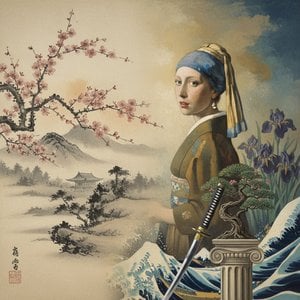
A Life Etched in Wartime Shadows: The Art of Kobayakawa Shūsei
Kobayakawa Shūsei, born in 1885 in Hyogo Prefecture, Japan, lived a life profoundly shaped by the tumultuous currents of modernization and militarization that swept through his nation. His artistic journey unfolded against a backdrop of rapid societal change—the waning years of the Meiji Period giving way to an increasingly nationalistic fervor culminating in World War II. This context wasn’t merely a historical detail for Kobayakawa; it became the very substance of his art, imbuing his canvases with a unique blend of traditional aesthetics and the stark realities of conflict. He witnessed firsthand the rise of imperial ambitions, the expansionist policies that defined Japan's trajectory in the early 20th century, and ultimately, the devastating consequences of war. This formative experience instilled within him a complex relationship to patriotism, duty, and the human cost of ideology—themes that would resonate powerfully throughout his oeuvre. While initially influenced by established masters, Kobayakawa carved out a distinctive style deeply rooted in Nihonga, a modern traditionalist mode of Japanese painting emphasizing classical techniques and materials.The Embrace of Nihonga and Early Artistic Development
Kobayakawa’s early artistic training laid the foundation for his later explorations. He wasn't initially drawn to overtly political subjects; rather, he honed his skills within the established conventions of Nihonga. This style, characterized by its meticulous detail, subtle coloration derived from natural pigments, and emphasis on narrative storytelling, provided him with a powerful visual language. The influence of Ozaki Kōyō, a prominent writer of the time, is noted in early accounts of Kobayakawa’s development, though their relationship proved to be short-lived. He soon began experimenting with a blend of naturalism and confessional writing—a style known as “Shizen-shugi”—evident in works like *Arajotai* (1908), which explored the frustrations of working-class life. However, it was his deeply personal work, *Kabi* (1911)—an example of the Japanese “I-novel” genre—that truly marked a turning point, revealing a willingness to delve into autobiographical themes and psychological complexities. This introspective approach would later inform his depictions of wartime experiences, lending them an emotional depth often absent in more propagandistic art of the period. His artistic path wasn’t solely defined by painting; he also engaged with literary circles, further enriching his understanding of human emotion and narrative structure.Wartime Commissions and the Depiction of Imperial Japan
The outbreak of war dramatically altered Kobayakawa's artistic focus. He became a prominent figure in documenting Japan’s military campaigns in China and Southeast Asia, accepting commissions to create paintings that glorified the nation’s efforts. These weren’t simply objective reportage; they were carefully constructed narratives designed to bolster morale and reinforce nationalistic sentiment. The Metropolitan Museum of Art describes his wartime works as being “associated with the modern traditionalist mode known as Nihonga,” utilizing familiar formats and media to evoke a sense of Japanese identity and purpose. However, Kobayakawa’s paintings weren't devoid of nuance. While they undoubtedly served a propagandistic function, they also captured the hardships endured by soldiers, the landscapes scarred by conflict, and the emotional toll of war. This tension—between patriotic duty and human suffering—is what sets his work apart from more overtly celebratory depictions of wartime Japan. He wasn’t merely painting flags and victories; he was documenting a lived experience, albeit one filtered through the lens of national ideology.Legacy and Historical Significance: A Complex Portrait of an Era
Kobayakawa Shūsei's legacy is complex and often debated. He died in 1974, leaving behind a body of work that continues to fascinate and provoke discussion. While some view his wartime paintings as complicit in the atrocities committed by Japan during World War II, others recognize them as valuable historical documents—a window into the mindset of a nation consumed by militarism. His ability to blend traditional artistic techniques with contemporary themes established him as a significant figure in Japanese art history. He was a member of the prestigious Japanese Imperial Art Academy, further solidifying his position within the cultural establishment. Beyond his wartime commissions, Kobayakawa’s earlier works—particularly *Kabi* and *Arakure*—remain important examples of the “I-novel” genre, offering insights into the social and psychological landscape of pre-war Japan. His paintings serve as a potent reminder that art is rarely created in a vacuum; it is always shaped by the historical, political, and cultural forces of its time.- Major Themes: Patriotism, duty, sacrifice, the human cost of war, national identity.
- Influences: Ozaki Kōyō, Nihonga painting traditions, Japanese literary movements (Shizen-shugi).
- Key Works: *Arajotai* (1908), *Kabi* (1911), Wartime paintings documenting campaigns in China and Southeast Asia.
Запитання та відповіді
Які псевдоніми або інші імена має Shūsei?
Shūsei також відомий/відома як Shūsei Tokuda (徳田秋声), Sueo Tokuda (Tokuda Sueo), Tokuda Shūsei, Shusei Nagaoka (長岡秀星), Nagaoka Shūsei.
Чи можу я переглянути роботи Shūsei за художніми напрямами?
Мистецькі напрями, у яких працював(ла) Shūsei, можна переглянути на сторінці Усі напрями, де твори мистецтва згруповані за напрямами.
Як мені знайти всі роботи Shūsei у певній техніці виконання?
Сторінка Усі техніки групує роботи Shūsei за технікою виконання.
Де я можу знайти статистику щодо творів Shūsei?
Для Shūsei існує сторінка Статистика, на якій представлено статистику про художні роботи митця на цей вебсайт.
Як мені знайти роботи Shūsei у певній палітрі кольорів?
Роботи Shūsei можна переглянути за кольоровою палітрою на сторінці митця За палітрами.
Де я можу побачити роботи Shūsei у 3D-галереї?
3D Музей Shūsei — це сторінка, на якій роботи митця представлені у віртуальній тривимірній галереї.
Як змінювався стиль творчості Shūsei з часом?
Хронологічний опис творчості Shūsei доступний на сторінці Хроніка, де витвір за витвором, розділ за розділом, представлені в порядку їх створення.
Чи можу я переглянути роботи Shūsei за кольоровим спектром?
Роботи Shūsei можна переглянути за кольором на сторінці Колірний індекс митця.