Niccolò Semitecolo: Venetian Painter of Spiritual Depth
Nicolò Semitecolo (c. 1353 – after 1370) stands as a singular figure in the late Trecento Venetian art scene, distinguished by his pioneering approach to naturalism within the prevailing Byzantine tradition. Born in Venice around 1353, Semitecolo’s artistic career unfolded during a period marked by profound religious fervor and societal upheaval—the Black Death ravaged Europe, reshaping cultural priorities and fostering an intense preoccupation with mortality. Despite limited biographical details surviving from his lifetime, Semitecolo's legacy rests firmly on his monumental altarpiece cycle for Padua Cathedral, a masterpiece that embodies the artistic spirit of its time and continues to inspire scholarly debate today.
Early Life and Training
Information regarding Semitecolo’s formative years remains scarce. Records indicate he was active in Venice by 1353, where he likely received his initial training—a crucial step considering the dominant stylistic conventions of the era. Venetian painting at this juncture leaned heavily on Byzantine iconography, prioritizing stylized figures and luminous backgrounds to convey spiritual truths. However, Semitecolo demonstrated an exceptional sensitivity to observation and anatomical accuracy, qualities that would characterize his distinctive artistic style. This inclination toward realism foreshadowed a significant shift away from purely symbolic representation, anticipating the humanist ideals emerging across Europe during the Quattrocento.
The Padua Altarpiece Cycle: A Revolutionary Vision
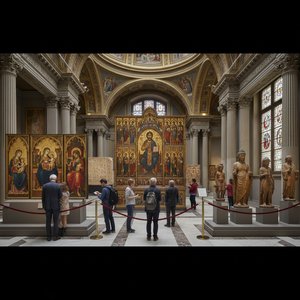
Semitecolo’s magnum opus—the Padua Altarpiece—represents an unparalleled achievement of Venetian art history. Commissioned by Bishop Pietro Querini in 1367, this ambitious project comprised nine panels depicting scenes from Saint Sebastian's martyrdom and the Trinity, alongside depictions of St Daniel and other saints. Unlike many contemporary altarpieces that adhered rigidly to Byzantine stylistic norms, Semitecolo’s cycle embraced a bold experiment in naturalism—a daring departure from convention that nonetheless retained profound spiritual resonance. The meticulous rendering of drapery folds, musculature, and facial expressions testifies to Semitecolo's mastery of technique and his unwavering commitment to capturing the human form with unprecedented realism.
- Compositional Innovation: Semitecolo skillfully employed pyramidal compositions—a technique borrowed from Florentine artists—to create dynamic visual hierarchies that drew viewers’ attention to key figures and narratives.
- Color Palette: The altarpiece's palette showcased a remarkable range of hues, achieved through the innovative use of glazing techniques—a method pioneered by Semitecolo and his contemporaries—that imparted luminous depth and atmospheric perspective.
- Psychological Depth: Semitecolo’s figures conveyed palpable emotion—pain, suffering, devotion—reflecting a humanist preoccupation with human psychology that distinguished Venetian art from its Byzantine counterparts.
Influence and Legacy
Semitecolo's Padua Altarpiece exerted considerable influence on subsequent Venetian painters, establishing him as a pivotal figure in the transition between Trecento and Quattrocento styles. His embrace of naturalism served as an impetus for artists to explore new expressive possibilities—a move that ultimately propelled Venetian art toward the humanist ideals championed by Leonardo da Vinci and Michelangelo. Furthermore, Semitecolo’s pioneering use of glazing techniques paved the way for advancements in pigment technology and artistic innovation. Although Semitecolo himself remained elusive—leaving no written records or portraits—his enduring contribution to Venetian art history is undeniable: he stands as a testament to the transformative power of artistic experimentation and the unwavering pursuit of beauty and truth.
Further Exploration