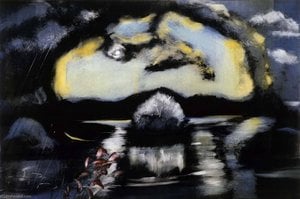
Michael Mazur (1935-2009) was an American printmaker whose distinctive style—characterized by lyrical monotypes, expansive Dante series prints, and a profound preoccupation with the interplay between shadow and form—established him as one of the most influential figures in contemporary American art. Born in Brooklyn, New York, Mazur’s artistic journey began modestly but swiftly ascended to international acclaim, cementing his legacy as a visionary artist who consistently pushed boundaries and explored complex themes within his meticulously crafted artworks.
Early Influences & Artistic Formation
Mazur's formative years were marked by exposure to diverse artistic stimuli. He attended Pratt Institute in Brooklyn, where he honed his skills in etching and mezzotint techniques—skills that would prove invaluable throughout his career. However, it was a pivotal encounter with the work of Josef Albers and Johannes Itten that truly ignited Mazur’s creative spirit. These masters championed color theory and explored perceptual illusions, concepts which deeply resonated with Mazur's artistic sensibilities and profoundly shaped his approach to printmaking. Specifically, Itten’s Bauhaus teachings instilled in Mazur a belief in the importance of simplifying forms and reducing visual complexity—a principle he consistently applied to his prints.
The Dante Series: A Monumental Undertaking
Mazur’s magnum opus is undoubtedly the Dante Series, begun in 1968 and continuing intermittently until his death. This ambitious project comprised over 300 monumental prints depicting scenes from Dante Alighieri's *Inferno*, *Purgatorio*, and *Paradiso*. The series represents a singular achievement of printmaking—a feat of technical mastery combined with intellectual depth. Mazur painstakingly recreated Dante’s vivid descriptions of Hell, Purgatory, and Paradise using a technique he termed “layered etching,” which involved applying multiple layers of acid to the plate surface to achieve astonishing tonal gradations and textural nuances. The resulting prints are not merely reproductions of Dante's poetry; they are visual interpretations that convey the emotional core of the narrative—a testament to Mazur’s ability to transform literature into art.
Monotype Prints: Exploring Intuitive Expression
Alongside his monumental Dante Series, Mazur produced a substantial body of monotype prints—works created on a single sheet of metal plate without any auxiliary impressions. Unlike etching or mezzotint, which rely on mechanical processes, monotypes prioritize spontaneity and intuitive expression. Mazur embraced this approach wholeheartedly, allowing the inherent qualities of the material to guide his artistic process. He achieved remarkable effects through subtle manipulations of ink—spreading, blotting, wiping—creating images that possessed a unique sense of immediacy and textural richness. These prints often featured abstract compositions dominated by luminous washes of color, reflecting Mazur’s fascination with light and its transformative power.
Recognition & Legacy
Mazur's artistic vision garnered considerable recognition throughout his lifetime. He was awarded fellowships from the National Endowment for the Arts and Yale University Graduate Center, providing crucial support for his creative endeavors. His work was exhibited extensively in museums across North America and Europe, including The Museum of Modern Art (MoMA) and Tate Britain, establishing him as a leading voice within the American printmaking community. Furthermore, Mazur’s influence extended beyond the realm of printmaking; he mentored numerous young artists and fostered a spirit of experimentation and innovation. Michael Mazur died in 2009, leaving behind an enduring legacy—a body of work that continues to inspire admiration for its formal elegance, intellectual rigor, and profound emotional resonance. His prints stand as powerful reminders of the transformative potential of art to engage with complex ideas and evoke visceral responses, securing his place among the most significant printmakers of the 20th century.
Master the nuances of Giclée printing with our expert guide. Discover how pigment-based inks and museum-grade substrates create fade-resistant, high-fidelity art reproductions designed for discerning collectors seeking unparalleled quality and longevity.