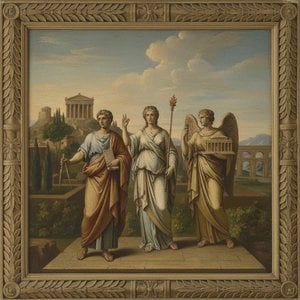
A Life Bridging Romanticism and Symbolism
Anne-François-Louis Janmot, a name perhaps less immediately familiar than some of his contemporaries, occupies a remarkably fascinating and pivotal position in 19th-century French art. Born in Lyon in 1814, his life was inextricably interwoven with the shifting currents of artistic thought, transitioning from the passionate emotionalism of Romanticism towards the more introspective and psychologically rich explorations of Symbolism. Janmot’s early years were profoundly shaped by a series of devastating losses – the untimely deaths of siblings at young ages – events that instilled within him a deep-seated sense of melancholy, spiritual sensitivity, and an enduring preoccupation with mortality. This personal tragedy wasn't merely a biographical detail; it became a foundational element shaping his artistic vision—a constant, often subtle, exploration of life’s fragility, faith, and the human condition in its entirety. Raised within a devoutly Catholic household, Janmot’s upbringing instilled a profound religious conviction that served as both an enduring source of inspiration *and* a subject matter he consistently returned to throughout his career.
Formative Years and Artistic Development
Janmot's artistic journey commenced with formal training at the prestigious Royal College of Lyon, where he encountered influential figures who profoundly shaped his intellectual and artistic development. He benefited from the guidance of Frederic Ozanam, a prominent social reformer and philosopher, and was deeply influenced by Abbé Noirot, whose philosophical teachings explored themes of faith, morality, and the nature of human existence. Janmot quickly demonstrated an exceptional talent for art, earning the coveted Golden Laurel at the École des Beaux-Arts de Lyon in 1832 – a remarkable achievement that propelled him to Paris, the epicenter of French artistic life. There, he sought mentorship from Victor Orsel and, crucially, Jean-Auguste-Dominique Ingres, arguably the most influential figure in his artistic development. While Ingres’s rigorous emphasis on precise draftsmanship, classical form, and meticulous attention to detail undoubtedly honed Janmot's technical skills – a mastery that is strikingly evident throughout his oeuvre – Janmot didn’t simply replicate his teacher’s style. He absorbed the discipline and the exacting standards of Ingres, but he skillfully layered them with his own unique sensibility, allowing his deeply personal vision to flourish beneath the surface. A period of study in Rome proved equally formative, exposing him to the evocative spirit of the Nazarene movement – a group of German Romantic artists who sought to revive the spiritual intensity and simplicity of early Renaissance art. This encounter profoundly influenced Janmot’s approach to religious subject matter, imbuing his work with a sense of timelessness and profound emotional depth.
The “Poem of the Soul” and Major Works
Janmot's artistic reputation truly began to ascend at the Salon de Paris in 1839 with the unveiling of *The Resurrection of the Son of the Widow of Nain*, a monumental painting that captivated audiences with its dramatic composition, luminous colors, and deeply moving depiction of compassion and faith. A year later, he presented *Christ in Gethsemane*, another powerful work demonstrating his ability to convey intense emotion and spiritual struggle through masterful brushwork and evocative lighting. However, it was his ambitious and profoundly personal project – “The Poem of the Soul” – that cemented his place as a major figure in 19th-century French art. This sprawling cycle, encompassing eighteen paintings and sixteen drawings accompanied by original verse, spanned nearly four decades of dedicated work and represents Janmot’s most significant artistic achievement. “The Poem of the Soul” isn't merely a collection of images; it is an immersive visual narrative—a complex allegory exploring themes of spiritual yearning, earthly suffering, the search for transcendence, and the relationship between humanity and the divine. Each painting within the cycle functions as a distinct episode in this extended meditation on the human condition, inviting viewers to contemplate profound questions about life, death, faith, and the nature of reality. Beyond this monumental undertaking, Janmot received numerous commissions to decorate churches throughout France, including significant frescoes at the Church of St. Polycarp and intricate decorative panels for the dome of the Church of St. Francis de Sales – showcasing his versatility as a painter and his ability to execute large-scale projects with both technical skill and artistic vision.
Influences and Artistic Style
Janmot’s artistic style is characterized by a remarkable synthesis of influences. While undeniably influenced by Ingres's rigorous draftsmanship and classical ideals, he never simply mimicked his teacher’s style. Instead, he skillfully integrated Ingres’s technical precision with a deeply personal and emotionally charged vision. The influence of the Nazarene movement is readily apparent in his depictions of religious subjects – particularly his use of muted colors, dramatic lighting, and an emphasis on spiritual symbolism. Furthermore, Janmot was profoundly affected by the literary currents of his time, drawing inspiration from the works of Shakespeare and Dante, whose exploration of human emotions, moral dilemmas, and philosophical questions resonated deeply with his own artistic sensibilities. This resulted in a distinctive allegorical approach to painting – a tendency to imbue his scenes with symbolic meaning and invite viewers to engage in a process of interpretation. His work is consistently imbued with a sense of melancholy and introspection, reflecting the personal tragedies he experienced throughout his life. Yet, despite this underlying sadness, Janmot’s paintings are also filled with moments of profound beauty, spiritual grace, and an enduring hope for redemption.
Legacy and Historical Significance
Despite facing significant personal hardships – including financial difficulties exacerbated by family tragedies – Janmot remained steadfastly committed to his art until his death in 1892. He continued to create, completing a fresco for a chapel in the Holy Land and diligently working on “The Poem of the Soul” right up to his final days. Janmot’s historical significance lies not only in his individual artistic achievements but also in his pivotal role as a transitional figure between Romanticism and Symbolism. He wasn't simply caught *between* these two movements; he actively foreshadowed aspects of both, blending Ingres’s meticulous technique with a deeply felt mysticism that anticipated the concerns of the Symbolists. He is often cited as an influence on the Pre-Raphaelite Brotherhood, and artists like Puvis de Chavannes, Odilon Redon, and Maurice Denis greatly admired his work. Janmot represents a unique synthesis—a blend of Ingres’s exacting standards with a profoundly personal spiritual vision that continues to resonate with viewers today. His art stands as a testament to the power of painting to grapple with life's most profound questions and offer glimpses into the realm of the soul, reminding us of the enduring importance of faith, beauty, and human connection.