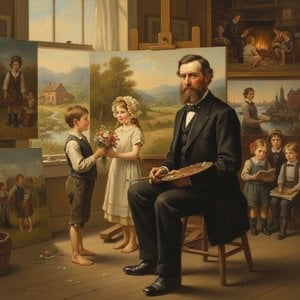
George Washington Thomas Lambert (1873–1930): An Australian Visionary
George Washington Thomas Lambert, commonly known as GW Lambert, stands as a pivotal figure in Australian art history—a painter whose evocative landscapes and poignant portraits captured the spirit of his era and cemented his place among Australia’s most celebrated artists. Born September 13, 1873, in St Petersburg, Russia, Lambert's artistic journey began amidst the intellectual ferment of late Imperial Russia, shaping his sensibilities before he emigrated to Australia in 1887.
- Early Life and Education: Lambert’s upbringing instilled a deep appreciation for observation and craftsmanship. Educated at Kingston College, Yeovil, Somerset, he honed his artistic skills under Julian Ashton’s tutelage, absorbing the stylistic precepts of Impressionism and mastering draughtsmanship techniques that would define his oeuvre.
- Move to Australia & Initial Artistic Explorations: Arriving in Sydney with his family aboard the *Bengal*, Lambert quickly embraced the Australian bush landscape—a formative influence evident in early works like “Across the Black Soil Plains,” which secured him the prestigious Wynne Prize in 1899. This painting exemplifies Lambert’s commitment to portraying the natural world with honesty and sensitivity.
- Illustrative Career & Literary Partnerships: Lambert's talent extended beyond painting; he collaborated extensively with writers, notably Will H. Ogilvie, producing illustrations for bush ballads that captured the essence of Australian folklore. His work graced publications such as *The Bulletin* and Cassell’s Magazine, demonstrating his versatility as an artist and communicator.
- War Artist & Recognition: Lambert's involvement in World War I marked a significant turning point—he served as an official war artist with the Australian Light Horse Brigade, documenting the battles of Gallipoli and Palestine with remarkable detail and emotional depth. His depictions of soldiers and landscapes earned him acclaim and contributed to the formation of the Australian War Memorial.
- Mature Artistic Style & Legacy: Lambert’s artistic style matured throughout his life—characterized by a masterful command of tonal subtlety, meticulous brushwork, and an unwavering dedication to capturing human emotion. He achieved international recognition with commissions from royalty and established himself as a respected teacher at the London School of Art. His enduring legacy resides in his captivating portraits and landscapes, which continue to inspire admiration for their beauty and psychological insight—a testament to Lambert’s profound contribution to Australian art.
Lambert's influence extended beyond his own artistic output; his son Maurice Lambert became a sculptor of considerable renown, furthering the family’s artistic tradition. George Washington Thomas Lambert remains an icon of Australian art, remembered for his unwavering devotion to capturing the spirit of his time and leaving behind a body of work that embodies the values of observation, empathy, and artistic excellence.