A Brushstroke Across Eras: The Life and Art of Kiwon, Yoo Hanji
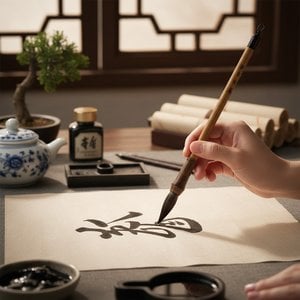
Kiwon, Yoo Hanji (兪漢芝, 綺園, 1760-1834) emerges from the annals of Korean history as a quintessential *wenren* – a scholar-official artist deeply embedded in the cultural and intellectual currents of his time. Born in Korea during the late Joseon dynasty, a period marked by both artistic flourishing and socio-political upheaval, Yoo Hanji wasn’t merely a calligrapher; he was a vessel through which the spirit of an era found expression. His life unfolded against a backdrop of Neo-Confucian ideals, where mastery of calligraphy was considered not just an art form but a testament to moral cultivation and refined sensibility. He dedicated his existence to perfecting this ancient practice, ultimately becoming celebrated for his exceptional skill in all script styles, with particular renown bestowed upon his fluid and evocative “sea style” (haeche), reminiscent of waves crashing against the shore.The Scholar’s Path: Cultivating Mind and Brush
Yoo Hanji's journey began within the established framework of Joseon society – a rigorous education steeped in Confucian classics. This foundation wasn’t simply about acquiring knowledge; it was about shaping character, fostering inner harmony, and developing an acute awareness of tradition. The *wenren* ideal demanded a holistic approach to life, where art, poetry, music, and calligraphy were interwoven with ethical conduct and political engagement. While details surrounding his early life remain somewhat scarce, it’s clear that Yoo Hanji embraced this ethos wholeheartedly. He wasn't simply replicating forms; he was internalizing the principles they represented. His dedication led him to master a diverse range of calligraphic scripts – from the formal *kaishu* (regular script) to the dynamic *xingshu* (semi-cursive script) and the expressive *caoshu* (cursive script). However, it was his mastery of the *haeche* style that truly distinguished him. This particular style, characterized by its bold strokes, rhythmic flow, and suggestion of natural movement, allowed Yoo Hanji to convey a sense of both power and grace.The Sea Style and Artistic Legacy
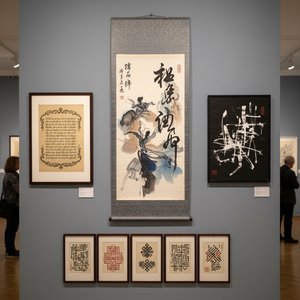
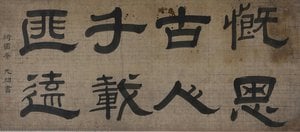
The “sea style” calligraphy for which Yoo Hanji is so highly regarded wasn’t merely a technical achievement; it was an artistic statement. The ocean held profound symbolic weight in Korean culture, representing vastness, resilience, and the cyclical nature of life. By imbuing his calligraphy with this imagery, Yoo Hanji imbued his work with layers of meaning. His brushstrokes weren't simply lines on paper; they were echoes of waves, currents, and the boundless energy of the sea itself. This style allowed him to express a range of emotions – from quiet contemplation to passionate intensity – with remarkable subtlety and nuance. He is particularly remembered for his album, aptly titled ‘Un Album Coréen’ (A Korean Album), which showcases the breadth of his talent and serves as a testament to his artistic vision. The album isn't just a collection of calligraphy; it’s a window into the mind of a scholar-artist grappling with the complexities of his world.Historical Significance: A Representative Voice of the Late Joseon
Yoo Hanji lived during a period of significant transition in Korea, as the Joseon dynasty faced internal challenges and external pressures. His art, while rooted in tradition, also reflects a growing awareness of individual expression and a desire to push boundaries. He wasn’t necessarily advocating for radical change, but his work embodies a spirit of intellectual curiosity and artistic innovation that was characteristic of the late Joseon period. As a *wenren*, he played a crucial role in preserving and transmitting cultural values while simultaneously exploring new avenues of creative expression. His calligraphy continues to be studied and admired today not only for its technical brilliance but also for its historical significance – it offers valuable insights into the aesthetic sensibilities, intellectual climate, and socio-political context of 18th and 19th century Korea.Further Exploration
- Key Style: *Haeche* (Sea Style) Calligraphy – characterized by bold, flowing strokes evoking the movement of waves.
- Notable Work: ‘Un Album Coréen’ – a collection showcasing Yoo Hanji's diverse calligraphic skills and artistic vision.
- Cultural Context: Late Joseon Dynasty (1760-1834) – a period of artistic flourishing amidst socio-political change.
- Artistic Identity: *Wenren* – Scholar-official artist embodying Confucian ideals and refined sensibility.
Питання та відповіді
Чи є хронологічна лінія творів Kiwon, Yoo Hanji?
Твори Kiwon, Yoo Hanji можна переглянути в хронологічному порядку на сторінці Хронологія творів митця.
Звідки родом Kiwon, Yoo Hanji?
Kiwon, Yoo Hanji народився у South Korea.
Які настрої передають роботи Kiwon, Yoo Hanji?
Роботи Kiwon, Yoo Hanji можна переглядати за настроєм на сторінці художника Простір настрою, де витвори мистецтва впорядковані відповідно до їхнього емоційного забарвлення.