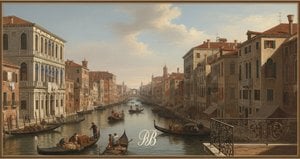
Jacopo Bilivert: Painter of Florentine Grandeur
Jacopo Bilivert (1550 – 1603) stands as a singular figure in the Dutch Golden Age, an artist whose reputation initially overshadowed by his craftmanship—specifically his exquisite goldsmithing—has since been recognized for his remarkable contribution to panoramic painting and architectural illustration. Born in Delft, Netherlands, Bilivert’s artistic journey began not with brushstrokes but with meticulous craftsmanship, shaping him into a master jeweler before he turned his talents towards capturing the splendor of Florence under Cosimo II Medici.
- Early Life & Training: Little is known about Bilivert's formative years beyond confirmation that he was apprenticed to Johannes Maasdam in Delft around 1570. Maasdam, a prominent landscape painter and architect, instilled in Bilivert a profound understanding of perspective and spatial representation—skills that would become hallmarks of his later artistic endeavors.
- The Florentine Patronage: Bilivert’s fame ascended dramatically when he secured commissions from Cosimo II Medici and Ferdinando I Medici. These patrons entrusted him with creating monumental oval paintings depicting Florence's cityscape, showcasing the city's architectural achievements and celebrating its cultural vibrancy.
Bilivert’s style distinguishes itself through a masterful manipulation of perspective—a technique honed during his apprenticeship—that achieves unparalleled realism. Unlike many contemporaries who relied on aerial perspective to convey depth, Bilivert employed a more assertive approach, utilizing linear perspective to create astonishingly accurate representations of buildings and streets. This meticulous attention to detail extended beyond architectural renderings; he incorporated intricate depictions of Florentine life, capturing the bustle of marketplaces and the grandeur of public spaces with remarkable precision.
- Notable Works: Among Bilivert’s most celebrated paintings are “Florence,” commissioned by Cosimo II Medici in 1596, and “The Piazza della Signoria,” depicting Florence's central square during Ferdinando I’s reign. These canvases exemplify his signature style—expansive panoramas rendered with breathtaking accuracy—and serve as invaluable visual records of Renaissance Florence.
- Influence & Legacy: Bilivert’s pioneering use of linear perspective profoundly impacted subsequent generations of painters, establishing him as a pivotal figure in the development of architectural illustration. His meticulous observation and masterful technique continue to inspire artists today, cementing his place among the foremost masters of the Dutch Golden Age.
Bilivert's contribution transcends mere visual representation; he embodies the spirit of humanist inquiry that characterized the Renaissance. By faithfully documenting Florence’s physical environment—its buildings, plazas, and daily life—he captured not only a snapshot of history but also an idealized vision of urban grandeur and civic pride. His paintings stand as enduring monuments to Cosimo II Medici's ambition and Ferdinando I Medici’s patronage, offering invaluable insight into the cultural landscape of one of Europe’s most influential cities.
Sources: Various scholarly publications on Renaissance art and architectural illustration provide detailed biographical information and analyses of Bilivert’s artistic achievements.