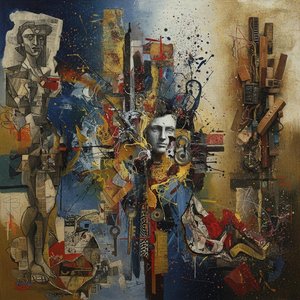
The Textured Narratives of Iwona Liegmann
Born in the historic Polish city of Toruń in 1971, Iwona Liegmann has cultivated a visual language that is as much about scholarly depth as it is about raw, intuitive expression. Her artistic journey is marked by a rigorous academic foundation, beginning with her painting specialization at Nicolaus Copernicus University in 1993, followed by an influential period of study at Gray's School of Art in Aberdeen, Scotland, where she earned her Master’s degree in 1996. This dual exposure to the Polish and Scottish art scenes allowed her to weave together a unique perspective that bridges traditional European sensibilities with a contemporary, experimental edge. By the time she attained her Ph.D. from Nicolaus Copernicus University in 2015, Liegmann had emerged not just as a painter, but as a profound thinker capable of translating complex sociological and biological themes into tangible, tactile art.
Liegmann’s work is a mesmerizing exploration of the intersections between womanhood, nature, and identity. She often describes her approach through the lens of "moderate intuitive expressionism," a style that prioritizes the emotional weight of color and the freedom of form. Her canvases are rarely mere surfaces; they are living histories. By masterfully manipulating oil paint and incorporating repurposed materials—such as fragments of old fabric and weathered canvases—she introduces a conceptual dimension of time and decay. This deliberate process of "aging" her pieces imbue them with a sense of resonance, suggesting that the narratives of femininity and the natural world are subject to the same cycles of growth and erosion as the earth itself.
Symbolism and the Materiality of Art
The essence of Liegmann’s practice lies in her ability to find extraordinary meaning within the mundane. Her compositions often draw from a rich tapestry of influences, ranging from the decorative aesthetics of mass media—such as cartoons and colorful packaging—to the intimate, domestic traditions of embroidery and textile work. In her hands, these elements are transformed into profound inquiries into gender roles and social constructs. She frequently references the "work of the mother"—the acts of knitting, sewing, and mending—as a way to explore the construction of cultural femininity and the strength found in traditional craftsmanship.
Beyond the human experience, Liegmann’s connection to the environment serves as a cornerstone of her creative output. Her work often reflects an active engagement with animal welfare and the protection of the natural world. This commitment is perhaps most evident in her recent projects documenting animal rights activists, where her art transcends the gallery space to become a tool for social advocacy. Whether she is exploring organic plant forms or addressing the complexities of biological existence, her art remains deeply rooted in an ecological consciousness that seeks to honor the sanctity of all living things.
A Legacy of Multidisciplinary Innovation
Throughout her prolific career, Liegmann has refused to be confined by a single medium. Her repertoire is impressively diverse, spanning:
- Painting: Utilizing oil and mixed media to create textured, emotive landscapes and portraits.
- Illustration and Graphic Design: Blending fine art sensibilities with modern visual communication.
- Object Making and Installation: Creating three-dimensional works that challenge the boundaries between sculpture and painting.
Her achievements have been recognized through prestigious accolades, including scholarships from the Polish Ministry of Culture and the Stellwerk Zollverein Foundation in Germany. As she continues to evolve, Liegmann remains a vital figure in contemporary art, constantly pushing the limits of materiality and meaning. Her ability to synthesize the scholarly with the visceral ensures that her work remains not only a beautiful spectacle of color and texture but a profound dialogue on what it means to exist within the intricate web of nature and society.