Early Life and Background
Henri Le Sidaner, a name synonymous with evocative domestic scenes and tranquil landscapes, was born on August 7th, 1862, in the vibrant port city of Port Louis, Mauritius. His origins were deeply rooted in Breton heritage – his father, Jean Marie Le Sidaner, worked as a ship inspector for Lloyd’s, a position that necessitated frequent travels and exposed the family to diverse cultures. The Le Sidaners' life took an important turn in 1872 when they relocated to Dunkerque, France, establishing a new home amidst the bustling coastal town. This move marked the beginning of Henri’s journey into the world of art, nurtured by his parents who recognized and encouraged his early artistic inclinations.
Henri's formative years were spent in Dunkerque, where he attended the Collège et Lycée Notre Dame des Dunes. It was here that a spark ignited within him – a passion for painting that would eventually define his entire career. The town’s atmosphere, with its blend of maritime traditions and burgeoning artistic circles, undoubtedly played a role in shaping his nascent talent.
Artistic Training and Influences
Driven by an unwavering dedication to his craft, Henri secured a prestigious scholarship that enabled him to pursue his artistic ambitions in Paris. In 1880, at the tender age of eighteen, he enrolled at the École nationale supérieure des beaux-arts – a renowned institution that had nurtured generations of French artists. It was within these hallowed halls that he began his formal training under the tutelage of Alexandre Cabanel, a prominent figure in Belle Époque French painting. However, their artistic philosophies soon diverged, leading to a respectful but ultimately decisive separation. Le Sidaner’s early influences were profoundly shaped by the revolutionary techniques and aesthetics of Impressionism and Pointillism.
Artists like Édouard Manet, known for his bold departures from academic tradition, and Claude Monet, with his groundbreaking explorations of light and color, served as pivotal mentors. Furthermore, he was captivated by the innovative approach of the Pointillists – artists who employed tiny dots of pure color to create luminous effects. These diverse influences coalesced within Le Sidaner’s artistic vision, laying the foundation for his distinctive style.
Seeking further inspiration and collaboration, Henri joined the Colonie artistique d'Étaples – a collective of artists dedicated to honing their skills in the coastal town of Étaples. This environment fostered experimentation, camaraderie, and a shared pursuit of artistic excellence.
Artistic Style and Development
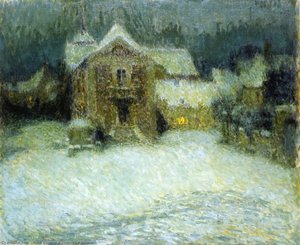
Le Sidaner’s artistic style is instantly recognizable for its subtle yet profound beauty. He eschewed bold brushstrokes and vibrant hues in favor of a muted palette dominated by subdued colors, nuanced greys, and delicate opals. His technique involved applying these pigments with uneven, dappled brushstrokes – a deliberate choice that created an atmosphere of gentle mystery and quiet contemplation. This masterful manipulation of light and shadow is particularly evident in his nocturnes, where he captured the ethereal beauty of twilight hours with remarkable sensitivity.
Over time, Le Sidaner’s style underwent a subtle but significant evolution. Initially influenced by Impressionism and Pointillism, he gradually developed a more personal aesthetic – one that blended these techniques with elements of Symbolism. This resulted in paintings that possessed both a sense of realism and an underlying emotional depth.
In 1905, Le Sidaner sought refuge from the Parisian bustle, establishing a home in Gerberoy, a charming village nestled in the Picardy countryside. It was here, amidst the ruins of a medieval fortress, that he created his most celebrated works – seductive views of meticulously cultivated gardens filled with roses and dappled sunlight. These paintings became synonymous with his artistic identity, solidifying his reputation as a master of atmospheric landscapes.
Major Works and Recognition
Throughout his prolific career, Henri Le Sidaner produced a remarkable body of work encompassing still lifes, domestic interiors, and evocative landscape scenes. Among his most celebrated paintings are "Still Life and a Window, Gisors," a captivating study of light and form, and “Table Au Clair De Lune,” which exemplifies his mastery of capturing the subtle nuances of twilight. His works have been exhibited in prestigious galleries across France and internationally, garnering critical acclaim and attracting discerning collectors.
Le Sidaner’s artistic achievements were formally recognized by the French government, culminating in a Legion of Honour award in 1913 – a testament to his enduring contribution to the world of art. His paintings are currently housed in museums across Europe, including the Musée des Beaux-Arts Tournai in Belgium, ensuring that his legacy will continue to inspire and delight for generations to come.
Historical Significance
Henri Le Sidaner is often regarded as a pivotal figure bridging the gap between Impressionism and Post-Impressionism. His unique style – characterized by its subtle color harmonies, atmospheric depth, and intimate subject matter – distinguishes him from his contemporaries. He possessed an extraordinary ability to capture the essence of everyday life, transforming ordinary scenes into moments of profound beauty and emotional resonance.
Le Sidaner’s legacy extends beyond his individual works; he represents a culmination of artistic trends and influences, embodying the spirit of innovation and sensitivity that defined the late 19th and early 20th centuries. His paintings continue to resonate with viewers today, offering glimpses into a world of quiet contemplation and understated elegance.