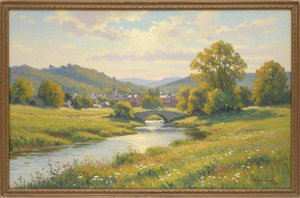
Gaines Ruger Donoho: Life & Art
Early Life and Education
- Born: December 21, 1857, in Church Hill, Mississippi.
- Donoho’s father, Robert Donoho, was a planter from Virginia, and his mother, Julia Sophia Ruger, hailed from New England.
- His childhood on a Mississippi plantation was disrupted by the American Civil War, during which his father was killed.
- Following this tragedy, Donoho and his family relocated to New England under the care of a maternal relative, General Thomas H. Ruger.
- He received formal artistic training at the Art Students League of New York before embarking on an eight-year period of study in Paris.
Artistic Development and Influences
- Donoho’s artistic style evolved through Impressionism, Symbolism, and Tonalism.
- Key Influence: He was profoundly influenced by Claude Monet, particularly evident in his garden paintings which echo the aesthetic of Giverny.
- His time in Paris exposed him to avant-garde artistic movements and techniques, shaping his approach to color, light, and composition.
- He skillfully blended these influences with his own unique vision, creating a distinctive style characterized by atmospheric effects and evocative landscapes.
Career and Major Works
- Donoho primarily worked as a painter in Manhattan before moving to East Hampton in 1891, where he continued his artistic pursuits.
- Notable Themes: His work frequently features landscapes and garden scenes, capturing the beauty of nature with a delicate touch.
- “La Marcellerie” (1882) is among his well-known works, showcasing his early Impressionistic style.
- Other significant paintings include "The Garden Steps" and "A Garden", demonstrating his mastery of light and color in depicting garden settings.
- He also produced drawings alongside his paintings, expanding his artistic repertoire.
Recognition and Legacy
- Donoho’s work has been exhibited at prestigious institutions including the Metropolitan Museum of Art in Manhattan, the Brooklyn Museum, and the Mississippi Museum of Art in Jackson.
- Portraiture: He was himself the subject of a portrait painted by Sir John Lavery, highlighting his standing within artistic circles.
- While not as widely celebrated as some of his contemporaries, Donoho’s contributions to American Impressionism and Tonalism are increasingly recognized for their subtlety and beauty.
- Historical Significance: He represents a generation of American artists who embraced European artistic trends while developing their own unique voices.
Personal Life & Death
- Donoho was married to Matilda Ackley Donoho, daughter of Thomas and Caroline Ackley of Philadelphia, Pennsylvania.
- Death: He passed away on January 28, 1916, in New York City.