Bartholomeus Spranger: The Court Painter of Eroticism and Majesty
Bartholomäus Spranger (1546-1611), a name that resonates through the halls of Northern Mannerism, was more than just a painter; he was a pivotal figure in shaping artistic sensibilities during his time. Born in Antwerp, the son of a merchant with extensive travels, Spranger’s early life hinted at a future steeped in art and foreign influences. His initial training under Jan Mandijn, Frans Mostaert, and Cornelis van Dalem provided him with a solid foundation in landscape painting – a surprising starting point for an artist who would later become renowned for his intensely sensual depictions of the nude. However, it was his sojourn to Paris in 1565, working within the studio of Marc Duval, that truly ignited his artistic trajectory, exposing him to new techniques and perspectives.Early Influences and Italian Journeys
Spranger’s artistic development wasn't confined to the Netherlands. He diligently copied prints by Frans Floris and Parmigianino, absorbing their elegant lines and sophisticated compositions. Crucially, his travels extended into Italy, where he spent eight months in Milan and three months in Parma, assisting Bernardino Gatti on the ambitious fresco project for the dome of Santa Maria della Steccata. This experience offered invaluable insight into large-scale painting techniques and exposed him to the vibrant artistic scene of Renaissance Italy. His time in Rome proved particularly formative, establishing a connection with Giulio Clovio, a renowned mannerist painter and designer, who became his protégé. It was here that he encountered Karel van Mander, whose *Schilder-boeck* would later provide a detailed account of Spranger’s life and work – a testament to the artist's significance within the artistic community.The Imperial Court of Prague
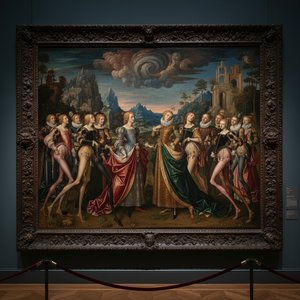
Spranger’s career truly ascended when he was appointed court painter to Pope Pius V in 1570. However, his most enduring legacy lies in his service to the Holy Roman Emperor Rudolf II, a passionate collector of art and esoteric knowledge. Rudolf's relocation of the imperial court to Prague in 1581 marked a turning point for Spranger. The emperor’s fascination with classical antiquity, mythology, and alchemy profoundly influenced the artist’s work. Spranger responded directly to these preferences, creating a body of paintings dominated by exquisitely rendered nude figures – often seen from behind, conveying an aura of mystery and sensuality. These weren't merely decorative studies; they were carefully constructed allegories reflecting Rudolf II’s philosophical leanings and his desire to project an image of power and sophistication.Style and Technique: Northern Mannerism at its Peak
Spranger’s style is a quintessential example of Northern Mannerism, characterized by elongated figures, complex poses, and a deliberate emphasis on elegance and refinement. His paintings are distinguished by their smooth modeling, meticulous detail, and a subtle use of color. He skillfully blended Netherlandish realism with Italian mannerist influences, particularly the Roman tradition of depicting classical mythology. His drawings, in particular, possess remarkable energy and freedom – a testament to his masterful draftsmanship. Spranger’s work is notable for its dynamism, achieved through carefully orchestrated diagonals and a sense of movement within each composition. The influence of his earlier training in landscape painting can be seen in the atmospheric backgrounds he often employed, adding depth and context to his figures.Legacy and Influence
Bartholomeus Spranger’s impact on European art is considerable. His paintings, particularly those housed in Vienna's Kunsthistorisches Museum, represent a pinnacle of Northern Mannerism. His work served as an inspiration for subsequent generations of artists, including the Dutch Republic, where his style was widely disseminated through prints and by artists who had worked with him. The meticulous detail and sensual appeal of his nudes continue to captivate viewers today, solidifying Spranger’s place as a master of his craft and a significant figure in the history of Western art. His story is one of artistic evolution, shaped by diverse influences and ultimately defined by his unique vision—a vision that seamlessly blended eroticism, allegory, and imperial grandeur.Запитання та відповіді
Де я можу побачити роботи Bartholomeus Spranger у 3D-галереї?
Твори Bartholomeus Spranger можна побачити в 3D-галереї на сторінці митця 3D Музей.
Наскільки популярні роботи Bartholomeus Spranger?
Для Bartholomeus Spranger існує сторінка Статистика, на якій представлено статистику про художні роботи митця на цей вебсайт.
Де можна знайти роботи Bartholomeus Spranger, згруповані за технікою виконання?
Роботи Bartholomeus Spranger можна переглянути за технікою виконання на сторінці митця Усі техніки.