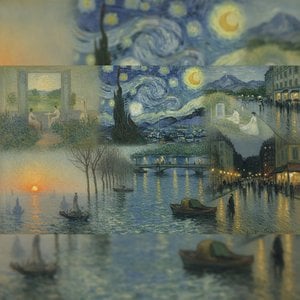
The Luminous Journey of Armand Schonberger
Armand Schonberger (1885–1974) stands as a captivating figure in the tapestry of early 20th-century modernism, a painter whose brush bridged the delicate light of Impressionism with the fractured, rhythmic energy of Cubism. Born in Galgóc and later finding his artistic soul within the vibrant bohemian circles of Munich and Budapest, Schonberger’s life was a continuous dialogue between tradition and the avant-garde. As the son of the engraver Mór Schönberger, he was immersed in an environment where craftsmanship met creativity from his earliest years. His initial path was one of self-taught devotion, beginning with the imitation of the great Mihály Munkácsy, but his hunger for formal exploration soon led him to the prestigious halls of the Hungarian Academy of Fine Arts and eventually to the revolutionary atmosphere of Munich.
The evolution of Schonberger’s style was deeply rooted in the shifting artistic currents of Europe. In Munich, he moved away from rigid academism, seeking instead the freedom offered by the school of the Slovenian painter Anton Ažbe. This period of experimentation allowed him to absorb the psychological depth and expressive color palettes characteristic of masters like Gustav Klimt and Edvard Munch. His fascination with Symbolism infused his work with a sense of spiritual inquiry, as he sought to capture not just the visible world, but the unseen textures of the subconscious. This era of his development was marked by a profound sensitivity to atmosphere, where light was not merely a physical phenomenon but an emotional medium used to evoke serenity and grandeur.
A Synthesis of Form and Light
As Schonberger’s career progressed, his encounter with the radical shifts in Paris during 1909 fundamentally altered his visual language. The monumental influence of Paul Cézanne’s structural approach to space and Robert Delaunay’s vibrant Cubist-Expressionism provided him with the tools to deconstruct reality. He began to move beyond the soft, atmospheric landscapes of his Impressionistic period—exemplified by works such as Bank Of The Seine—toward a more geometric and fragmented interpretation of the world. This transition was not a rejection of his earlier mastery of light, but rather a sophisticated integration of it; he learned to apply luminous colors to the bold, rhythmic planes of modern abstraction.
His later works demonstrate a remarkable ability to navigate diverse genres, from intimate portraits to dynamic urban scenes. In pieces like Tempera, one can witness the artist’s mastery of the Cubist aesthetic, where fragmented urban forms and bold colors create a sense of movement and modern vitality. Similarly, his landscapes and genre scenes often retain a soulful, textured quality that speaks to his roots in the Nagybánya school. Whether exploring the muscularity of a Nude Composition or the cool, geometric abstractions of a Cityscape, Schonberger’s work remains anchored by a unique tension between the organic beauty of nature and the structured intellect of modernism.
Legacy and Historical Significance
Beyond his individual stylistic achievements, Armand Schonberger played a vital role in the collective movement of the European avant-garde. He was a key participant in the intellectual ferment of the 1910s, collaborating with influential groups such as the Tett (Deed) and Ma (Today) magazines under the leadership of Lajos Kassák. As a founding member of the Hetek painting group, he stood at the forefront of a generation that sought to redefine Hungarian and European art through a lens of radical modernity. His ability to synthesize the disparate movements of his time—Impressionism, Symbolism, and Cubism—ensures his place as a significant architect of the modern visual era, leaving behind a body of work that continues to resonate with its profound emotional depth and structural brilliance.