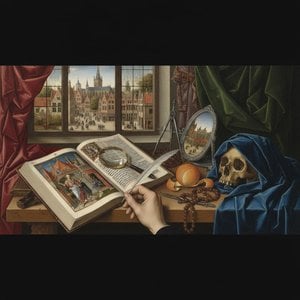
The Silent Majesty of Mary: Unveiling Jan van Eyck’s Lucca Madonna
Jan van Eyck's Lucca Madonna, painted in 1437, isn’t merely a depiction of the Virgin and Child; it’s an immersive experience, a meticulously crafted jewel box offering glimpses into the burgeoning world of Early Netherlandish art. More than six centuries after its creation, this small panel radiates with an almost unsettling intensity – a testament to van Eyck's revolutionary techniques and his profound understanding of symbolism. Housed within the Städel Museum in Frankfurt, it invites viewers to linger, to decipher the layers of meaning embedded within its serene yet complex composition.
The painting immediately captivates with its luminous quality, a hallmark of van Eyck’s pioneering use of oil paint. Unlike the tempera-based pigments favored by his predecessors, oil allowed for unprecedented detail and depth – each fold in Mary’s crimson gown, each glint of light on the infant Christ’s face, is rendered with astonishing precision. This mastery isn’t simply technical; it’s a deliberate choice to draw the viewer into the scene, creating an illusion of tangible reality. The palette itself is restrained yet rich, dominated by deep reds and blues offset by earthy browns and golds, lending the image a sense of quiet dignity.
A Throne of Wisdom: Symbolism in Every Detail
The composition is meticulously structured around the concept of divine authority. Mary isn’t simply seated; she occupies a throne – not one of earthly power, but a symbolic representation of Solomon's throne, adorned with twelve lion statues crafted from brass. This immediately elevates her status, connecting her to biblical precedent and reinforcing her role as Queen of Heaven. The placement of the figures within the room is equally deliberate. The narrow space, reminiscent of a small chapel, directs the viewer’s gaze towards Mary and Christ, creating a sense of intimacy and reverence.
- The Bowl: Positioned near the bottom right corner, this simple bowl symbolizes purity and innocence – a visual echo of the Virgin’s own immaculate conception.
- The Vase: Situated on the far right side, the vase represents Mary’сь role as a vessel for Christ, mirroring the concept of the Eucharist and her connection to the sacrament.
- The Cup: Above the bowl, a cup signifies the Eucharist, further emphasizing the central theme of sacrifice and redemption.
- The Book: Found towards the top right corner, this book symbolizes knowledge and wisdom – qualities associated with both Mary and Christ.
Beyond these primary symbols, subtle details contribute to the painting’s richness. The window behind them, crafted from crown glass, reflects light and adds depth to the scene. A shelf holds a half-filled carafe, suggesting domestic tranquility alongside spiritual devotion. Even the floor tiles, patterned with geometric designs, speak to an ordered universe governed by divine principles.
A Window into a Renaissance Mind
The Lucca Madonna is more than just a beautiful painting; it’s a window into the intellectual and artistic landscape of the Early Northern Renaissance. Van Eyck's meticulous attention to detail, his innovative use of oil paint, and his profound understanding of symbolism reflect the era’s fascination with realism, religious devotion, and human potential. It stands as a testament to the burgeoning humanist ideals that were beginning to challenge medieval orthodoxies, while simultaneously reaffirming the importance of faith and tradition.
Considered alongside other works by Jan van Eyck, such as the Ghent Altarpiece and the Portrait of Giovanni Arnolfini, the Lucca Madonna offers a compelling glimpse into the artist’s evolving style and his mastery of technique. Its enduring appeal lies not only in its aesthetic beauty but also in its ability to evoke a sense of wonder and contemplation – a reminder of the power of art to transcend time and connect us to something larger than ourselves.
For those seeking a high-quality reproduction, WahooArt offers stunning reproductions of this masterpiece. To learn more about Jan van Eyck and his legacy, visit WahooArt’s page or explore the Northern Renaissance on Wikipedia: Wikipedia.
The Lucca Madonna’s luminous quality, achieved through van Eyck's masterful application of oil paint—a revolutionary departure from tempera—immediately establishes it as a cornerstone of Early Netherlandish art. This technique allowed for unprecedented levels of detail and tonal gradation, capturing the subtle nuances of light and shadow with remarkable accuracy. The painting’s serene composition centers around Mary seated on a throne adorned with twelve brass lion statues, symbolizing Solomon's throne and elevating her spiritual stature.
The carefully positioned bowl and vase serve as potent symbols—the bowl representing purity and innocence, mirroring the Virgin’s immaculate conception; the vase embodying Christ’s role as vessel of divine grace. Above them hangs a cup signifying the Eucharist, reinforcing the central theme of sacrifice and redemption. The inclusion of a book symbolizes wisdom and knowledge, reflecting the intellectual currents of the Renaissance.
Furthermore, subtle visual elements contribute to the painting's profound impact—the window crafted from crown glass diffusing light and creating depth; the shelf displaying a carafe symbolizing domestic tranquility alongside spiritual devotion; and the geometric floor tiles conveying an ordered cosmos governed by divine principles. The Lucca Madonna remains a testament to Jan van Eyck’s artistic genius and his ability to infuse religious iconography with humanist ideals.



 Переглянути в інтер'єрі
 Купити картину ручної роботи
 Надіслати
 Поділитися
 Деталі
 Посібник

 Завантажити
 Схожі предмети колекціонування
 Рентгенівське дослідження
 Слайд-шоу
 Статистика переглядів


 Читати далі






































 Скляний варіант доступний лише для розмірів до 110 см