The Soul of a City – Unveiling El Greco’s “A View of Toledo”
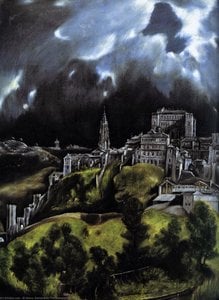
El Greco’s “A View of Toledo,” painted in 1597 and now residing within the Metropolitan Museum of Art, is far more than just a picturesque depiction of a Spanish city. It's an immersive journey into a landscape saturated with psychological depth – a visceral expression of spiritual tension and impending drama. Born Domenikos Theotokopoulos on the island of Crete, his artistic evolution was a remarkable synthesis of Byzantine tradition, Italian Mannerism, and Venetian Renaissance influences, culminating in a uniquely personal style that continues to resonate centuries later. “A View of Toledo” stands as the pinnacle of this transformation, showcasing El Greco’s mastery of elongated figures, intensely vibrant pigmentation, and an unparalleled ability to evoke atmosphere and emotion.
The painting immediately commands attention with its overwhelming sense of foreboding. A colossal hill dominates the composition, crowned by a formidable castle – a silent sentinel anchoring the scene within a valley bisected by two powerful rivers. These waterways aren’t serene; they surge forward with an almost violent energy, mirroring the turmoil brewing above. Scattered throughout the image are figures – not idealized inhabitants enjoying the vista, but individuals engaged in everyday activities, seemingly oblivious to the impending storm. This deliberate juxtaposition of human activity and atmospheric drama creates a potent sense of unease, suggesting that even amidst routine, a deeper, more unsettling reality lies beneath the surface. The artist doesn’t offer comfort or resolution; instead, he presents a world poised on the brink.
A Synthesis of Artistic Influences
El Greco's distinctive style in “A View of Toledo” is a testament to his diverse artistic training. The painting’s foundation rests firmly within the Byzantine tradition – evident in the meticulous detail, the rich, layered colors, and the stylized rendering of figures. However, he skillfully integrates elements of Italian Mannerism, particularly in the elongated forms and dramatic perspective, alongside Venetian Renaissance influences, most notably in the use of color and light. This confluence results in a style that anticipates the emotional intensity of Expressionism and the fragmented forms of Cubism – movements centuries later. The artist’s signature, “Krḗs” (Cretan), proudly declares his origins, even as he boldly ventured into new artistic territories.
Notice the careful construction of the scene. El Greco employs a technique known as *sfumato*, subtly blurring outlines and creating an atmospheric haze that contributes to the painting’s sense of mystery and unease. The use of color is particularly striking – deep blues and blacks dominate the sky, contrasting sharply with the vibrant greens of the hills and the muted tones of the figures below. This creates a dynamic interplay of light and shadow, further enhancing the painting's dramatic effect.
The Symbolism of Toledo
Toledo itself held immense significance in 16th-century Spain – a city steeped in history, religious fervor, and political intrigue. It was a stronghold of Catholicism and a symbol of Spanish identity. El Greco, who spent his later years in Toledo, likely imbued the painting with layers of symbolic meaning. The castle atop the hill could represent the strength and resilience of faith, while the turbulent rivers might symbolize the challenges and uncertainties faced by humanity. The seemingly oblivious figures in the foreground could be interpreted as a commentary on human complacency – a warning against neglecting spiritual concerns amidst worldly distractions.
Interestingly, some scholars believe that El Greco’s Toledo wasn't entirely faithful to the actual city. He may have used it as a canvas for his imagination, creating an idealized vision of the landscape—a reflection of his own inner world and spiritual beliefs. The slight inaccuracies in the placement of landmarks suggest a deliberate departure from strict topographical realism, prioritizing emotional impact over precise representation.
A Legacy of Dramatic Intensity
“A View of Toledo” is more than just a landscape; it’s a profound meditation on faith, doubt, and the human condition. El Greco's masterful use of color, composition, and symbolism creates an unforgettable experience for the viewer – one that lingers long after the painting has been observed. It’s a testament to his ability to transform a simple depiction of a city into a powerful expression of spiritual tension and emotional depth. Owning a reproduction of this iconic artwork offers a unique opportunity to connect with the genius of El Greco and immerse oneself in the soul of a city.



 Переглянути в інтер'єрі
 Замовити репродукцію ручної роботи
 Надіслати як листівку
 Поділитися
 Детальніше

 Завантажити
 Схожі експонати
 Рентгенівське дослідження
 Слайд-шоу
 Статистика


 Читати далі






































 Скляний варіант доступний лише для розмірів до 110 см