Стати продавцем
x
Переглянути в інтер'єріПереглянути в інтер'єрі Перегляд в ARПерегляд в AR Замовити принт Замовити принтКупити цифрове зображення Купити цифрове зображення Надіслати як листівкуНадіслати як листівку
ДетальнішеДетальніше Додати до улюблених Додати до улюблених ЗавантажитиЗавантажити Схожі експонатиСхожі експонати Рентгенівське дослідженняРентгенівське дослідження Слайд-шоуСлайд-шоу

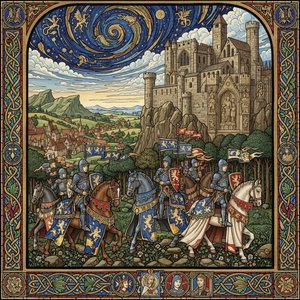
Medieval Pageantry

Discover John Taylor Arms’ ‘Medieval Pageantry,’ an exquisite 1934 etching of a grand cathedral scene. Admire intricate detail & historical realism at the Smithsonian!

John Taylor Arms (1887-1953) was a renowned American etcher celebrated for his detailed cityscapes, gothic architecture series of French & Italian cathedrals, and masterful printmaking techniques. Explore his iconic works!

Олійная репродукція ручної роботи

Написана вручну олією на полотні у вашому розмірі та рамі, виготовлена на замовлення нашими художниками. (Замовити принт Замовити принтКупити цифрове зображення Купити цифрове зображення)

Standard
custom
CM
INCH

Обирайте з наших стандартних розмірів, що відповідають оригінальним пропорціям твору мистецтва.

ширина
висота

Ви можете вказати власні розміри, щоб репродукція ідеально підійшла до конкретної рами або інтер'єру. Якщо вибраний вами розмір не відповідає пропорціям оригіналу, ми або обріжемо полотно, або доповнимо картину додатковими елементами, промальованими вручну. Цифровий макет буде надіслано вам на затвердження перед початком виробництва.
Зверніть увагу, що попередній перегляд на екрані не відображає фактичне обрізання або розширення зображення. Тільки макет точно покаже остаточну композицію.
Хоча ми можемо виготовити виріб у нестандартному розмірі, для збереження оригінальних пропорцій рекомендуємо обирати варіанти зі встановленого списку.

Приклади можливих змін: замінити обличчя на фото клієнта; додати домашню тварину (наприклад, замінити кота на собаку); додати приховане повідомлення на фоні; змінити ландшафт або елементи фону.
Після оформлення замовлення команда WahooArt.com зв'яжеться з клієнтом електронною поштою для отримання інструкцій та надасть попередній макет

Доставка по всьому світу () за 3–4 тижні замість стандартних 5 тижнів. (19 Серпень). Без жодних компромісів у якості.

why_choose_icon
Безкоштовна експрес-доставка по всьому світу
why_choose_icon
Високоякісне лляне полотно
why_choose_icon
Повне страхове покриття доставки
why_choose_icon
Гарантія відшкодування митних зборів
why_choose_icon
Гарантія точного відтворення кольорів
why_choose_icon
Політика повернення протягом 60 днів (лише у разі виявлення дефектів)
why_choose_icon
Гарантія повернення 100% коштів
why_choose_icon
Пропозиція на оптові замовлення

Загальна вартість

$ 622

reproduction

Medieval Pageantry

Матеріал репродукції

Розмір репродукції

-

Підсумкова вартість

$ 622

Опис твору

The Medieval Pageantry is a captivating etching created by John Taylor Arms in 1934. This artwork is a testament to the artist's skill and attention to detail, showcasing a medieval scene with a large church and a horse-drawn carriage. The etching measures 32 x 22 cm and is currently housed at the Smithsonian American Art Museum in the United States.

The Artist and His Work

John Taylor Arms was an American etcher, born in Washington, DC in 1887. He studied architecture at the Massachusetts Institute of Technology, Boston, graduating in 1912. After serving as an officer in the United States Navy during World War I, he devoted himself full-time to etching. His work is characterized by its precision and attention to detail, often depicting medieval churches and cathedrals. The Medieval Pageantry is a prime example of John Taylor Arms' skill in capturing the essence of medieval life. The etching features a large church with a tall steeple tower, surrounded by people and a horse-drawn carriage. The level of detail in the artwork is impressive, with intricate stone carvings and ornate architectural features.

Key Features of the Artwork

Some key features of the Medieval Pageantry include:
  • The use of etching techniques to create a detailed and intricate image
  • The depiction of medieval architecture, showcasing the artist's interest in historical buildings
  • The inclusion of people and animals in the scene, adding a sense of life and movement to the artwork
For more information on John Taylor Arms and his work, visit /art/list/?Filter=John-Taylor-Arms. To learn more about the Smithsonian American Art Museum, visit https://en.wikipedia.org/wiki/Smithsonian_American_Art_Museum.
The Medieval Pageantry is a remarkable artwork that showcases the skill and artistry of John Taylor Arms. Its intricate details and historical significance make it a must-see for anyone interested in medieval art and architecture.

Біографія митця

The Architect of the Etched Line

John Taylor Arms was far more than a mere printmaker; he was an architect of light and shadow, a man who used the needle to resurrect the grandeur of a bygone era. Born in Washington, D.C., on April 19, 1887, his early life was marked by a rigorous intellectual pursuit that would later define the precision of his art. Before he ever touched an etching plate, Arms navigated the demanding corridors of Princeton University, studying law, before pivoting toward the structural complexities of architecture at the Massachusetts Institute of Technology. This foundational training in architectural drafting provided him with a unique ocular discipline, allowing him to perceive the world not just as a collection of shapes, but as a sophisticated interplay of weight, balance, and historical narrative.

The turbulence of the early twentieth century left an indelible mark on his spirit. Serving as an officer in the United States Navy during World War I, Arms experienced a world in flux, yet it was this very period of service that seemed to crystallize his dedication to craftsmanship. Upon returning to civilian life, he turned his focus toward the graphic arts, publishing his first original etchings in 1919. His initial subject matter—the soaring, industrial majesty of the Brooklyn Bridge—demonstrated an early mastery of perspective and tonal gradation, proving that his architectural eye could find beauty in both the ancient and the modern.

A Devotion to Gothic Grandeur

As his career matured throughout the 1920s and 30s, Arms’ artistic gaze drifted from the steel spans of New York toward the hallowed, stone-carved sanctuaries of Europe. He became a preeminent interpreter of Gothic architecture, particularly the magnificent cathedrals of France and Italy. While many of his contemporaries were swept up in the fluid, emotive strokes of Impressionism, Arms remained steadfast in his commitment to an almost scientific accuracy. To him, every flying buttress, every intricate finial, and every delicate rose window held a spiritual and historical weight that demanded absolute fidelity.

His technical process was nothing short of legendary among printmaking circles. To achieve the microscopic detail required to render medieval stone carvings, Arms employed unconventional tools, such as sewing needles, to etch hairline precision into his plates. Working under the scrutiny of magnifying glasses, he painstakingly built layers of texture and depth, creating works that felt less like prints and more like windows into the past. This meticulousness allowed him to capture the soul of the architecture; through his lines, one could almost feel the cool dampness of a cathedral nave or the weight of centuries-old masonry.

Legacy in Ink and Iron

The significance of John Taylor Arms lies in his ability to bridge the gap between technical documentation and fine art. His oeuvre serves as a vital graphic record of architectural splendor, preserving the intricate details of medieval structures with a clarity that photography of the era could not replicate. His work was celebrated by numerous printmaking societies, and he became a prominent figure in the American graphic arts scene, blending humanist sensibilities with his structural expertise.

Throughout his life, Arms’ contributions to the medium can be summarized by several defining characteristics:

  • Architectural Precision: A unique ability to translate complex structural engineering into delicate, expressive line work.
  • Historical Preservation: The use of etching as a tool to document and venerate the Gothic and medieval heritage of Europe.
  • Technical Innovation: The mastery of specialized tools and extreme detail that pushed the boundaries of traditional printmaking.
  • Tonal Mastery: An exceptional command over light and shadow, creating atmospheric depth within monochromatic compositions.

When he passed away in 1953, Arms left behind a legacy etched into the very fabric of American printmaking history. His works, now held in prestigious institutions such as the Smithsonian American Art Museum, continue to inspire awe, reminding us that true beauty is often found in the most minute and meticulously crafted details.

John Taylor Arms

John Taylor Arms

1887 - 1953

Короткі факти

  • Artistic Movement Or Style: Gothic Architecture Series
  • Date Of Birth: 1887
  • Date Of Death: 1953
  • Full Name: John Taylor Arms
  • Nationality: American
  • Notable Artworks:
    • Medieval Pageantry
    • Somewhere in France
    • French Lace
  • Place Of Birth: Washington, DC