The Dawn of Modern Landscape: Cézanne’s “Mountains in Provence”
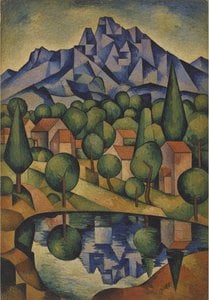
Paul Cézanne's "Mountains in Provence," painted in 1890, isn’t merely a depiction of a Provençal hillside; it’s a pivotal moment in art history – the tangible beginning of a revolutionary shift away from traditional representation and towards a new understanding of form, color, and space. This oil on canvas, currently residing within the esteemed National Gallery in London (measuring 65 x 81 cm), embodies Cézanne's unique approach to capturing nature: one rooted not in photographic accuracy, but in meticulous observation and a deliberate, structured analysis of the world around him. It’s a painting that whispers of quiet contemplation, inviting us to lose ourselves within its geometric harmony and luminous depths.
The scene unfolds with serene beauty – a hillside bathed in the soft light characteristic of Provence. The foreground is populated by trees, rendered with Cézanne's signature brushstrokes—not as individual leaves, but as blocks of color and texture, suggesting volume and mass rather than detailed representation. A prominent rock wall anchors the composition, providing a sense of solidity and depth. Nestled in the distance, a small village offers a grounding element, a reminder of human presence within this vast landscape. Cézanne masterfully avoids the illusionistic techniques of earlier painters; instead, he organizes these elements into distinct geometric planes – horizontal bands representing landforms, vertical blocks for trees and rock – creating a composition that feels both profoundly naturalistic and deliberately constructed.
Building Form with Color: Cézanne’s Innovative Technique
Cézanne's artistic style in “Mountains in Provence” is defined by his relentless pursuit of form and his groundbreaking use of color. He abandoned the fleeting impressions favored by the Impressionists, opting instead to build up complex fields of color that define volume and structure. Notice how he employs repetitive, exploratory brushstrokes—not blended smoothly, but applied in small, distinct strokes – to create a textured surface. These aren’t simply colors; they are planes of color—varying shades of green, brown, yellow, and touches of blue—carefully layered to represent the rocks and trees. This technique is remarkably anticipatory; it foreshadows his later explorations into geometric abstraction, laying the groundwork for artists like Picasso and Braque.
The artist’s deliberate choice not to blend colors creates a remarkable sense of solidity and presence within the painting. The individual strokes catch the light differently, adding dynamism and visual interest. This technique is crucial to understanding Cézanne's revolutionary approach – he wasn’t trying to capture a fleeting moment; he was striving to represent the *essence* of the landscape, its underlying structure and form.
A Bridge Between Eras: Historical Context and Influence
"Mountains in Provence" emerged during a period of profound artistic transformation. Cézanne was actively moving away from the subjective impressions of Impressionism towards a more objective, analytical approach to art. He wasn’t simply reacting against Impressionism; he was building upon its foundations, pushing them in new and exciting directions. The painting reflects his deep engagement with the landscape of Provence – particularly Mont Sainte-Victoire, which looms prominently in the background, serving as both a subject and an obsession for the artist throughout his career. Cézanne’s repeated studies of this mountain are legendary, demonstrating his tireless dedication to understanding its form and capturing its essence on canvas.
The influence of Cézanne's work is undeniable. He paved the way for Cubism, with its fragmented forms and multiple perspectives, and inspired generations of artists to reconsider their relationship to nature and representation. His emphasis on structure and geometric abstraction fundamentally altered the course of modern art, establishing a new visual language that continues to resonate today.
The Emotional Resonance of Provence
Beyond its technical innovations, “Mountains in Provence” evokes a powerful sense of tranquility and contemplation. The muted colors, the simplified forms, and the deliberate composition all contribute to this feeling of serene beauty. It’s a painting that invites us to slow down, to observe, and to appreciate the simple elegance of the natural world. The light, diffused and soft, suggests either an early morning or late afternoon – a timeless moment captured forever on canvas. This is not merely a landscape; it's an invitation to find peace within the grandeur of nature.



 Переглянути в інтер'єрі
 Перейти до друку
 Надіслати
 Поділитися
 Деталі
 Посібник

 Завантажити
 Схожі предмети колекціонування
 Рентгенівське дослідження
 Слайд-шоу
 Статистика переглядів


 Читати далі






































 Скляний варіант доступний лише для розмірів до 110 см