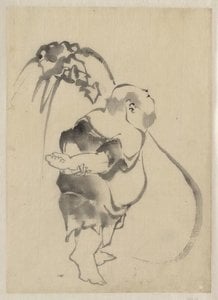
A Life Etched in Ink: The World of Katsushika Hokusai
Katsushika Hokusai, a name that resonates deeply within the world of art and inextricably linked to the iconic image of *The Great Wave off Kanagawa*, was far more than simply a printmaker. Born in Edo (modern-day Tokyo) around 1760, his life unfolded as an extraordinary, restless pursuit of artistic mastery – a continuous evolution characterized by shifting names and an insatiable curiosity about the world around him. From humble beginnings as the son of a mirror maker, Hokusai’s initial inclination towards art wasn't immediately nurtured; however, he relentlessly honed his skills, reportedly beginning to draw at the tender age of six. This unwavering dedication would ultimately define a career spanning nearly nine decades, leaving behind a legacy that continues to captivate and inspire audiences globally. His father, Nakajima Ise, though not himself an artist, recognized and perhaps subtly fostered this nascent talent, providing the foundational support for a journey that would fundamentally transform Japanese visual culture. Hokusai’s early life wasn't one of privilege or ease; rather, it was a steady climb fueled by ambition, a deep-seated passion to capture the essence of the world in all its fleeting beauty and enduring strength.
From Apprenticeship to Innovation: The Blossoming of a Style
Hokusai’s formal artistic training commenced at twelve when he entered the prestigious studio of Katsukawa Shunshō, a leading master of *ukiyo-e* – “pictures of the floating world.” This vibrant genre, immensely popular during the Edo period, served as a mirror reflecting the diverse facets of Japanese society: actors performing in Kabuki theaters, courtesans embodying elegance and allure, sweeping landscapes capturing the beauty of nature, and glimpses into the bustling urban life of Edo. Under Shunshō’s tutelage, Hokusai diligently mastered the intricate techniques of woodblock printing – a demanding process requiring exceptional precision, artistic skill, and an understanding of color theory. Yet, he possessed a spirit that refused to be confined by mere imitation; even in his early works, a palpable restlessness was evident, a desire to push boundaries, experiment with new subjects, and ultimately forge his own unique visual language. He began exploring various avenues of expression, venturing beyond the traditional confines of *ukiyo-e* to include book illustrations and single-sheet prints, constantly refining his skills and developing a distinctive style that would soon set him apart. This period also marked the beginning of a fascinating pattern – a series of name changes, a common practice among Japanese artists of the time, each shift signifying a new phase in his artistic development or an affiliation with different schools and styles.
Mount Fuji and the Floating World: Defining Masterpieces
Hokusai’s artistic output was astonishingly prolific; tens of thousands of sketches, prints, illustrated books, and paintings bear his signature – a testament to his tireless dedication. While he explored a remarkably diverse range of subjects – from scenes of everyday life to fantastical creatures and detailed botanical studies – it was his series *Thirty-Six Views of Mount Fuji* (circa 1831) that cemented his enduring fame and established him as one of the greatest artists in Japanese history. This monumental collection wasn’t simply a straightforward depiction of a mountain; rather, it was a profound exploration of perspective, composition, and the raw power of nature. *The Great Wave off Kanagawa*, arguably the most recognizable image in the series, embodies both the breathtaking beauty and the terrifying force of the ocean – a towering wave poised to engulf tiny fishing boats, capturing a moment of sublime drama. Beyond *Fuji*, works such as *Fireworks at Ryōgoku Bridge* (1790) demonstrated his remarkable ability to capture dynamic scenes of daily life with an astonishing level of energy and detail, showcasing his mastery of color and composition. His *Hokusai Manga* – a collection of sketches and studies encompassing people, animals, landscapes, and fantastical creatures – was groundbreaking in its scope and influence, foreshadowing the development of modern manga as an art form. These works weren’t isolated achievements; they were milestones in a continuous artistic journey, each building upon the last to create a body of work that is both deeply rooted in Japanese tradition and remarkably innovative.
A Legacy Beyond Borders: Hokusai's Enduring Influence
Hokusai’s impact extended far beyond the borders of Japan. As Japan cautiously opened its doors to the West during the late 19th century, *ukiyo-e* prints flooded European markets, sparking a phenomenon known as *Japonisme*. Artists like Claude Monet, Edgar Degas, and Vincent van Gogh were profoundly influenced by Hokusai’s bold compositions, vibrant colors, and unconventional perspectives. Van Gogh, in particular, was deeply moved by *The Great Wave*, even recreating it in his own paintings, demonstrating a clear understanding of its dynamic energy and emotional impact. Hokusai's influence wasn’t limited to Impressionism; it permeated various modern art movements, shaping the way artists approached composition, color, and subject matter. His emphasis on capturing fleeting moments, his masterful use of line, and his ability to find beauty in everyday life resonated with a generation of artists seeking new forms of expression. Even today, Hokusai’s work continues to inspire and challenge artists around the world, solidifying his place as one of the most important figures in art history – an artist whose vision transcends cultural boundaries and connects us to something profoundly universal.
The Old Man Mad About Painting
Hokusai's life was a testament to relentless self-improvement and artistic exploration, marked by numerous name changes – over thirty throughout his career – each reflecting a new phase in his artistic development or an affiliation with different schools and styles. He often referred to himself as “Gakyō Rōjin,” or "Old Man Crazy to Paint," a fitting title for an artist who remained passionately devoted to his craft well into his eighties. This unwavering commitment to perfection, coupled with his innovative spirit and profound understanding of both Japanese tradition and the wider world, cemented Hokusai’s legacy as a true master of *ukiyo-e* and a pivotal figure in the history of art. His work continues to captivate audiences, reminding us of the power of art to transcend cultural boundaries and connect us to something larger than ourselves.
- Major Influences: Ukiyo-e traditions, Chinese landscape painting, everyday life in Edo.
- Key Characteristics: Bold lines, vibrant colors, dynamic compositions, keen observation of nature.



 Переглянути в інтер'єрі
 Перейти до друку
 Надіслати як листівку
 Поділитися
 Детальніше

 Завантажити
 Схожі експонати
 Рентгенівське дослідження
 Слайд-шоу
 Статистика
 Читати далі






































 Скляний варіант доступний лише для розмірів до 110 см