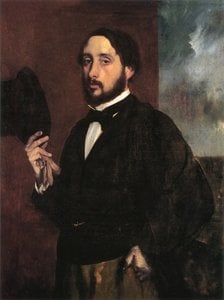
A Life Immersed in Movement
Edgar Degas, born Hilaire-Germain-Edgar De Gas in Paris on July 19, 1834, remains one of the most intriguing and complex figures in art history. Often grouped with the Impressionists – alongside Monet, Renoir, and others who revolutionized painting in the late 19th century – Degas fiercely resisted this label, identifying instead as a realist. This commitment stemmed from his unwavering dedication to observing the world around him with meticulous detail and portraying it with an honesty that challenged conventional artistic norms. His early life was comfortably bourgeois; his father, Auguste, was a banker, and his mother, Celestine, hailed from a Creole family in New Orleans – a heritage that subtly informed his unique perspective. This background afforded him access to education and artistic training, though he often felt constrained by the rigid structures of academic art. Initially enrolled at the Lycée Louis-le-Grand, Degas’s true education began when he started spending hours copying works within the hallowed halls of the Louvre, honing his skills and igniting a lifelong passion for classical art. However, Degas's path wasn’t one of simple adherence to tradition; it was marked by constant questioning and a relentless reevaluation of artistic conventions. He possessed an independent spirit – a rebellious streak – that would define his entire career and ultimately shape the distinctive character of his work.
Beyond Impressionism: A Unique Artistic Vision
While contemporaries like Monet chased the fleeting effects of light outdoors, capturing the ephemeral beauty of landscapes, Degas largely worked within the confines of his studio. He meticulously constructed scenes from observation and memory, creating a world that felt both familiar and subtly altered. His subject matter was decidedly modern – a deliberate departure from the historical or mythological themes favored by many academic painters. Instead, he found inspiration in the everyday lives of Parisians: laundresses hauling their heavy loads, cabaret singers captivating audiences with their performances, milliners crafting elaborate hats, and, most famously, dancers—particularly those performing at the Paris Opera Ballet. It is this fascination with ballet that profoundly shaped much of his oeuvre. Degas didn’t simply paint beautiful ballerinas; he captured the grueling reality of their profession – the endless rehearsals, the physical strain, the fleeting moments of grace amidst a world of relentless hard work and demanding expectations. His compositions are often unconventional, cropping figures in unexpected ways—sometimes isolating them within tightly framed spaces, or presenting them at unusual angles—and utilizing asymmetrical arrangements that create a sense of dynamism and immediacy. He was a master of capturing movement, not through blurred lines or hazy effects, but through precise observation, careful rendering of form, and an understanding of the underlying structure of the human body in motion. Works like *Dancer, A Group of Dancers*, *Women Combing Their Hair*, and *The Dance Class* are prime examples of this dedication to portraying the human figure in motion and revealing the complexities of modern life. He wasn’t interested in superficial beauty; he sought to expose the truth beneath the surface – the sweat, the strain, the vulnerability—of his subjects.
Influences and Artistic Development
Degas's artistic journey was a rich tapestry woven from diverse influences. His early training emphasized classical principles, particularly the work of Jean-Auguste-Dominique Ingres, whose emphasis on draftsmanship, precise line, and idealized forms left an indelible mark on his style. However, Degas also admired the Realists – artists like Gustave Courbet who challenged academic conventions and championed the depiction of contemporary life with unflinching honesty. A pivotal moment in his development came through his association with Camille Pissarro, a leading Impressionist who encouraged him to experiment with new techniques and broadened his artistic horizons. He was deeply captivated by Japanese prints—
Ukiyo-e – which exerted a powerful influence on his compositions, particularly his use of asymmetrical arrangements, flattened perspectives, and bold patterns. The dynamic energy and unconventional cropping of these prints resonated profoundly with Degas’s own desire to break free from traditional artistic constraints. He also embraced photography as a tool for studying movement and capturing fleeting moments in time – often using photographs as reference material for his paintings. This willingness to incorporate diverse influences into his work—classical training, Realist principles, Japanese aesthetics, and photographic techniques—is what ultimately defines Degas’s unique style and contributes to the enduring power of his art.
Major Achievements and Legacy
Edgar Degas died in Paris on September 27, 1917, leaving behind a remarkably extensive body of work that continues to captivate and inspire audiences worldwide. His innovative approach to composition, his masterful draftsmanship, and his unflinching portrayal of modern life have had a profound impact on the course of art history. He wasn’t simply a painter of dancers or racehorses; he was a keen observer of human nature, a master of form and movement, and a true innovator who redefined the possibilities of art. His influence can be seen in the work of future generations of artists – from Pablo Picasso to Henri Matisse – demonstrating his lasting legacy as one of the most significant figures of the late 19th and early 20th centuries. Museums across Europe—including the Musée d'Orsay and the Musée de l’Orangerie in Paris—house significant collections of his paintings, pastels, sculptures, and prints, ensuring that his artistic vision will continue to be appreciated for years to come. Degas’s work stands as a testament to the power of observation, experimentation, and a refusal to conform to established conventions.
- Masterful Draftsmanship: His exceptional skill in drawing was unparalleled.
- Modern Subject Matter: He brought contemporary Parisian life into his art.
- Influence on Modern Art: His work paved the way for future generations of artists.



 Переглянути в інтер'єрі
 Замовити репродукцію ручної роботи
 Надіслати як листівку
 Поділитися
 Детальніше

 Завантажити
 Схожі експонати
 Рентгенівське дослідження
 Слайд-шоу
 Статистика


 Читати далі






































 Скляний варіант доступний лише для розмірів до 110 см