Arthur Green: A Visionary of Surrealist Iconography
Arthur Green (May 13, 1941 – April 14, 2025), born in Frankfort, Indiana, was an American artist whose distinctive style—characterized by bold geometric abstraction infused with vibrant pop-art motifs—established him as a pivotal figure within the Chicago Imagist movement. His artistic journey began with aspirations of designing automobiles but swiftly pivoted towards graphic design at the School of the Art Institute of Chicago, where he honed his skills and cultivated an unwavering fascination for exploring subconscious imagery and challenging conventional perceptions.
Green’s formative influences stemmed from his upbringing amidst a family steeped in craftsmanship—his father, a civil engineer specializing in bridge construction, instilled in him a meticulous attention to detail, while his mother nurtured her passion for quilting and gardening, fostering an appreciation for organic forms and textural richness. These experiences profoundly shaped his artistic sensibility, informing his approach to composition and color palettes. He embraced the Surrealist aesthetic championed by artists like René Magritte and Salvador Dalí, incorporating dreamlike juxtapositions and symbolic representations into his artworks.
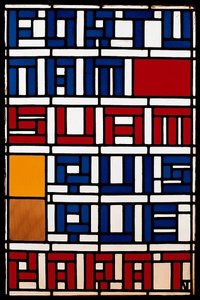
His breakthrough came with “Dead Reckoning,” a digitally rendered stained-glass window that exemplifies Green’s signature style. Combining Art Deco elegance with geometric abstraction—cool blues harmoniously interwoven with fiery reds—the piece speaks to complex ideas of symbolism and contemplation. It's a testament to his ability to distill profound concepts into visually arresting forms, reflecting the core tenets of Imagism: precise visual language prioritizing sensation over intellectual explanation. This artwork solidified Green’s reputation as an innovator who pushed boundaries while maintaining a steadfast commitment to artistic integrity.
- Early Influences & Artistic Education
- The Chicago Imagist Movement & Collaborative Spirit
- Notable Works: Surrealism and Geometric Abstraction
- Controversy & Legacy
Green’s artistic education began at the School of The Art Institute of Chicago, where he initially pursued graphic design but quickly discovered a deeper resonance with painting. Recognizing the limitations of formal instruction in this discipline, he shifted his focus to mastering the techniques of abstraction and Surrealism—influences that would permeate his entire oeuvre. He particularly admired Giorgio de Chirico’s metaphysical period, drawn to its exploration of psychological landscapes and unsettling juxtapositions.
His involvement in Chicago's artistic milieu was marked by a collaborative spirit—he joined forces with Harold Newman and Robert Losey to establish the Chicago Imagist group, which championed a distinctive blend of representational painting and Surrealist iconography. Together, they challenged prevailing artistic conventions and interrogated societal anxieties about modernity, fostering a dialogue that continues to resonate today.
Among Green’s most celebrated artworks are “Dead Reckoning,” a monumental stained-glass window that embodies his stylistic vision—a masterful fusion of Art Deco grandeur and geometric abstraction—and numerous paintings featuring recurring motifs such as ice cream cones, zipper closures, and stylized hands. These pieces exemplify Imagism's commitment to sensory experience and visual precision, conveying complex ideas through deceptively simple forms.
Despite achieving considerable acclaim during his lifetime, Green’s career was unfortunately marred by allegations of sexual misconduct that resulted in sanctions from Hebrew College—a regrettable episode highlighting the importance of ethical conduct within creative professions. Nevertheless, Arthur Green's enduring legacy resides in his groundbreaking contribution to Chicago Imagism and his unwavering dedication to artistic exploration—a testament to the transformative power of imagination and visual storytelling.



 Замовити репродукцію
 Надіслати
 Поділитися
 Деталі

 Завантажити
 Схожі вироби
 Рентгенівське дослідження
 Слайд-шоу


 Розгорнути текст






































 Скляний варіант доступний лише для розмірів до 110 см