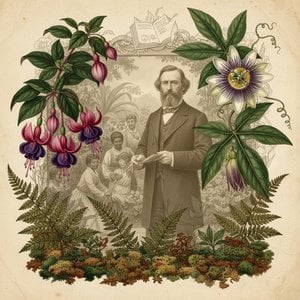
William Hough (1819 – 1897): A Pioneer of Victorian Still Life
William Hough was born in Bangor, Gwynedd, Wales, on November 23, 1819, into a family steeped in artistic tradition. His father, John Hough, was a landscape painter and instilled in William a lifelong appreciation for observation and meticulous detail—qualities that would become hallmarks of Hough’s distinctive style. Despite facing considerable challenges during his formative years due to debilitating illness, Hough persevered with unwavering determination, ultimately establishing himself as one of the most respected British artists of the Victorian era.
Early Life & Artistic Training
Hough's early artistic education began at Shrewsbury School, where he honed his drawing skills and developed a keen understanding of perspective. Recognizing his talent, his father encouraged him to pursue formal studies at Slade School of Fine Art in London, under the tutelage of Frederic Leighton—a pivotal encounter that profoundly shaped Hough’s aesthetic sensibilities. Leighton championed a humanist approach to art, emphasizing moral seriousness and psychological insight—principles that resonated deeply with Hough's artistic vision.
The Aesthetic Movement & Symbolism
Hough emerged as a prominent figure within the Aesthetic Movement, which advocated for art divorced from utilitarian concerns and driven by emotional expression. Influenced by writers like Walter Pater and Oscar Wilde, Hough embraced symbolism as a means of conveying complex ideas and emotions—a technique evident in his masterful depictions of fruit arrangements and botanical studies. He skillfully employed chiaroscuro – dramatic contrasts between light and dark – to heighten the visual impact of his canvases and imbue them with an aura of contemplative beauty.
Notable Works & Artistic Style
Hough’s oeuvre comprises approximately 350 paintings, predominantly still lifes featuring meticulously rendered fruits, flowers, and drapery—often illuminated by soft, diffused light. His compositions are characterized by a remarkable sensitivity to texture and color, reflecting his meticulous observation of nature. Among his most celebrated works include “Fruit and Flowers,” “Study of peaches and plums,” “Still life of a bird’s nest with blossom branch and primroses before a mossy bank,” "A STILL LIFE OF PLUMS AND APPLES," "Blackberries and Ivy on a Mossy Bank," "William Hough," "STILL LIFE WITH FRUIT," "Still life of peaches," "A fallen Lapwing on a mossy bank," “Pears and plums on a mossy bank” and “Still life of pink roses on a marble topped table.” These paintings exemplify the Victorian ideal of decorative art—elegant, refined, and imbued with intellectual depth.
Legacy & Influence
William Hough’s artistic legacy extends beyond his individual achievements; he served as an influential teacher at Slade School of Fine Art for over 30 years, nurturing generations of aspiring artists and fostering a tradition of meticulous observation and symbolic representation. His work continues to inspire admiration for its understated beauty and profound psychological insight—a testament to Hough's enduring contribution to British art history. He died in London on November 28, 1897, leaving behind an impressive body of paintings that remain treasured examples of Victorian artistic excellence.