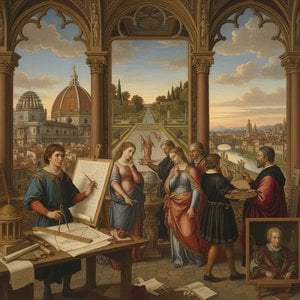
Narciso da Bolzano: A Florentine Sculptor Shaping Renaissance Faith
Narciso da Bolzano, known affectionately as Meister Narziss, stands as a testament to the flourishing artistic spirit of late fifteenth and early sixteenth-century Florence. Born in Bolzano (modern Italy) around 1474, his life’s trajectory intertwined with the burgeoning humanist movement and the profound religious fervor that characterized the era, leaving an indelible mark on Florentine sculpture and altar decoration. While biographical details remain somewhat sparse – largely due to the limitations of archival records – scholarly research suggests he honed his craft in Florence itself, absorbing the stylistic innovations championed by artists like Michelangelo Buonarroti and Andrea del Verrocchio.
- Early Influences & Training: Da Bolzano’s formative years coincided with a period of intense artistic experimentation. He likely benefited from the patronage of wealthy Florentine families, allowing him access to workshops where he could learn from masters renowned for their anatomical precision and dramatic expressiveness. The humanist ideals prevalent at the time undoubtedly instilled in him a fascination with classical antiquity and a desire to imbue his sculptures with moral significance.
- Notable Works & Artistic Style: Da Bolzano’s oeuvre is primarily comprised of religious sculptures and altarpieces, reflecting the dominant spiritual concerns of the Renaissance. His “Winged Altarpiece with the Coronation of the Virgin,” housed in San Nicola da Tolentino Cathedral, exemplifies his masterful technique – characterized by smooth surfaces, subtle drapery folds, and a remarkable sensitivity to naturalistic detail. The sculpture’s dynamic composition captures the ethereal beauty of divine grace.
- Collaboration & Patronage: Da Bolzano frequently collaborated with other prominent artists, contributing to ambitious projects that aimed to elevate religious devotion within Florentine churches. His involvement in the Cappella Gavotti at San Nicola da Tolentino underscores his role as a key figure in shaping the visual landscape of Rome during the Baroque period.
- Legacy & Historical Significance: Although overshadowed by giants like Michelangelo and Leonardo, Narciso da Bolzano’s sculptures nonetheless hold considerable historical importance. They represent a crucial link between Gothic sculpture traditions and the stylistic breakthroughs of Mannerism and Early Renaissance art. His work continues to inspire admiration for its elegance, craftsmanship, and profound spiritual resonance.
Technique & Materials: Mastering Florentine Sculpture
Da Bolzano’s sculptures demonstrate a meticulous attention to detail and an unwavering commitment to achieving anatomical accuracy—a hallmark of Florentine artistic excellence. He skillfully employed marble – sourced primarily from Carrara quarries – as his preferred medium, capitalizing on its ability to capture subtle tonal variations and convey textural nuances. Furthermore, he utilized pigments derived from minerals and plants to enrich the color palette of his sculptures, creating vibrant hues that complemented the overall aesthetic impact.
- Marble Carving: Da Bolzano’s mastery extended beyond mere technical proficiency; he possessed an intuitive understanding of how marble could be manipulated to evoke emotion and convey spiritual ideas.
- Pigment Application: The artist's use of pigments—often derived from lapis lazuli, ochre, and malachite—added depth and luminosity to his sculptures, enhancing their visual appeal.
Influence & Artistic Context
Da Bolzano’s artistic endeavors unfolded against the backdrop of a transformative period in European art history. The humanist revival championed by figures like Pico della Mirandola fostered an intellectual climate receptive to classical ideals and a renewed appreciation for human beauty—influences that undeniably shaped Da Bolzano's creative vision. Simultaneously, he absorbed stylistic innovations emanating from workshops led by Michelangelo Buonarroti and Andrea del Verrocchio, integrating elements of Mannerism into his sculptural practice.
Major Achievements & Recognition
Despite the challenges inherent in reconstructing biographical information, Narciso da Bolzano’s contribution to Florentine sculpture remains undeniable. His “Winged Altarpiece with the Coronation of the Virgin” stands as a masterpiece of Renaissance art—a testament to his artistic skill and unwavering devotion to religious expression. Da Bolzano's legacy persists through his enduring sculptures, which continue to captivate audiences worldwide.