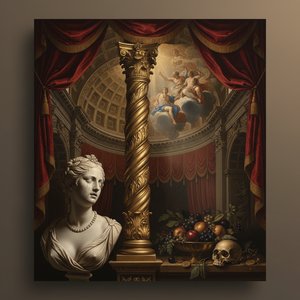
A Flemish Baroque Luminary: The Life and Art of Lucas Faydherbe
Lucas Faydherbe, born in Mechelen (Malines) in 1617, stands as a pivotal figure in the development of High Baroque sculpture within the Southern Netherlands. His career unfolded during a period of intense artistic ferment, shaped by the religious and political currents of the Counter-Reformation and the enduring legacy of masters like Rubens. Faydherbe wasn’t simply an artist; he was a product of a deeply ingrained artistic lineage, inheriting a passion for creation from both sides of his family. His father, Hendrik Faydherbe, was a respected workshop owner specializing in decorative sculpture and alabaster carving, providing young Lucas with foundational training in the tactile arts. This practical grounding was beautifully complemented by the influence of his mother, Cornelia Franchoys, whose brothers—Lucas and Peter Franchoys the Elder—were accomplished painters. This familial embrace of artistic expression instilled within Faydherbe a sensitivity to form, composition, and the expressive potential of visual media. Following his father’s death and his mother's remarriage to sculptor Maximilian Labbé, he continued honing his skills under Labbé’s guidance, solidifying his technical prowess before embarking on what would become a defining chapter in his artistic journey: an apprenticeship with Peter Paul Rubens around 1636.
Under the Wing of Rubens and Forging a Personal Style
The three years Faydherbe spent within Rubens’s bustling Antwerp workshop were transformative. Immersed in the master's dynamic style, he absorbed the principles of dramatic composition, vibrant color, and emotionally charged narratives that characterized Baroque art. This period wasn’t merely about technical instruction; it was an immersion into a world where classical ideals intertwined with theatrical flair. However, Faydherbe didn’t remain solely within Rubens’s orbit. Circumstances—including marriage and the expectation of fatherhood—led him to return to Mechelen in 1640, establishing his own workshop as a master within the Guild of St. Luke. His early works undeniably bore the imprint of his mentor, exhibiting solemn monumentality, heavy draperies, and a restrained level of detail – exemplified by the statue of Saint Andrew in Brussels Cathedral. Yet, Faydherbe possessed an innate artistic curiosity that propelled him beyond imitation. Around 1645-1655, a distinct shift occurred in his style. His figures gained increased plasticity, designs became richer, and a newfound expressiveness emerged. He began to portray subjects with greater humanity and psychological depth, moving away from the purely decorative towards a more profound engagement with human emotion. This evolution wasn’t solitary; Faydherbe frequently collaborated with fellow sculptors on large-scale religious commissions, notably within St. Rumbold's Cathedral in Mechelen, working alongside artists like Rombaut Pauwels and Mattheus van Beveren.
Monumental Commissions and Architectural Ambitions
Faydherbe’s talent quickly garnered recognition, leading to a series of significant commissions that cemented his reputation as a leading sculptor in the region. His contributions to St. Rumbold's Cathedral were particularly substantial, encompassing altars, funerary monuments, and decorative elements that showcased his mastery of both sculpture and architectural design. The Funeral Monument of Archbishop Andreas Creusen (1660) stands as a testament to his skill in creating commemorative memorials—a poignant blend of sculptural portraiture and symbolic ornamentation. However, it was the High Altar for St. Rumbold's Cathedral that represented the culmination of his artistic vision. This ambitious project wasn’t merely a sculptural undertaking; it was an integrated work of art, seamlessly blending sculpture with painted wood and stone elements to create a breathtaking spectacle of Baroque grandeur. Beyond his sculptural achievements, Faydherbe harbored a strong belief in the importance of formal artistic education. Inspired by the academies flourishing in Brussels and Antwerp, he tirelessly advocated for the establishment of a similar institution in Mechelen, hoping to foster a new generation of artists. Though his efforts ultimately proved unsuccessful during his lifetime, his commitment underscored his dedication to the advancement of art within his community.
Legacy and Historical Significance
Lucas Faydherbe’s impact on Flemish Baroque sculpture is undeniable. He skillfully synthesized the lessons learned from Rubens with his own artistic sensibilities, creating a unique style characterized by dramatic lighting, dynamic compositions, and emotionally resonant figures. His work wasn't simply aesthetically pleasing; it served a vital religious purpose, fulfilling the demands of the Counter-Reformation by producing impactful sculptures that inspired devotion and reinforced Catholic doctrine. He played a crucial role in developing the High Baroque style in the Southern Netherlands, establishing himself as a leading figure in Flemish art. His ability to translate Rubens’s artistic principles into three dimensions was particularly noteworthy, demonstrating a profound understanding of form, movement, and emotional expression. Beyond his individual creations, Faydherbe's legacy extends to the artists he mentored, including Jan van Delen, who continued to carry forward the traditions of Flemish Baroque sculpture. He fostered a tradition of artistic excellence in Mechelen, leaving behind a body of work that continues to captivate and inspire audiences today—a testament to his enduring contribution to the rich tapestry of European art history.