Julian Barrows: A Painter of Light and Landscape
Julian Barrow (1939 – 2013) was a British landscape artist renowned for his evocative depictions of Cumbria’s dramatic scenery and meticulously rendered historical portraits. Born in Barrow-in-Furness, Lancashire, he developed an early passion for drawing and painting, honing his skills through self-study and experimentation before pursuing formal artistic training at Chelsea School of Art. His distinctive style—characterized by luminous color palettes and a masterful command of brushwork—captured the essence of both natural beauty and human experience.
- Early Influences: Barrow’s formative years were marked by exposure to Impressionist painters like Monet and Sisley, whose techniques of capturing fleeting moments of light profoundly impacted his artistic vision.
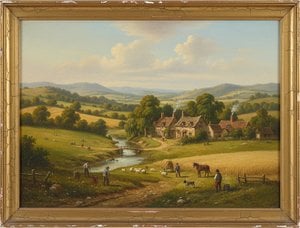
- Cumbria Landscapes: He established himself as a leading figure in Cumbria landscape painting, producing numerous canvases that celebrated the region's rugged mountains, serene lakes, and picturesque villages. Notable works include “View of Greenway, Devon” (1999), which showcases a breathtaking panorama of Dartmoor National Park, and “View of the Great Hall, the Royal Hospital Chelsea,” capturing the grandeur of London’s historic institution.
- Historical Portraits: Beyond landscapes, Barrow excelled in portraiture, creating striking likenesses that conveyed not only physical appearance but also psychological depth. His meticulous attention to detail—particularly in capturing subtle nuances of expression—earned him acclaim for his ability to portray subjects with sensitivity and insight. “1 Parliament Street” (1991) exemplifies this skill, presenting a captivating portrayal of London’s architectural heritage.
His artistic journey continued throughout the 1990s and early 2000s, during which he actively participated in exhibitions across Britain and internationally. He was awarded honorary doctorates from Cumbria University and Newcastle University for his contributions to art education and scholarship. Barrow’s legacy extends beyond his paintings; he served as a respected mentor to aspiring artists and championed the importance of preserving Cumbria's cultural heritage.
- Technique: Barrow employed a layered approach to painting, utilizing thin glazes over underpaintings to achieve remarkable luminosity and tonal gradation. He favored oil paints for their ability to blend seamlessly and capture subtle variations in color and texture.
- Symbolism & Emotion: His landscapes weren’t merely representations of places; they conveyed profound emotions—a sense of solitude, contemplation, and connection with the natural world. Barrow skillfully employed compositional devices and atmospheric perspective to heighten the impact of his paintings.
Julian Barrows passed away in 2013, leaving behind a substantial body of work that continues to inspire admiration for its beauty and artistic integrity. His paintings reside in private collections worldwide and are frequently featured in art publications—a testament to his enduring contribution to British landscape painting and portraiture. He remains remembered as a visionary artist who transformed ordinary scenes into extraordinary expressions of human emotion and artistic brilliance.