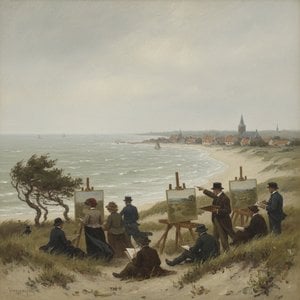
Johannes Warnardus Bilders: A Pioneer of Dutch Realism
Early Life and Education
Born in Utrecht, Netherlands on August 18, 1811, Johannes Warnardus Bilders began his artistic journey under the tutelage of Jan Lodewijk Jonxis.
Early in life, he briefly served as a soldier during the Belgian Revolution, an experience that likely shaped his perspective and later influenced his art.
Following his military service, Bilders returned to Utrecht and continued refining his skills with Jonxis before embarking on travels through Germany.
Settling in Oosterbeek and the Rise of the Hague School
In 1841, Bilders settled in Oosterbeek, a village that would become known as the ‘Dutch Barbizon’ due to its concentration of landscape painters.
Oosterbeek became a hub for artistic exchange, and Bilders played a pivotal role in mentoring many young artists who later became central figures in the Hague School. These included Anton Mauve, Paul Gabriël, and his own son, Gerard Bilders.
His influence extended beyond direct mentorship; he fostered an environment of collaboration and shared artistic vision that was crucial to the development of the Hague School’s distinctive style.
Artistic Development and Style
Bilders' early work demonstrated a traditional approach to landscape painting, but he gradually moved towards a more realistic and atmospheric style.
He was influenced by the Barbizon school in France, adopting their emphasis on direct observation of nature and capturing the subtle nuances of light and atmosphere.
His landscapes often depict scenes of rural life, featuring peasants working in fields or traveling along country roads. He skillfully conveyed a sense of tranquility and harmony between humans and nature.
Bilders’ palette was typically subdued, with earthy tones dominating his compositions. This contributed to the overall mood of quiet contemplation and realism.
Later Life and Legacy
Bilders moved between Utrecht, Amsterdam, and Oosterbeek throughout his career, seeking new inspiration and artistic opportunities.
In 1858-1880 he spent a long period in Amsterdam where he was acquainted with Jozef Israëls.
He married Marie Bilders-van Bosse, also a painter, and they lived together in Oosterbeek for ten years before his death on October 29, 1890.
Bilders’ legacy lies in his role as a bridge between the traditional Dutch landscape painting of the past and the innovative realism of the Hague School. He paved the way for a new generation of artists who sought to capture the essence of Dutch life and nature with honesty and sensitivity.
Historical Significance
Johannes Warnardus Bilders is recognized as a key figure in the development of 19th-century Dutch art.
His influence on the Hague School artists helped establish a distinct national style that resonated with audiences both at home and abroad.
He remains an important artist for understanding the transition from Romanticism to Realism in Dutch painting, and his works continue to be admired for their beauty, tranquility, and insightful portrayal of rural life.
WahooArt.com Editör Ekibi Tarafından
Sanat Bilgisi Testi
Her soru için yalnızca bir doğru cevap bulunmaktadır.
Soru 1:
Johannes Warnardus Bilders is considered a forerunner of which Dutch art movement?
Soru 2:
Bilders spent significant time in Oosterbeek, an area often referred to as…
Soru 3:
Who was Johannes Warnardus Bilders' son?
Soru 4:
Before dedicating himself fully to painting, Bilders briefly served as a…
Soru 5:
Which artist did Bilders become acquainted with during his time in Amsterdam?
Explore the breathtaking mastery of Dutch Golden Age landscapes. From Italianate light to atmospheric realism, discover the techniques of 17th-century masters and learn how to bring these timeless, museum-quality masterpieces into your home through expert oil reproductions.
Explore the ethereal beauty of the Hague School art movement. Discover how masters like Jan Weissenbruch captured the atmospheric grey light of the Dutch landscape through unparalleled technique and emotive, misty compositions.
Merhaba! Bir sanat eseri seçmenize, siparişinizi takip etmenize veya garanti sorularınızı yanıtlamanıza yardımcı olabilirim. Size nasıl yardımcı olabilirim?